In June 1956, the CIA began operating the new U-2 reconnaissance aircraft. The aircraft’s high-altitude performance made it unreachable for existing Soviet air defense systems at the time. However, the CIA was staffed by well-informed realists who understood that within the next 18–24 months, the U-2 would likely become vulnerable to emerging Soviet air defense technologies. The proposed solution was a dramatic increase in flight speed: the subsonic U-2 was expected to be replaced by a new aircraft capable of flying at more than three times the speed of sound.
TABLE OF CONTENT:
Concept
Creating an aircraft with such extreme speed characteristics required solving a whole range of technical challenges. The key issue was mastering structural materials capable of withstanding extremely high temperatures over long periods of time.
In an effort to minimize technical risk, the customer insisted on limiting major innovations primarily to aerodynamics and materials technology. This meant abandoning the ramjet engines considered optimal for very high-speed flight in favor of more conventional turbojet engines. Another requirement was that the new reconnaissance aircraft had to take off independently from a standard airfield, instead of relying on the then-popular but technically complex air-launch concept using a carrier aircraft. The aircraft’s maximum takeoff weight was not to exceed 100,000 pounds (45,360 kg).
The final requirements for the new reconnaissance platform were formulated in mid-1958. The only contractors willing to undertake such an ambitious project were Lockheed Corporation and Convair.
Lockheed was in a more favorable position, as it already had the A-11 supersonic reconnaissance aircraft project in development, which generally met the customer’s primary demands: turbojet propulsion, conventional runway takeoff, and compliance with the weight limitation. The A-11’s projected takeoff weight was 92,000 pounds (41,730 kg).
Convair, meanwhile, had been pursuing a different approach. Its FISH reconnaissance aircraft concept relied on ramjet engines and launch from a carrier aircraft – specifically a modified Convair B-58 Hustler bomber.
Despite this disadvantage, Convair engineers accepted the challenge. They drew heavily upon experience gained from developing the B-58 bomber and the Convair F-102 Delta Dagger and Convair F-106 Delta Dart interceptors. In particular, this involved the use of stainless steel honeycomb panels as major structural components, as well as employing an escape capsule for the pilot instead of a traditional ejection seat, allowing operations without a full pressure suit.
Naturally, technologies and concepts from the earlier FISH project were also incorporated. This continuity was reflected in the new project’s name – Kingfish.
Read also:
- Last Torpedo Carrier: Argentina’s IA-58 Pucará Experiment
- An old warrior ready for battle: Everything you need to know about Pakistan’s ‘Mirage’ jets
Project Evolution
The initial design, designated Kingfish Lower, was based on the earlier FISH configuration and featured an air intake mounted beneath the fuselage. As development progressed, the aircraft’s design was refined with a strong focus on reducing its radar cross-section (RCS). Engineers actively explored ways to minimize the aircraft’s effective radar signature, making stealth characteristics an increasingly important part of the project. Radar cross-section measurements were conducted at a radar testing range near Indian Springs, Nevada, using 1:8 scale models of the aircraft.

Like Kingfish Lower, the other three initial configurations were also classified according to the placement of their air intakes.
In the Smelt configuration, the air intakes were positioned above the wing, angled slightly upward, and tilted toward the rear.
In the Herring configuration, the air intakes were also mounted above the wing, but they were angled slightly outward to the sides while still being tilted toward the rear.
The Kingfish Upper configuration used an air intake mounted on top of the fuselage. Each of the four intake arrangements had its own drawbacks in terms of radar cross-section, structural complexity, and aerodynamic performance. However, the Smelt and Herring concepts ultimately proved to be the most promising. As a result, the final Kingfish intake design became a hybrid combination known as the Smelt-Herring configuration.
For the final radar cross-section tests, engineers constructed a highly detailed model of the finalized aircraft configuration at a 7:10 scale. This scale was chosen because the model’s dimensions were nearly identical to an existing full-scale FISH mock-up. Reworking the already available structure allowed the team to complete the project faster and at a lower cost than building an entirely new full-scale mock-up from scratch.
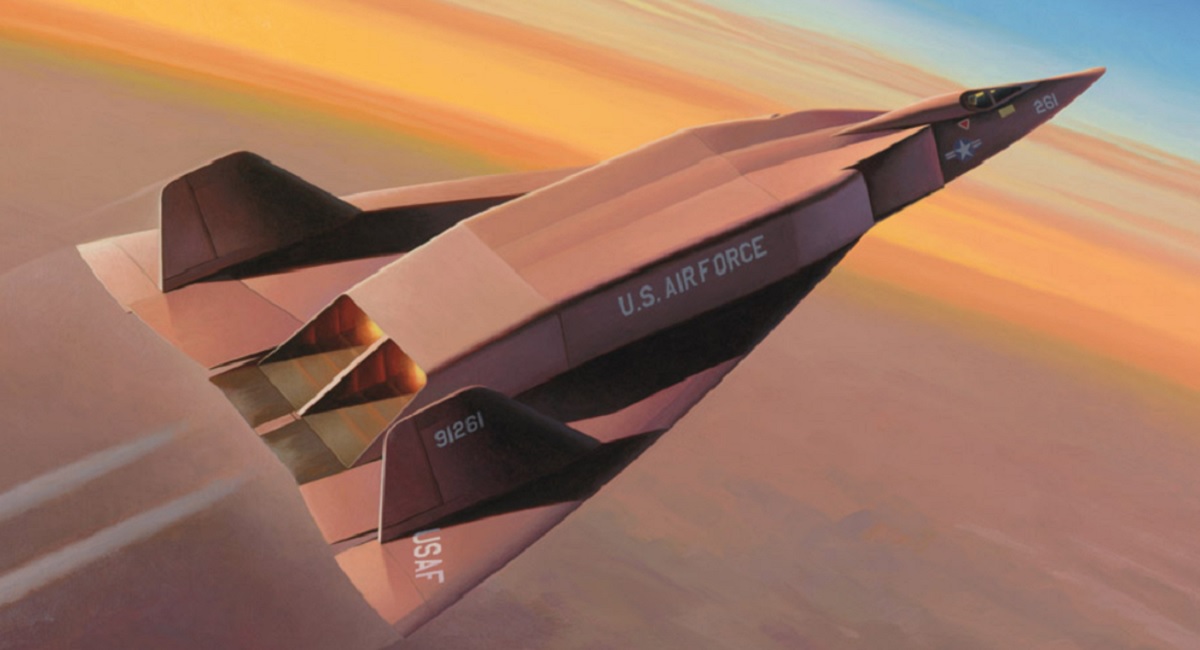
The final Kingfish configuration was a single-seat aircraft featuring a delta wing with a highly swept leading edge. Two vertical stabilizers were mounted above the wings, aligned with the trailing edge. The aircraft had a maximum takeoff weight of 103,200 pounds (46,720 kg), of which 62,750 pounds (28,463 kg) consisted of fuel. Its length measured 22.43 meters, height 5.59 meters, and wingspan 18.29 meters. The wing area totaled 168.62 square meters.
The wing’s leading and trailing edges were constructed from serrated steel panels with inserts made of pyroceram – a high-strength glass-ceramic material with an extremely low coefficient of thermal expansion, resistant to cracking under sudden temperature changes. These inserts were reinforced with graphite. The fuselage structure consisted of steel honeycomb sandwich panels strengthened with frames and spars. Special attention was paid to the leading edges, since they were expected to heat up to 425°C during flight. These edges were formed from triangular pyroceram panels reinforced with steel ribs, with the flat edges of the pyroceram inserts forming the actual leading edge profile.
The aircraft was powered by two Pratt & Whitney JT11 turbojet engines with afterburners mounted on the sides of the fuselage. A B-58-style escape capsule eliminated the need for the pilot to wear a high-altitude pressure suit. Aerial refueling was performed through a receptacle located on the upper surface of the nose section. The landing gear used a conventional tricycle arrangement with a nose wheel.
Read also:
- The story of Rosie the Rocketeer: Little airplane with ‘bazooka’
- Business Jet in Uniform: How Pilatus PC-24 Enters the Military Market
Estimated Performance
The projected cruising speed and operational altitude of the Kingfish were Mach 3.2 and 26,000 meters respectively. The aircraft’s maximum altitude was estimated at 30,000 meters. A typical reconnaissance mission profile was divided into three phases: the initial segment, the tactical segment, and the return segment. The aircraft was designed to refuel in midair from a Boeing KC-135 Stratotanker tanker both before and after the tactical portion of the mission. The initial phase began with takeoff from a base located in the continental United States. The aircraft required approximately 350 kilometers to climb to operational altitude and accelerate to cruising speed.
Before aerial refueling, the aircraft had to descend. Around 600 kilometers before reaching the tanker rendezvous point, the pilot would reduce the engines to idle thrust, allowing the aircraft to descend to 35,000 feet (10,670 meters) and slow to subsonic speed. This maneuver was initiated well in advance of refueling to ensure safe tanker operations. The estimated flight range of the Kingfish was approximately 4,000 nautical miles (7,400 kilometers).
Selection
Convair and Lockheed Corporation submitted their proposals on August 20, 1959. Although Kingfish offered better flight performance and a lower radar cross-section, its competitor – the A-12 project – was cheaper, carried less technical risk, and had greater operational range. On August 29, the winner of the competition was announced as Lockheed, with one condition: the company had to demonstrate the feasibility of its radar cross-section reduction concept for the A-12. This requirement was met by mid-January 1960, and on February 11 a contract was signed for twelve A-12 aircraft.
Convair continued working on the project for some time, studying the geometry of two-dimensional engine nozzles, but in February 1960 it ultimately terminated work on the Kingfish program. The history of this project and the competition it was part of clearly illustrates how technologically more advanced designs can sometimes lose to more conservative approaches. In retrospect, the choice of the A-12 can be considered justified: the SR-71 Blackbird, which evolved from it, proved highly successful, remaining in service with the United States Air Force for over 30 years – from 1966 to 1998.
Read also: