You may remember one of the most dramatic scenes in the film Midway – where American torpedo bombers fly at low altitude directly into heavy anti-aircraft fire and are subsequently engaged by Japanese “Zero” fighters, resulting in severe losses in the air. Roughly four decades later, a similar scenario could have unfolded over the South Atlantic…
TABLE OF CONTENT:
How to Fight the Royal Navy?
In the spring of 1982, after entering a conflict with the United Kingdom over the Falkland (Malvinas) Islands, Argentine military leadership was forced to look for ways to counter the strength of the Royal Navy. As is well known, after the sinking of the cruiser General Belgrano on May 2, 1982, the Argentine Navy was effectively paralyzed. The burden of combat operations against the British naval task force fell primarily on the air force. The most effective weapon proved to be the carrier-based strike aircraft Dassault Super Étendard equipped with AM-39 Exocet anti-ship missiles. However, their numbers were extremely limited – so few that they could be counted on one hand. Additional strikes were carried out by Douglas A-4 Skyhawk and Dassault Mirage III aircraft, but these platforms relied on conventional bombs and had to penetrate the air defense envelope of the British fleet, which resulted in significant losses.
One of the measures proposed by the Argentine Air Force command to improve anti-ship effectiveness was the use of aerial torpedoes. The Argentine Navy reportedly held a substantial stock of Mark 13 aerial torpedo, making it a tempting option for operational use. These torpedoes were of American World War II origin – the same type used by TBD Devastator aircraft during the attack on Japanese carriers near Midway. The Mark 13 had a range of approximately 5 km at 30 knots, a total mass of about 970 kg, and a 272 kg warhead.
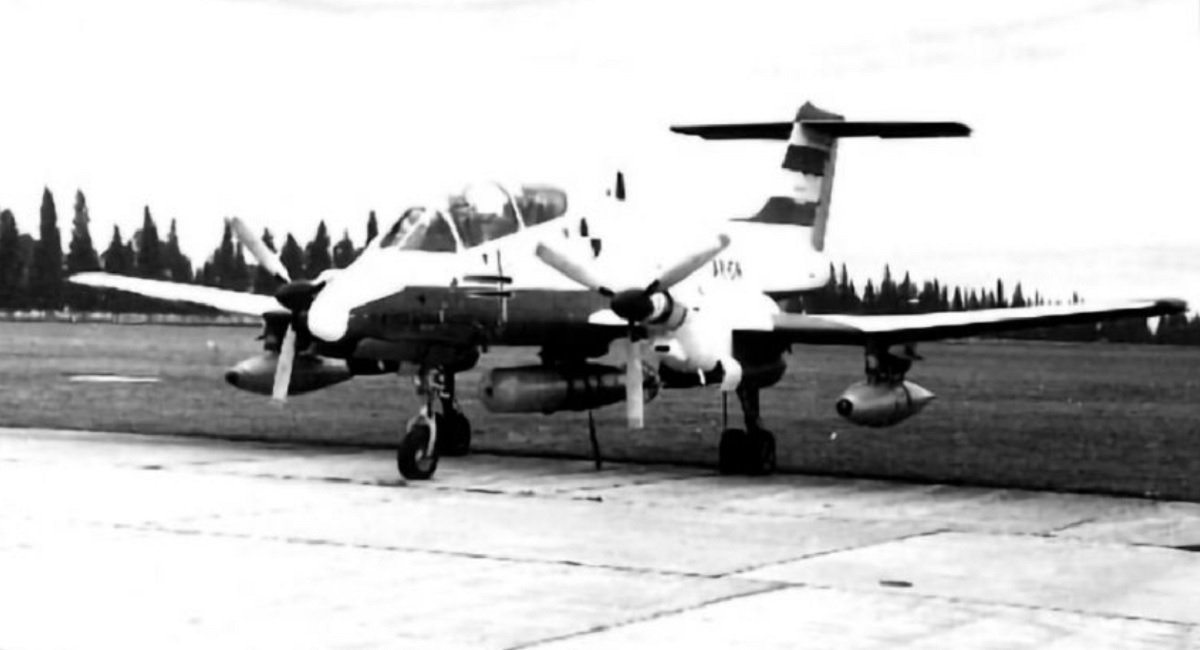
In mid-May 1982, the torpedo weapons program was launched. The choice of platform was made quickly: the drop-speed envelope for the Mark 13 aerial torpedo was below the minimum safe operating speed of jet aircraft. As a result, the only viable candidate for a torpedo carrier was the twin-engine turboprop ground-attack aircraft FMA IA-58 Pucará.
The project was coordinated by Commodore Jorge Raimondi. Specialists from the naval arsenal in Comodoro Rivadavia rapidly de-preserved torpedoes that had been stored for over twenty years and transferred them to the Comandante Espora Air Base. On May 21, an IA-58 aircraft, tail number AX-04, arrived from the Air Force Flight Test Center (CEV – Centro de Ensayos en Vuelo). The aircraft was flown by CEV personnel: Captain Rogelio Marcialetti and test engineer Mario Losiano.

Read also:
- An old warrior ready for battle: Everything you need to know about Pakistan’s ‘Mirage’ jets
- The story of Rosie the Rocketeer: Little airplane with ‘bazooka’
Testing
From the outset, sceptics raised reasonable doubts about the feasibility of the program. In the Argentine Navy, the Mark 13 aerial torpedo had previously only been deployed from Catalina flying boats at speeds not exceeding 160 km/h. In contrast, the FMA IA-58 Pucará would need to conduct attack runs at significantly higher speeds in order to reduce exposure time within the engagement envelope of shipborne air defenses. Additionally, to avoid ricocheting off the water surface, the Mark 13 required release from a dive of at least 20 degrees. This meant the torpedo aircraft had to perform a climb-and-dive attack profile, increasing its vulnerability to defensive fire during the maneuver. Concerns were also raised regarding the reliability of the “antique” torpedoes themselves, given their age and long storage period.
Test drops of inert (practice) warheads began on 22 May at a naval range approximately 40 miles from Puerto Belgrano Naval Base. The torpedo was mounted on an Aero 20A-1 bomb rack under-fuselage hardpoint on the aircraft. Initial tests confirmed the sceptics’ concerns. During the first drop, the Mark 13 aerial torpedo was released at a 20-degree dive angle, a speed of 545 km/h, and an altitude of 100 m, but it disintegrated upon impact with the water. The following day, the test was repeated with adjusted parameters – 45-degree dive angle, 450 km/h speed, and approximately 200 m altitude – with the same result.
Project leadership subsequently convened a group of retired officers and technicians with operational experience using the Mark 13 from Consolidated PBY Catalina operations in the 1950s. A workable solution was identified: the installation of a nose-mounted aerodynamic brake and a rear biplane-style stabilizing fin assembly, designed to detach upon water entry. This allowed torpedoes to be dropped at higher speeds while still enabling low-altitude deployment. Within a single night, the modifications were implemented in workshop facilities at the air base, and by 24 May the first successful test of the modified Mark 13 was conducted.
Shortly afterward, a second FMA IA-58 Pucará aircraft, tail number A-566 from the 4th Attack Squadron of the Argentine Air Force, was assigned to the torpedo testing program. The test range was relocated to the area near Puerto Santa Cruz and Pingüino Island, where hydrological conditions more closely matched those around the Falkland Islands.
A pair of Pucará aircraft conducted a total of seven successful drops of the Mark 13 aerial torpedo with inert warheads, at speeds between 370 and 450 km/h and at an altitude of approximately 15 meters. On June 10 and June 14, live (combat-configured) torpedoes were successfully released from aircraft A-566. In parallel, work was also conducted on the potential use of another “antique” weapon system – the Mark 12 naval mine – intended for deployment in the San Carlos Strait. In this case, efforts were limited to feasibility testing of external carriage on the aircraft. The Argentine surrender on the Falkland Islands and the end of the war led to the termination of all further development of torpedo and mine armament integration on the IA-58 platform.
Read also:
- American Successor to “Pilatus”: Overview of Beechcraft T-6 Texan II
- “Pilatus” of 21st Century: Everything About RS-21 Trainer-Combat Aircraft
Aircraft Fate
A brief overview of the aircraft involved in the program. The FMA IA-58 Pucará with tail number A509 (serial number 009) was produced by FMA in July 1977. In October of the same year, it was transferred to the Flight Test Center (CEV) and redesignated AX-04. The aircraft was specially modified for weapons testing, including the installation of a camera system to record weapon release events. It remained in service there until 1986, also supporting testing related to the development of the IA-63 Pampa training aircraft. In 1986, it was sent for overhaul, which was never completed.
The airframe was later stored at a factory facility and subsequently installed as a static display in Río Tercero under a false designation, A-537. After the transfer of the original A509 designation to another aircraft (serial number 016), that airframe also saw combat service during the Falklands conflict. Another aircraft, Pucará A566 (serial number 067), was produced in November 1981. It was delivered to the CEV on 7 May 1982, where it remained only briefly before being reassigned to the 3rd Attack Group of the 3rd Air Brigade. Its current status is uncertain – it is either in storage or has been scrapped.
Designed primarily for counterinsurgency operations, the FMA IA-58 Pucará unexpectedly became, by circumstance, the last aircraft in aviation history to be adapted for aerial torpedo delivery against surface naval targets. Although these aircraft never actually employed torpedoes in combat, the program remains a notable example of attempts to develop asymmetric methods of engagement against a significantly more capable naval force.
Read also: