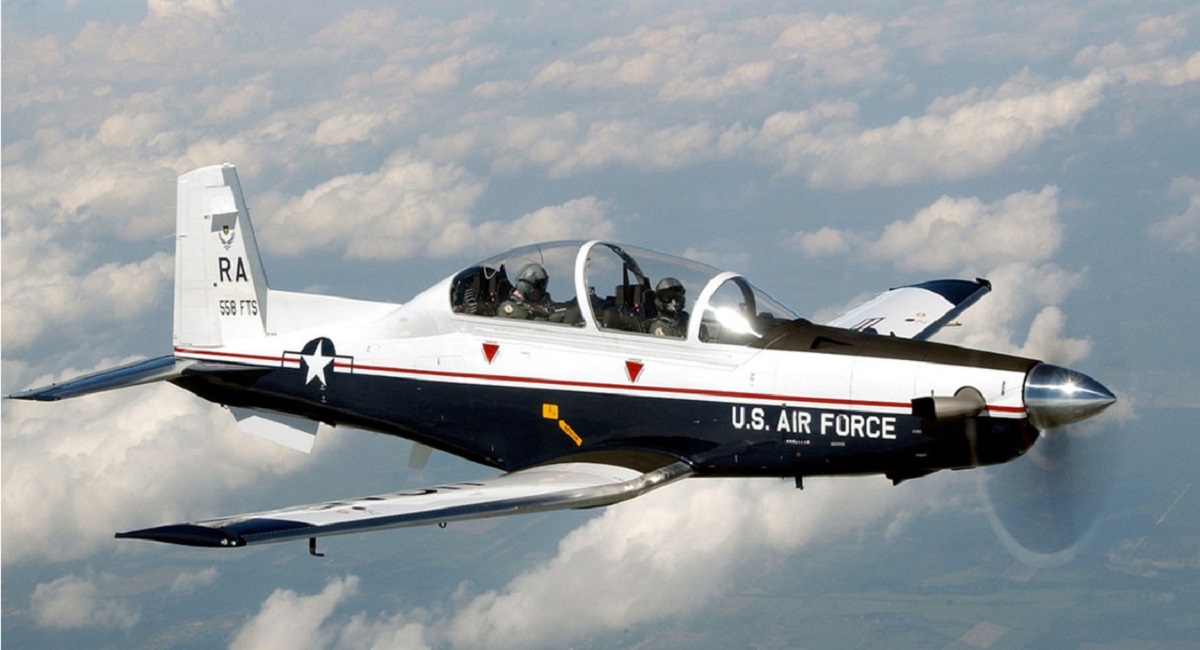
In the late 1980s, the United States began developing the concept of a new training aircraft intended for both the Air Force and Naval aviation, to replace the jet T-37B/C and the turboprop T-34C, respectively. In 1990, the JPATS (Joint Primary Aircraft Training System) program was formally launched, and a competition for the new aircraft was announced.
More than ten companies submitted proposals, primarily foreign manufacturers, for whom partnering with a U.S.-based company was a requirement. Both jet and turboprop aircraft were represented among the entries. Most participants proposed adaptations of existing designs rather than entirely new aircraft. This approach was also taken by the eventual winners – the Swiss company Pilatus Aircraft and the American Beechcraft.
Beechcraft was later acquired by Raytheon, which in 2007 transferred the aircraft program to the newly formed Hawker Beechcraft. This company was subsequently renamed Beechcraft Defense and, in 2014, was acquired by Textron.
TABLE OF CONTENT:
Development History
Pilatus and Beechcraft proposed an upgraded version of the turboprop PC-9M. To support development, the Swiss company delivered two PC-9 aircraft to its American partner in 1990 and 1991. Later, two full prototypes were built in the United States specifically for participation in the JPATS competition – the first entered testing in December 1992, and the second in July 1993.
Comparative trials of the finalist aircraft were conducted between July and October 1994, although the official results were not announced until June 22, 1995. The Swiss-American design was selected as the winner and received the designation T-6A and the name Texan II, in reference to the widely used World War II-era North American T-6 Texan.
Due to legal disputes initiated by the losing competitors, the contract was only signed in February 1996. The first production T-6A made its initial flight on July 15, 1998. However, due to required modifications to onboard systems, full-scale serial production did not begin until 2001.
Read also:
- Pilatus Turboprop Aircraft: An Overview of PC-9
- All About Lightweight Patrol and Counter-Drone Aircraft “Draco”: Reincarnation of Iconic “Vilga”
Design Features
Despite its external similarity to the PC-9M, the Texan II has a significantly revised design, with only about 30% of components shared between the Swiss and American aircraft. Notably, the T-6 features an extended fuselage and a pressurized cockpit, whereas the PC-9 does not have cabin pressurization.
The Texan II is powered by a Pratt & Whitney Canada PT6A-68 turboprop engine rated at 1,100 hp. Its onboard systems reflect modern standards, with each cockpit equipped with three multifunction displays and a wide-angle head-up display.
Aircraft delivered to the U.S. armed forces are not equipped with weapons. However, export versions can be fitted with up to six underwing hardpoints, depending on customer requirements.

In mid-2006, development began on a counterinsurgency light attack aircraft designated AT-6B Wolverine (later redesignated AT-6E). This variant is equipped with an electro-optical targeting system and a self-protection suite, including the AN/AAR-60 missile warning system and AN/ALE-47 countermeasure dispensers. Unlike armed versions of the Texan II (such as the T-6A NTA and T-6C), which are limited to unguided weapons, the Wolverine can carry precision-guided munitions, including Paveway-series guided bombs, AGM-114 Hellfire anti-tank missiles, and AIM-9 Sidewinder air-to-air missiles. It can also be fitted with external pods for reconnaissance equipment.
Read also:
- All about the “passenger attack” Cessna AC-208 Combat Caravan: an air‑defense variant?
- Cessna 408 SkyCourier: From Commercial Cargo Aircraft to Military Use
In the United States and Abroad
The U.S. Air Force received 454 T-6A aircraft, with deliveries completed in 2010. These aircraft are operated by ten training squadrons. The U.S. Navy, after acquiring 43 T-6A units, transitioned to the improved T-6B variant. By June 2015, the Navy had received 252 T-6B aircraft, which are operated across six training squadrons.
The third branch of the U.S. Armed Forces, the Army, procured four T-6D aircraft in 2015. These are equipped with underwing hardpoints for weapons and are used as test platforms at Redstone Arsenal.
In 2018, the AT-6E, alongside the Embraer A-29 Super Tucano, was selected as a finalist in the U.S. Air Force’s Light Attack/Armed Reconnaissance program. Two AT-6E aircraft were built in 2021 for comparative testing. The Brazilian aircraft was ultimately selected, while the two AT-6E units were later assigned to the U.S. Navy Test Pilot School.
Canada became the first export customer for the Texan II. In December 1997, it selected the T-6A-1 variant for the NATO Flying Training in Canada (NFTC) program. The aircraft received the Canadian designation CT-156 Harvard II and differs from the U.S. version with an upgraded navigation system, while its cockpit equipment aligns with the CT-155 standard – the Canadian version of the Hawk jet trainer.
Between 2000 and 2003, Canada received 26 CT-156 aircraft. Although they carry Royal Canadian Air Force markings, they are owned by Bombardier, which is responsible for their operation and provides pilot training services to the government. The CT-156 fleet is expected to be replaced in the coming years by the PC-21 aircraft.
In October 1998, the Texan II was selected in a Greek competition. Greece ordered 45 aircraft, with deliveries beginning in 2000. The first batch of 25 aircraft corresponded to the U.S. T-6A standard, while the remaining 20 were produced in the T-6A NTA configuration, equipped with a targeting system and six underwing hardpoints for weapons.
Following the Canadian and Greek contracts, export activity for the Texan II slowed for several years, as the aircraft faced strong competition from Swiss and Brazilian counterparts. A new contract was signed only in 2008, when Israel ordered 20 T-6A aircraft, delivered between 2009 and 2010 (an additional aircraft was purchased in 2012 to replace one lost in an accident). In Israeli service, the Texan II – locally designated Efroni – is operated under a model similar to the Canadian approach: the aircraft are owned by Elbit Systems but operated in the interests of the Air Force and carry its markings.
In August 2009, Iraq ordered 15 T-6A aircraft, which entered service with the Iraqi Air Force College in December of the following year. In September 2009, Morocco ordered 24 Texan II aircraft, becoming the first customer of the T-6C variant – an export version of the T-6B with expanded strike capabilities. Deliveries to Morocco were carried out between 2011 and 2012.
Mexico is currently the largest foreign operator of the Texan II. Its Air Force ordered a total of 63 T-6C+ aircraft in several batches, with deliveries carried out between 2012 and 2019. These aircraft are operated by the School of Combat Application and five light attack squadrons, where they replaced PC-9 aircraft. In addition, the Mexican Navy acquired 13 T-6C+ units.
In 2014–2015, the Royal New Zealand Air Force received 11 T-6C+ aircraft, followed by the United Kingdom, which accepted 14 aircraft in 2019–2020. In British service, the T-6C+ is designated Texan T.1. These aircraft are operated under a public-private partnership model, with civilian ownership and military use.
In 2017, it was suggested that the Texan II faced uncertain prospects on the global market due to strong competition from the Pilatus PC-21 in the training segment and the Embraer EMB 314 Super Tucano in the light attack role, where the latter outperformed the AT-6 variant in several aspects. However, subsequent developments have not confirmed this assessment.
The Texan II has continued to secure export orders, entering markets traditionally dominated by its competitors. Between 2017 and 2019, Argentina acquired 12 T-6C+ aircraft to replace the EMB-312 Tucano. Colombia, which had previously operated Brazilian EMB-312 and EMB-314 aircraft, received 10 T-6C+ units from 2020, with an option for an additional 14.
Thailand received 12 T-6TH trainer aircraft in 2022–2023, followed by eight AT-6TH light attack aircraft in 2024–2025, comparable to the AT-6E Wolverine variant. In Thai service, they replaced Czech L-39ZA/ART aircraft.
Tunisia remains the first – and so far the only – operator of the Texan II in Africa, having received eight T-6C+ aircraft in 2022–2023. A relatively uncommon customer is Vietnam, which took delivery of 12 T-6C+ aircraft in autumn 2025. Notably, within the Vietnamese pilot training system, these U.S.-built aircraft are used alongside Russian Yak-130 and Czech L-39NG trainers.
The most recent export success for the Texan II was its selection in November 2024 as the new training aircraft for the Japan Air Self-Defense Force, intended to replace the Fuji T-7. Competing designs included the Pilatus PC-7 MkX and the Turkish Hürkuş. Japan plans to acquire a total of 49 aircraft, designated T-6JP.
In October 2025, Textron Aviation presented the AT-6E Wolverine in a new role – as a platform for countering drones such as the Shahed-136. Company specialists estimated the potential global market for such aircraft at around 200 units. Given current geopolitical developments involving Iran, this estimate appears plausible, at least in part. Among these potential operators could be Ukraine, although such prospects depend on future policy decisions.
Read also: