In the early 1940s, while developing a lightweight infantry anti-tank weapon – the M1 rocket launcher, later widely known as the “bazooka” – Colonel Leslie Skinner likely could not have anticipated the extent to which it would be adopted in the future. Much later, General Dwight D. Eisenhower, when asked which weapons systems he believed contributed most significantly to victory in World War II, reportedly listed: “the bazooka, the jeep, the atomic bomb, and the C-47 transport aircraft.”
In practice, the use of the bazooka sometimes extended beyond the roles originally envisioned by Skinner. In addition to infantry units, it was also employed by naval forces as auxiliary armament on small boats and was even adapted for limited use in aviation contexts.
TABLE OF CONTENT:
Aviation of Artillery
During World War II, each U.S. Army division included its own aviation units. These formations were subordinated to divisional artillery and were primarily intended to support artillery fire correction and observation tasks.
They operated a range of light aircraft, the most common being the Piper L-4 Grasshopper, a militarized version of the civilian J3 Cub. This fabric-covered, braced high-wing monoplane was powered by a 65 hp four-cylinder engine. It had strong short-field takeoff and landing performance, allowing operation from very limited ground areas. However, its payload capacity was minimal and typically only sufficient for a pilot, an observer, and radio equipment.
The L-4 was not originally designed to carry armament. However, in practice, operational conditions led to limited improvisation. During the Italian campaign in 1943, some crews reportedly carried small hand grenades for opportunistic use. By 1944 in France, experimentation with equipping observation aircraft with light offensive capabilities continued in various forms, reflecting ad hoc adaptations rather than formal design changes.
Read also:
- American Successor to “Pilatus”: Overview of Beechcraft T-6 Texan II
- “Pilatus” of 21st Century: Everything About RS-21 Trainer-Combat Aircraft
Carpenter’s Initiative
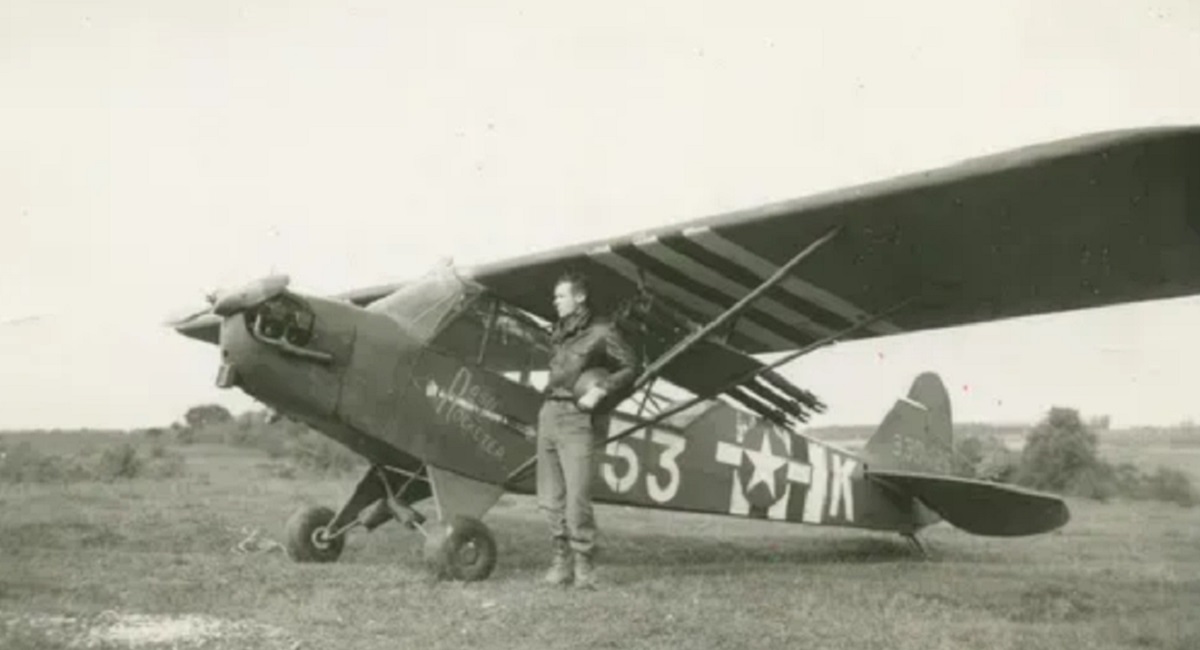
Shortly after the Allied landings in France in June 1944, one Army pilot, Major Charles Carpenter, developed the idea of converting his L-4 Grasshopper into a light anti-armor platform. He obtained approximately half a dozen M1 rocket launchers and mounted them on the aircraft’s wing struts of an L-4H variant – three on each side of the fuselage. Since the launchers used electrically triggered firing mechanisms powered by batteries, remote actuation from the cockpit was implemented using basic wiring and switches. To reduce weight, Carpenter also removed non-essential equipment, including the radio set and the second crew member.

During several test flights, the major confirmed that the modified configuration functioned as intended. His most notable operational sortie took place on 20 September 1944, when German forces launched a counteroffensive near Arracourt. The main attacking force was the 111th Panzer Brigade, equipped with Panther tanks. The attack was directed against positions held by the U.S. 4th Armored Division. Under normal conditions, fighter-bomber aircraft would have been used in support, but they were unable to operate effectively due to dense cloud cover and fog.
On his first sortie that day, Carpenter was unable to locate enemy forces. Once the weather conditions improved and visibility increased, he conducted three additional missions, expending a total of 16 rockets.
According to reports, he succeeded in damaging two Panther tanks and disabling several additional armored vehicles. Overall, eyewitness accounts sometimes attribute up to 14 armored vehicles as being destroyed, although these figures appear inconsistent with official records. The official assessment indicates six armored targets were destroyed or neutralized. Even on this basis, Carpenter was informally recognized as an “anti-tank ace” due to the unusual nature of his engagements and outcomes.
The success of the improvised aircraft operated by the major was largely attributed to the element of surprise. German forces typically disregarded light observation aircraft, not expecting them to engage in offensive action. It is generally assessed that Carpenter’s actions contributed to slowing the enemy advance near Arracourt. On 21 September, as weather conditions improved, the German offensive was ultimately disrupted by sustained attacks carried out by P-47 Thunderbolt aircraft operating in coordinated strikes.
Carpenter’s achievements did not go unnoticed by propaganda agencies. Articles about “Bazooka Charlie” and his aircraft, nicknamed “Rosie the Rocketeer,” appeared in major American newspapers. The nickname was a clear reference to the well-known “Rosie the Riveter” poster.
In early 1945, Carpenter was discharged from military service due to health reasons and returned to teaching history. By that time, he was credited with six confirmed destroyed tanks and armored vehicles.
Not Only Carpenter
It should be noted that Charles Carpenter was neither the only nor the first L-4 Grasshopper pilot to experiment with mounting “bazookas” on his aircraft. However, he became the most widely documented case. These experiments did not develop further in an operational sense. The practice remained limited, largely because arming light liaison and observation aircraft conflicted with their primary role within Army aviation – namely artillery spotting and fire correction rather than direct engagement.
The renewed interest in rocket-propelled grenade (RPG)-type weapons in aviation was associated with the emergence of helicopters and the search for suitable armament for rotary-wing aircraft. By that time, an improved version with better anti-armor performance had already been developed – the M20. It was adopted in 1945 and entered mass production after the outbreak of the Korean War.
The relatively compact and effective “super bazooka” appeared to be a viable option for arming helicopters. In 1950, the U.S. Army tested the installation of M20 launchers on the light H-13D helicopter, and a year later the U.S. Marine Corps conducted similar experiments using the HTL-4 within HMX-1 squadron. Both helicopters – the H-13D and HTL-4 – were variants of the Bell 47D. However, this approach was not further developed. Helicopter armament subsequently shifted toward more suitable systems, first unguided rockets and later anti-armor guided missile systems.
Read also: