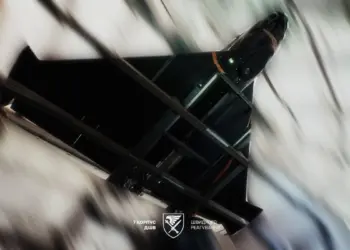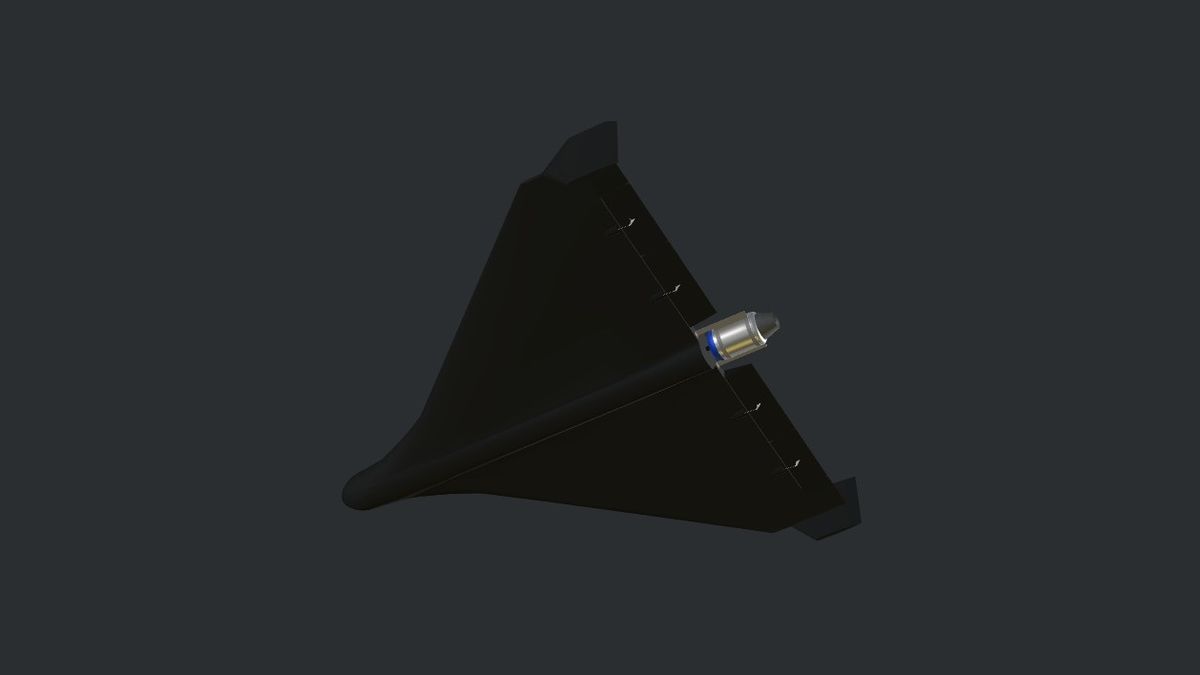
The Main Intelligence Directorate (HUR) has published an interactive 3D model, component breakdown, and foreign-sourced electronics used in the new Russian “Geran-4” jet-powered strike drone on the War&Sanctions portal. Russia began deploying this UAV in response to the growing effectiveness of Ukrainian interceptor drones.
By January 2026, Russia had reportedly completed the final stage of preparations for serial production of the Geran-4. Initial test launches were conducted from the “Primorsk” drone facility in Russia’s Oryol region, as well as from the territory of the former Donetsk Airport. In May, Russian forces began using these drones in strikes against targets in Ukraine.

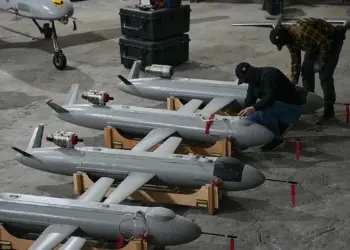
To produce earlier versions of the “Geran-3” jet-powered drone, Russian forces used the airframe of the gasoline-powered “Geran-2” UAV. In practice, however, the design proved insufficiently durable for sustained high-speed flight, particularly when performing maneuvers involving significant overload. The new “Geran-4” jet drone features a redesigned dedicated airframe with improved aerodynamics and a reinforced structure, along with a higher-thrust turbojet engine. The wings are no longer detachable from the center section. In addition, the number of maintenance and access panels on the fuselage has been reduced to lower aerodynamic drag.
Ukrainian intelligence has identified two types of turbojet engines used in the “Geran-4.” These include the Chinese-made Telefly LX-WP-160, which is no longer in production and delivers thrust of 160 kgf (1600 N), as well as the Chinese Telefly TF-TJ2000A with 200 kgf (1960 N) of thrust, previously observed on the “Geran-5.”
The updated “Geran-4” airframe enables active maneuvering at speeds of 300–400 km/h, while the reinforced structure is designed to withstand significant overloads. As a result, the drone can reportedly reach speeds of up to 500 km/h and operate at altitudes of up to 5,000 meters. The UAV can carry either a high-explosive fragmentation or thermobaric OFZBCH-50/TBBCH-50M warhead weighing 50 kg, or an enlarged thermobaric TBBCH-90 warhead weighing 90 kg, with an operational range of up to 450 km.
The onboard control system and its electronic component base remain identical to those used in previously known UAVs produced by JSC “Alabuga Special Economic Zone PPT.” The dimensions of the “Geran-4” airframe have also remained unchanged: 3.5 meters in length with a wingspan of 3 meters.
By publishing information about new Russian-Iranian developments, Ukraine’s Defense Intelligence Directorate once again emphasized that terrorism knows no borders, and that lasting global stability can only be achieved by denying Russia access to the technologies the aggressor state uses to wage its criminal war.
Read also:
- Ukrainian Drones Strike Russian Pilot Training School: Equipment, Ammunition, and Repair Facilities Reportedly Destroyed
- New Successful SBU Operation: Drones Strike FSB Headquarters in Kherson Region
Source: gur