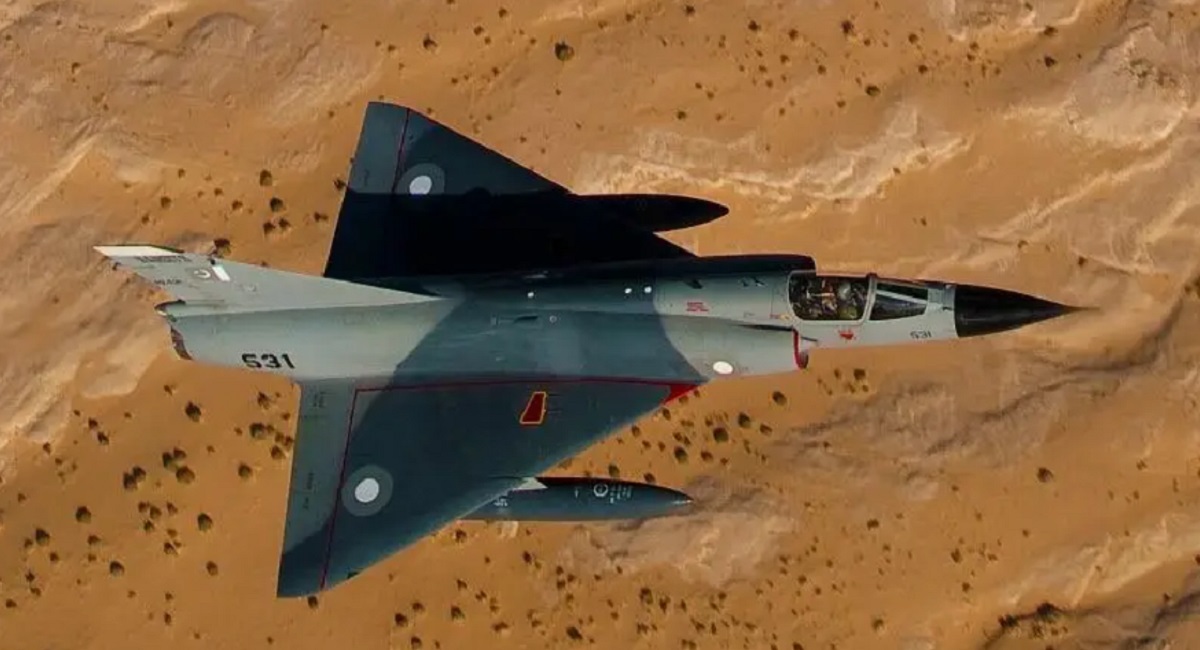
On 20 April 2026, reports indicated that eight Mirage 5 fighter-bombers from the Pakistan Air Force’s No. 27 Squadron were deployed to Saudi Arabia under a bilateral defense cooperation agreement. This development draws attention to the aircraft themselves, as they represent some of the last remaining operational examples of the Mirage III/5 family still in active service worldwide.
TABLE OF CONTENT:
Pakistan’s Mirage Program
The Pakistan Air Force was one of the largest operators of Mirage III/5 aircraft outside France, receiving a total of 139 Mirage III and 135 Mirage 5 units in various configurations and from multiple sources. The acquisition process can be outlined chronologically. The first batch, delivered between 1967 and 1970, included 18 Mirage IIIEP fighters, two Mirage IIIDP trainer variants, and three Mirage IIIRP reconnaissance aircraft. In 1970, an additional order was placed for two more Mirage IIIDP and 28 Mirage 5PA fighter-bombers, a simplified version without onboard radar.
In 1975, Pakistan procured ten Mirage IIIRP2 reconnaissance aircraft, delivered between 1977 and 1978. In 1979, a further order – reportedly financed by Saudi Arabia – covered 42 aircraft in three variants: two Mirage 5DPA trainers, 28 Mirage 5PA2 fighters equipped with Cyrano IV radar, and 12 Mirage 5PA3 aircraft optimized for maritime strike roles. The latter were fitted with Agave radar and could carry Exocet anti-ship missiles.
Deliveries under this order were completed by 1982. At that point, Pakistan began transitioning to more modern U.S.-supplied F-16 fighters. However, the subsequent imposition of a U.S. arms embargo forced Pakistan to seek additional aircraft on the secondary market. A key enabling factor in sustaining the Mirage fleet was the establishment of a domestic aircraft maintenance facility, originally built with French assistance. This infrastructure allowed Pakistan to conduct major overhauls and implement upgrades, extending the operational life of the Mirage platforms.

In 1991, Pakistan acquired 50 Mirage III aircraft – variants Mirage IIIO and Mirage IIID – previously retired from service with the Royal Australian Air Force. After evaluation, 12 airframes in the best condition were returned to operational service, five of the least serviceable were dismantled for spare parts, and the remaining 33 were selected for modernization. In the mid-1990s, Pakistan also purchased former Spanish aircraft, including 22 Mirage IIIEE and two Mirage IIIDE. These were not reintroduced into active service; instead, they were used as sources of spare parts and as ground-based training platforms.
In 1996, Pakistan acquired 34 Mirage 5F aircraft from France. These were among the earliest production Mirage 5 units, originally intended for Israel but not delivered due to an arms embargo. Alongside them, six Mirage IIIBE trainer aircraft were also purchased. The Mirage 5F fleet subsequently underwent modernization under two separate upgrade programs. In 2000, Pakistan obtained nine Mirage IIIEL aircraft from Lebanon. Despite having been out of service for approximately 25 years, their condition was assessed as adequate, and they were returned to operational use. Finally, in 2004, Pakistan purchased 50 Mirage 5 aircraft of various variants from Libya, along with 50 spare Atar 09C engines to support maintenance and sustainment of the fleet.
Read also:
- Tool of Global Power Projection: All About U.S. Air Force Aerial Refueling Aircraft
- “Pilatus” of 21st Century: Everything About RS-21 Trainer-Combat Aircraft
Modernization
In Pakistan, three modernization programs for the Mirage fleet were implemented under the collective designation ROSE (Refit of Strike Element). The ROSE I program, carried out in cooperation with Italian and French companies, covered 33 former Australian Mirage IIIO aircraft. The upgrade included replacement of the Cyrano IIbis radar with the Italian FIAR Grifo M3, installation of a new combined inertial and satellite navigation system developed by Sagem, and a comprehensive modernization of the electronic warfare suite, avionics, and cockpit systems.
The ROSE II modernization program, implemented in the second half of the 1990s, covered 20 former French Mirage 5F aircraft. The upgrade focused on enabling effective night strike capability against ground targets. Modifications included cockpit lighting compatible with night vision goggles, partial avionics updates, installation of a radar warning receiver, and the addition of a centralized refueling system. A further 14 Mirage 5F aircraft were upgraded under the ROSE III program starting in 2004. This phase involved more extensive avionics improvements, upgrades to navigation systems, and the integration of a modern thermal imaging system.
Since 2011, Pakistan’s Mirage fleet has been adapted to carry and launch Ra’ad cruise missiles. The aircraft have also been configured to employ H-2 and H-4 precision-guided aerial bombs.
Operational Use
In 1971, Mirage IIIEP aircraft from No. 5 Squadron took part in the Indo-Pakistani War. Their involvement included several strikes on Indian airfields, which were assessed as having limited effectiveness. In air-to-air engagements, they were credited with three confirmed victories: one Canberra bomber and two fighter-bombers – a Hunter and a Su-7 (additional claims against two more Su-7 aircraft were not confirmed).
Between 1980 and 1988, during the Soviet intervention in Afghanistan, Mirage IIIEP aircraft conducted air patrols along the Afghan–Pakistani border.
The Mirage fleet was also involved in the February 2019 crisis with India. A notable episode was the use of H-4 radio-command-guided bombs: these were released by two Mirage 5PA aircraft from No. 15 Squadron, with guidance provided by a weapons systems officer operating from the rear cockpit of a two-seat Mirage IIIDP.
In May 2025, during another confrontation with India, Pakistani Mirage aircraft were likely involved, although they played a secondary role compared to more modern fighters. Reports suggest that one aircraft may have been lost; Indian sources presented an ejection seat consistent with those used on Mirage III/5 aircraft.
Although the Pakistan Air Force had previously planned to retire its Mirage fleet by 2025, approximately 90 aircraft remain in service. Mirage III aircraft upgraded under the ROSE I program are assigned to No. 7 Squadron of the 32nd Wing (Southern Air Command, Masroor Air Base). Three additional squadrons form the 34th Wing under Central Air Command (Rafiqui Air Base): No. 25 Squadron operates Mirage 5 aircraft upgraded under ROSE II, No. 27 Squadron operates ROSE III variants, and No. 50 Squadron continues to use non-upgraded Mirage 5PA aircraft.
Additionally, No. 22 Operational Conversion Unit (Masroor) operates Mirage IIIEL aircraft, while another unit within the Combat Commanders’ School employs Mirage IIIEP and Mirage 5PA for advanced training.
In a potential conflict scenario involving Iran, the likely role of Pakistan’s Mirage 5 aircraft would be limited to strike missions. Based on their onboard systems and available weapons, they would be used for delivering cruise missiles and precision-guided bombs against selected targets, such as missile-related infrastructure posing a direct threat to regional allies. Whether these aircraft will see further combat use remains uncertain.
Read also: