• • CONTACTS
  • • PRIVACY POLICY
  • • GADGETS & TECHNOLOGIES
AERONAUT.media
  • NEWS:
  • • Aviation
  • • UAVs & drones
  • • Flying weapon
  • • Space
  • ARTICLES
  • Language:
  • EN
  • UA
No Result
View All Result
  • NEWS:
  • • Aviation
  • • UAVs & drones
  • • Flying weapon
  • • Space
  • ARTICLES
  • Language:
  • EN
  • UA
No Result
View All Result
AERONAUT.media
No Result
View All Result
Home Articles

“Pilatus” of 21st Century: Everything About RS-21 Trainer-Combat Aircraft

Andrij Kharuk by Andrij Kharuk
10/03/2026
in Articles
0
Pilatus РС-21
25
SHARES
473
VIEWS

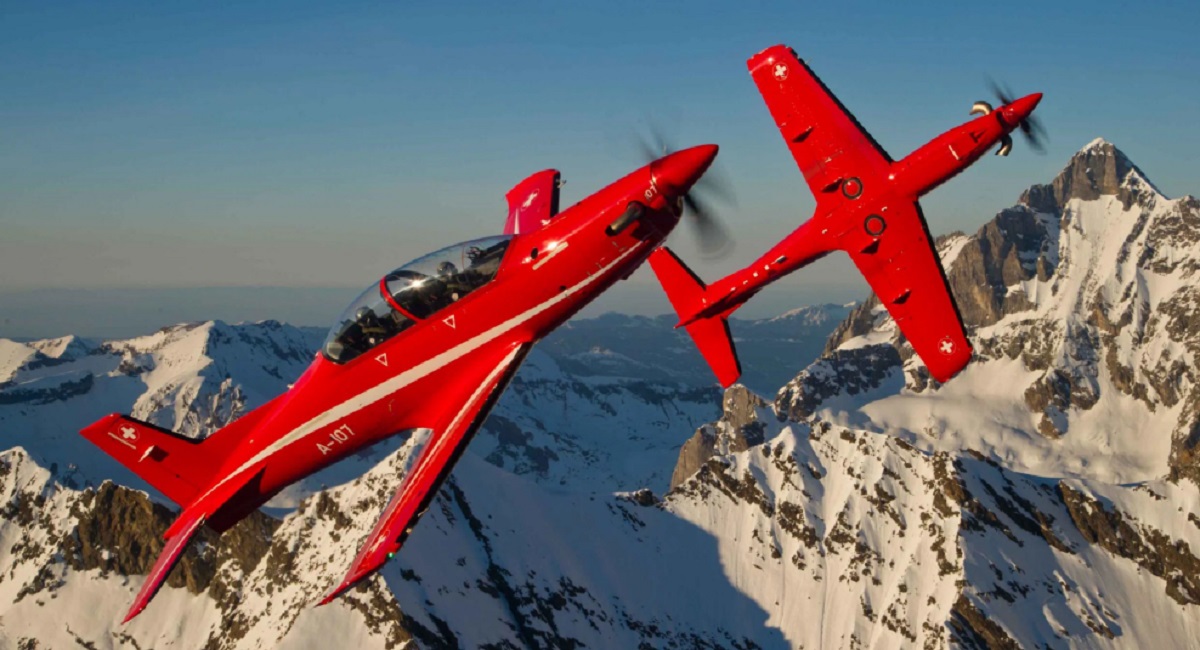
The pinnacle of turboprop trainer-combat aircraft developed by Pilatus Aircraft is the Pilatus PC-21. The prototype made its first flight on July 1, 2002, and since then the PC-21 has steadily expanded its presence in global markets. What are the key features of this aircraft, and what is the secret behind its success?

TABLE OF CONTENT:

  • Concept
  • Design
  • Service

Concept

Historically, the training of military pilots required at least two different types of aircraft: a piston or turboprop trainer for basic instruction and a jet aircraft for advanced training of future fighter pilots. In the mid-1990s, Pilatus Aircraft began exploring the possibility of combining these two roles using a high-performance turboprop aircraft. Achieving this would not only reduce procurement costs but also preserve the operational economy typical of turboprop platforms.

During the conceptual design stage, Pilatus engineers did not rule out the creation of a jet trainer. However, they ultimately concluded that modern aerodynamics combined with a sufficiently powerful turboprop engine could deliver the required performance. The new aircraft was expected to reach a maximum operating speed of 685 km/h (Mach 0.72) and a cruise speed of at least 555 km/h. It also needed acceleration comparable to the jet trainer BAE Systems Hawk and a roll rate similar to that of the fighter Lockheed Martin F-16 Fighting Falcon.

Development work on the new trainer began in the mid-1990s using the Pilatus PC-7 MkII as a test platform. This aircraft was fitted with a much more powerful Pratt & Whitney Canada PT6A engine producing 1,600 hp and equipped with a five-blade propeller. It also received an experimental wing shortened by two meters and fitted with spoilers to compensate for the shorter ailerons. The heavily modified PC-7 took to the air in November 1997, demonstrating that a significant increase in roll rate and improved straight-line acceleration to levels comparable with jet aircraft was achievable.

Despite the encouraging results of the test aircraft, it became clear that simple upgrades to existing Pilatus designs would not deliver the technological breakthrough the company was aiming for. As a result, the PC-XX program was launched in November 1998.

Pilatus engineers were tasked with creating a training system superior to any existing trainer aircraft, whether turboprop or jet. The aircraft had to offer significantly better aerodynamic performance than existing turboprop trainers while maintaining low life-cycle costs. The ambitious goal was for this single model to handle the entire pilot training cycle, replacing the traditional combination of turboprop and jet aircraft. Even if the Pilatus PC-21 could not completely eliminate the need for advanced jet trainers, it was expected to raise the transition threshold to more expensive aircraft and reduce the number that would need to be purchased.

РС-21
PC-21 of the Spanish Air Force

Read also: 

  • Mission Control: How Ukraine Is Building a Unified Digital Brain for Drone Warfare
  • All About Proteus: Self-Contained Helicopter with Potential Implications for Future of Aviation

Design

Although the RS-21 bears an external resemblance to the RS-9, it is essentially a new aircraft. It is powered by a significantly more powerful RT6A-68V engine, rated at 1,600 hp. The onboard systems have been substantially updated. Each crew station features three large and two smaller multifunction displays. The front cockpit includes a head-up display, while the rear cockpit is equipped with a repeater for its output. A digital fly-by-wire control system allows a wide range of adjustments to the aircraft’s handling characteristics, supporting pilot training from initial instruction to advanced stages. The aircraft can carry a payload of up to 1,150 kg on a fuselage-mounted hardpoint and four underwing hardpoints.

РС-21
Front cab PC-21

All previous models from the company featured an all-metal construction, and Pilatus opted to continue this approach rather than adopting widespread use of composites, allowing the PC-21 to be produced on the same assembly line as the PC-7 and PC-9. Some composite components, such as fairings, were still incorporated. A key design consideration was the use of modular components that could be quickly replaced, reflecting Pilatus’s goal of minimizing turnaround time and reducing maintenance costs per flight hour.

The most significant innovation was the wing design. Pilatus moved away from the constant-sweep wing characteristic of the PC-9 in favor of a higher-performance configuration, featuring a swept leading edge, a straight trailing edge, and wingtip devices. Compared with the PC-9 wing, it was smaller and carried a higher wing loading, enhancing maneuverability in turns to a level more typical of high-speed jet aircraft.

Additionally, the PC-21 wing eliminated the straight central section, resulting in a reduced wingspan (by 1.013 m) and a correspondingly smaller wing area. Like the concept demonstrator, the PC-21 incorporates hydraulically actuated interceptors that complement the shortened ailerons and engage after their initial deflection. This arrangement provides sufficient structural strength for the installation of flaps, enabling a stall speed of 150 km/h.

Read also:

  • Pilatus Turboprop Aircraft: An Overview of PC-9
  • All About Lightweight Patrol and Counter-Drone Aircraft “Draco”: Reincarnation of Iconic “Vilga”

Service

Despite its relatively high cost, the PC-21 has gradually established a presence in the training aircraft market. The Swiss Air Force received eight units, with deliveries beginning in April 2008. From January 2008, the PC-21 was delivered to the Republic of Singapore Air Force, which acquired 19 aircraft. These aircraft are operated by a private company under a public-private partnership and are permanently based at RAAF Base Pearce in Australia.

In November 2010, the first of 25 aircraft ordered by the United Arab Emirates took flight. Deliveries to Saudi Arabia and Qatar began in 2014, with those countries acquiring 55 and 24 aircraft, respectively. In 2015, Australia placed an order for 49 PC-21s, with deliveries completed by 2019. Jordan purchased eight aircraft in 2016 and subsequently added four more between 2016 and 2017.

Alpha Jet
In France, the PC-21 replaced the Alpha Jet jet aircraft.

A significant milestone for Pilatus was the PC-21’s selection in 2017 by the French Air Force to replace the Alpha Jet. The initial order was for 17 aircraft, with an additional nine acquired in 2021. Deliveries were completed in 2023. Spain also procured the PC-21 in two batches – 24 aircraft in 2020 and 16 in 2023 – with all units delivered by the end of 2025. Notably, Princess Leonor, heir to the Spanish throne, completed her flight training on the PC-21. Two aircraft are operated by Quinetic in the United Kingdom to train students at the Empire Test Pilots’ School. The most recent firm order was placed by Canada in November 2024 for 19 aircraft, designated CT-157 Siskin II, intended to replace the CT-156 (Beechcraft T-6A).

Potential customers for the PC-21 include Croatia, Bulgaria, Malaysia, Sweden, and several other countries. The aircraft continues to be purchased predominantly by financially capable nations for training purposes. In the light attack and trainer market, lighter aircraft such as the EMBRAER EMB-314 Super Tucano and Beechcraft T-6/AT-6 Texan II remain dominant, while the PC-21 occupies a higher-performance training niche. The PC-21 is replacing both turboprops – for example, substituting the PC-9 in Saudi Arabia and Australia – and jets, such as the Hawk in Switzerland and the Alpha Jet in France. A clear example is Spain, where the PC-21 has replaced two classes of aircraft: the piston-powered ENAER T-35B Pillan for initial training and the jet-powered CASA C-101 Aviojet for advanced training, in line with the aircraft’s original design concept.

t1

Read also:

  • Everything About Three Generations of PC-7: Predecessor of Pilatus Turboprop Aircraft Family
  • Everything About the P1-Sun – SkyFall’s Ukrainian Interceptor Drone
  • Light Fighters: Useful Option or an Unnecessary Substitute?
Tags: FavoritesMilitary aviationTOP
Share10Tweet6ShareShareShareShare2Pin3
Previous Post

Costly Refusal: Ukraine Offered the U.S. a Solution Against Iranian Drones Last Year

Next Post

Ukraine Strikes Russian “Kremniy El” Plant with Storm Shadow Missiles

Andrij Kharuk

Andrij Kharuk

RelatedPosts

Rassvet
Articles

“Rassvet” Over Russia: Or How to Catch Up with Starlink While Falling Behind

09/06/2026
257
AV-8В
Articles

End of an Era: The Retirement of the American AV-8B Harrier II

05/06/2026
622
Bell Textron Ukraine generated title
Articles

Interview with Bell Textron: Investing in the future in Ukraine

02/06/2026
1.1k
A-4 Skyhawk
Articles

Last of Mohicans: A-4 Skyhawk Attack Aircraft in Argentina and Brazil

02/06/2026
466
Meteor
Articles

Weapons of Ukraine’s Victory: Meteor Air-to-air Missile

31/05/2026
601
Middle Strike
Articles

Middle Strike: How Ukraine Is Building a New Class of Medium-Range Strike Systems

31/05/2026
790
Next Post
bryansk

Ukraine Strikes Russian “Kremniy El” Plant with Storm Shadow Missiles

Leave a Reply Cancel reply

Your email address will not be published. Required fields are marked *

Subscribe

  • Bluesky
  • Facebook
  • Mastodon
  • RSS
  • Twitter

Останні коментарі

  • Костян до Підготовка за стандартами НАТО: Україна отримала мобільні авіаційні тренажери F-16
  • like a joke до Полювання на дрон біля борту №1: Таємничий безпілотник переслідував борт Дональда Трампа
  • Andrij Kharuk до Все про Cessna 408: Кур’єр зі служби доставки прямує до війська
  • Макс до Все про Cessna 408: Кур’єр зі служби доставки прямує до війська
  • Vladyslav Surkov до Українські розвідники вперше в історії спалили два російських літаки-амфібії Бе-12 у Криму

Недавні записи

  • Новий крок до колонізації Місяця: Astrobotic представила посадковий модуль Griffin-1
  • Карма наздогнала в тилу: Під Іркутськом розбився російський Ту-22М3
  • Україна представила комплекс DRAGON: Авіаційні ракети адаптували для ППО
  • Ніхто і не підозрював: Дані Pokémon Go допомогли «натренувати» систему навігації для військових дронів
  • Американська фірма увійшла в історію, здійснивши перший політ електричного літака на твердотільних батареях

Help this site

ПЕРЕМКНУТИ МОВУ:

  • EN
  • UA
  • • CONTACTS
  • • PRIVACY POLICY
  • • GADGETS & TECHNOLOGIES

© 2024-2025 AERONAUT.media

No Result
View All Result
  • NEWS:
  • • Aviation
  • • UAVs & drones
  • • Flying weapon
  • • Space
  • ARTICLES
  • Language:
  • EN
  • UA

© 2024-2025 AERONAUT.media