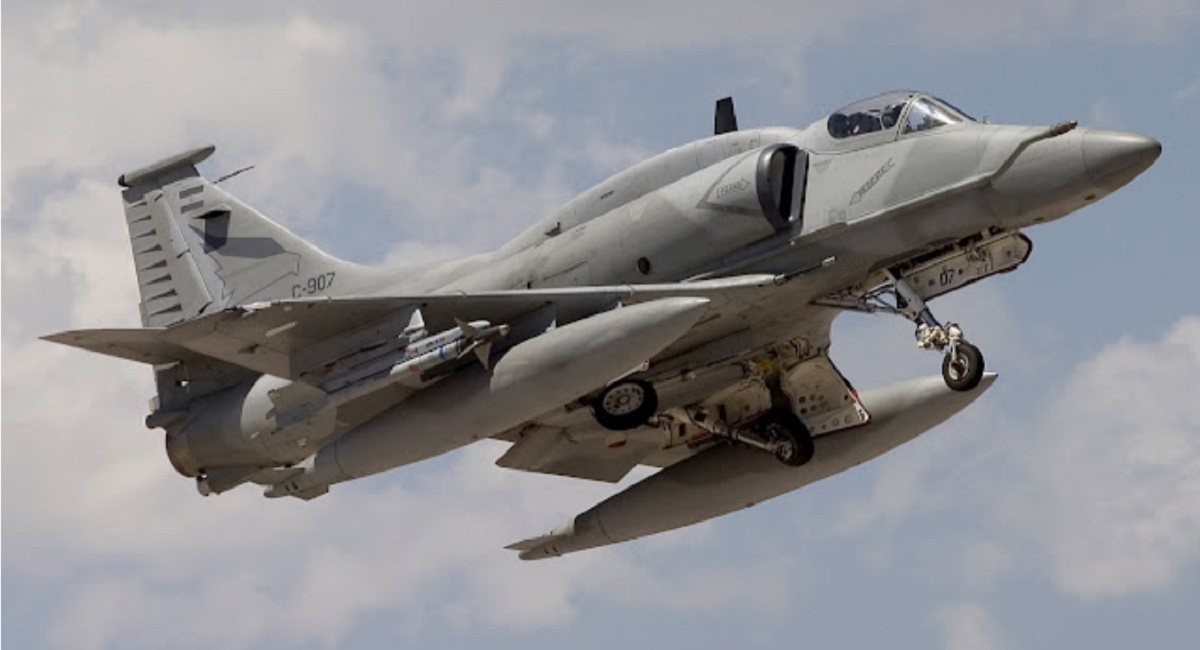
On May 14, 2026, the Argentine Air Force retired its last A-4AR attack aircraft from operational service. This marked the end of the Skyhawk’s combat career in one of the two remaining countries that still operated the type in their military aviation inventory. This development provides an opportunity to take a closer look at the history and service of the A-4 Skyhawk family of attack aircraft.
TABLE OF CONTENT:
Argentine Fightinghawk – modernization driven by necessity
The Argentine Air Force and Naval Aviation received their first Skyhawks sixty years ago, in 1966. In total, 91 used aircraft were acquired by 1975: 66 upgraded A-4B airframes, divided between the Air Force (50 aircraft designated A-4P) and Naval Aviation (16 A-4Q), as well as 25 A-4C aircraft for the Air Force.
These aircraft were used extensively during the 1982 Falklands conflict. Operating independently or in coordination with other aircraft types, the Skyhawks sank four and damaged 14 British ships and vessels. However, their own losses were also substantial: 19 aircraft from the Air Force and three (according to other sources, six) naval aircraft.
The Naval Aviation branch retired the remaining A-4Q aircraft in 1988. The only Argentine aircraft carrier, Veinte y Cinco de Mayo (incidentally, a former British vessel), rarely went to sea. As a result, the Navy concluded that a single squadron of more modern French-made Super Étendard strike aircraft was sufficient to maintain at least a symbolic carrier aviation capability.
The situation in the Air Force was more complex. A replacement for the aging and worn-out A-4P and A-4C aircraft proved difficult to secure for an extended period. Due to financial constraints, the procurement of new aircraft was not considered. When a deal was finally reached to acquire used (but newer than Argentina’s existing fleet) Skyhawks from Israel, the United States intervened and blocked the transaction. As a result, the last A-4P and A-4C aircraft were only retired in 1999. Ironically, they were replaced… by Skyhawks.
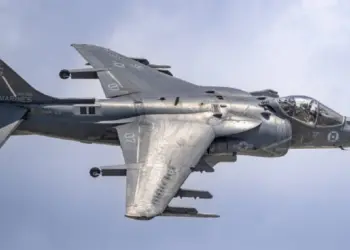
In 1994, Argentina purchased 32 A-4M aircraft and four two-seat TA-4F trainer-combat aircraft from the United States. The A-4M was the final production variant of the Skyhawk, originally delivered to the U.S. Marine Corps between 1971 and 1979. Before entering operational service with the Argentine Air Force, these aircraft underwent modernization and received the designation A/TA-4AR Fightinghawk.
The modernization program was developed by the American corporation Lockheed Martin, which also carried out the conversion of the first nine aircraft. The remaining 27 units were upgraded in Argentina between 1998 and 2000.

Read also:
- The Aircraft That Never Were: Convair Kingfish
- The story of Rosie the Rocketeer: Little airplane with ‘bazooka’
The Fightinghawk retained the original powerplant, the Pratt & Whitney J52-P-408A turbojet engine with a thrust of 5,080 kgf. The armament also remained unchanged. It consisted of two 20 mm Colt Mk 12 cannons (with 100 rounds per barrel), as well as a range of unguided munitions (bombs and rockets) and short-range air-to-air guided missiles AIM-9 Sidewinder, carried on five external hardpoints (one under the fuselage and four under the wings). The total external payload capacity reached 4,500 kg.
The avionics suite, however, was substantially upgraded. The Fightinghawk received the Westinghouse AN/APG-66(V)2 multimode radar (a variant derived from the radar developed for the F-16), an electronic warfare system including the AN/ALR-93(V)1 radar warning receiver, AN/ALQ-126B and AN/ALQ-162 active jamming systems, and AN/ALE-47 countermeasure dispensers. It was also equipped with new onboard computers, an updated navigation system, and a modernized cockpit featuring a “glass cockpit” layout.
All A/TA-4AR aircraft entered service with the 5th Air Brigade of the Argentine Air Force, based at Villa Reynolds airfield in San Luis Province, in the central part of the country. As the most modern aircraft in the Air Force inventory, they were regularly employed in various training exercises. In addition, the Fightinghawks were used for air defense alert duties during international events held in Argentina. After the retirement of the last Argentine Mirages in 2015, the A-4AR became the only aircraft in the Air Force equipped with a radar and capable of carrying air-to-air missiles. As a result, they assumed responsibility for air defense tasks.
Continuous operational use led to a gradual reduction in the fleet. Five A-4AR aircraft were lost in accidents. Maintaining the aging and heavily used airframes in airworthy condition became increasingly difficult over time. By 2023, 12 strike aircraft remained in service (10 single-seat and two two-seat variants), but only five were operational at that time – four single-seat aircraft and one trainer. The acquisition of second-hand F-16A/B fighters from Denmark ultimately enabled the retirement of the A-4AR fleet, concluding the Skyhawk’s sixty-year service history in Argentina.
Read also:
- Business Jet in Uniform: How Pilatus PC-24 Enters the Military Market
- An old warrior ready for battle: Everything you need to know about Pakistan’s ‘Mirage’ jets
The Brazilian carrier aviation ambition
The most recently acquired operator of Skyhawk aircraft has been the Brazilian Navy. Interest in purchasing second-hand A-4 aircraft in Brazil dates back to the first half of the 1980s, following the Falklands War, which demonstrated the importance of carrier-based aviation in modern conflicts.
Since 1960, the Brazilian Navy operated the aircraft carrier Minas Gerais (a sister ship to the Argentine Veinte y Cinco de Mayo). However, its air group consisted exclusively of anti-submarine aircraft and helicopters. Only in 1997 did Brazilian naval aviation receive its first jet-powered carrier aircraft: 23 former Kuwaiti attack aircraft, including 20 single-seat A-4KU and three two-seat TA-4KU. These aircraft were modified versions of the A-4M delivered to Kuwait in 1977 (30 A-4KU and six TA-4KU). In Kuwaiti Air Force service, the Skyhawks participated in the 1990–1991 Gulf War before being withdrawn from service a few years later.
In Brazil, the former Kuwaiti aircraft were redesignated AF-1 (single-seat) and AF-1A (two-seat). They equipped VF-1 Squadron, formed in 1998 at the São Pedro da Aldeia naval air base (approximately 120 km from Rio de Janeiro). In September 1999, the adaptation of the Minas Gerais for Skyhawk operations was completed, with its air group consisting of six attack aircraft and 9–11 helicopters of various types. However, just two years later, Minas Gerais was decommissioned. This was due to Brazil’s 1999 acquisition from France of the aircraft carrier Foch, a vessel commissioned in 1963 but significantly larger. After refurbishment, it entered Brazilian Navy service in 2002 under the name São Paulo. This carrier could operate up to 15 Skyhawks and 11 helicopters simultaneously.
In 2010, an agreement was signed with EMBRAER for the modernization of 12 attack aircraft (nine AF-1 and three AF-1A; after upgrading they were redesignated AF-1B and AF-1C, respectively). The program included the installation of an Israeli-made Elta EL/M-2032 multimode radar, along with new communications and navigation systems, updated onboard computers, and multifunction displays in the cockpit.
The first upgraded attack aircraft was delivered to the customer in May 2015, and the second the following year. However, on 26 July 2016, the two aircraft collided in mid-air. As a result, one aircraft was destroyed (the pilot was killed), while the other managed to land safely.
After the modernization of seven aircraft, including the one lost on 26 July 2016 (five single-seat and two two-seat aircraft), the program was halted. This was linked to the Brazilian government’s decision in early 2017 to discontinue the modernization of the aircraft carrier São Paulo and proceed with its decommissioning. Instead, Brazil acquired the British amphibious assault helicopter carrier Ocean, which entered Brazilian service under the name Atlântico. However, Skyhawk operations cannot be conducted from this vessel.
At present, VF-1 Squadron retains four AF-1B and two AF-1C aircraft within the Brazilian Navy. Nevertheless, the rationale for maintaining the unit is increasingly limited, as there are no concrete plans or prospects for acquiring a conventional aircraft carrier. In July 2025, Brazilian Skyhawks reportedly began adopting a new role – counter-unmanned aerial vehicle (C-UAV) operations, reflecting operational lessons associated with the Russia–Ukraine war that have also influenced Brazil’s defense considerations. The aircraft’s onboard systems allow interception of such targets even under conditions of reduced visibility.
As a result, the Skyhawks are likely to remain in Brazilian naval aviation service for several more years, until the remaining airframe life is exhausted.
Read also: