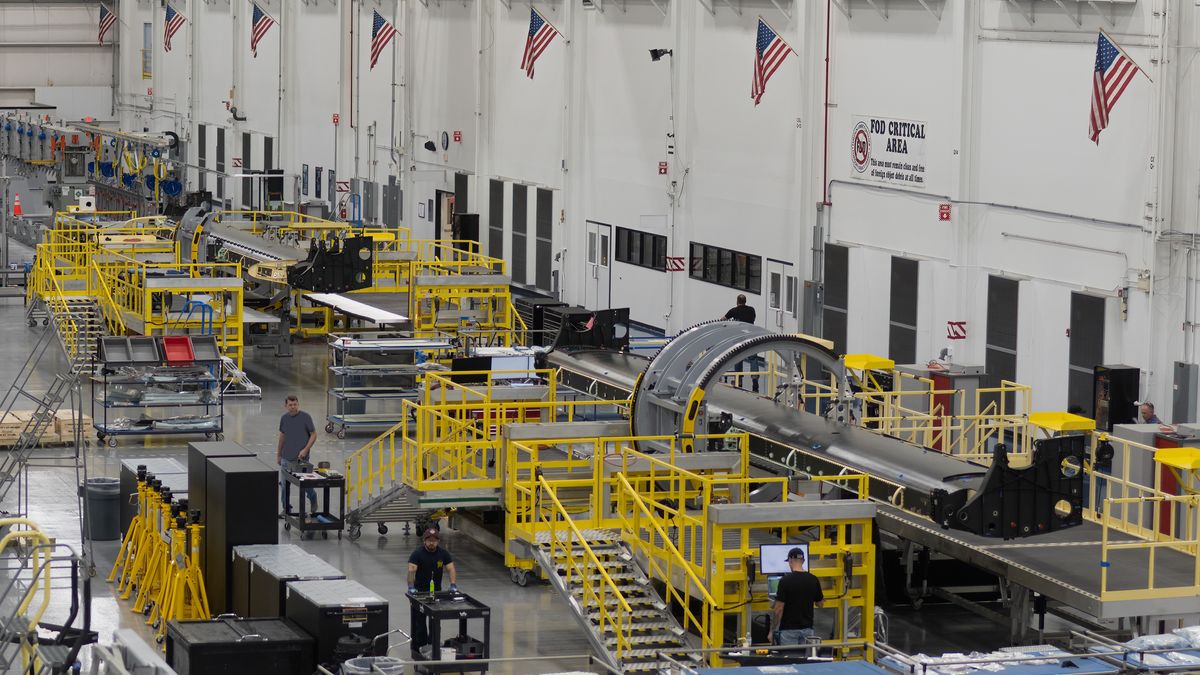
Bell announced the completion of wing structures for the first two MV-75 Cheyenne II tiltrotor aircraft being built for the U.S. Army. The milestone marks another step in the production of the initial batch of eight test aircraft, six of which are already at various stages of assembly. Following systems integration, the wings will be mated with other major components, including the fuselage and engine nacelles, which are also currently in production.
Read also: Interview with Bell Textron: Investing in the future in Ukraine
Bell stated that the wing is a key structural element of the MV-75, as it “provides the aircraft’s structural foundation, delivering high strength, optimized stiffness, and enhanced survivability.” According to the manufacturer, the wing consists of composite skins and spars mounted on a specially designed aluminum framework, with all components being manufactured and assembled in-house.

Bell representatives stated that the first wing, completed in February 2026, required “90% fewer labor hours compared with the initial V-22 wing production effort.” Lessons learned from that process enabled an “additional 40% reduction” during the manufacture of the second wing relative to the V-22 Osprey.
“Over decades of V-22 wing production, we have learned how to do it better, faster, and more efficiently, applying those lessons during the design phase,” said Bell Chief Operating Officer Kully Schaefer. “The team continues to evolve, making adjustments, refining work sequences, and implementing engineering changes to continuously raise the bar for quality, safety, and efficiency.”
The company also reported significant progress on the MV-75 test aircraft and said the program is advancing toward the testing and full-rate production phases at an accelerated pace. The military is expected to receive the first MV-75 prototype by the end of this year, with flight testing scheduled to begin in early 2027.
In April 2026, the U.S. Army officially announced that the Future Long Range Assault Aircraft (FLRAA), designated MV-75, would be named Cheyenne II, in keeping with the longstanding tradition of naming aircraft and helicopters after Native American tribes. Army officials stated that the MV-75’s speed, range, and adaptability reflect the historical qualities associated with the Cheyenne people. Notably, the MV-75 Cheyenne II represents the first entirely new aircraft platform slated for introduction into Army aviation since the 1980s. The tiltrotor will complement existing helicopter fleets, extending the operational reach of Army aviation units.
“MV-75 Cheyenne II marks a new era for Army aviation, with capabilities that significantly exceed those of the current fleet,” U.S. Army officials stated. With an officially stated range of approximately 4,500 km, the MV-75 is expected to fly twice as fast and cover twice the distance of the current UH-60M Black Hawk (you can find out more about this helicopter here).
In May 2025, the U.S. Army formally approved MV-75 as the Mission Design Series (MDS) designation for the new aircraft. The number “75” references 1775, the year the U.S. Army was established, while the letter “M” denotes its multi-mission role and “V” indicates vertical takeoff capability.
Under the current schedule, the MV-75 is expected to enter operational service with frontline units in 2031–2032. The Army has already designated the 101st Airborne Division as the first unit to receive the MV-75. It has also been reported that specific design requirements were incorporated to facilitate the aircraft’s integration into the elite 160th Special Operations Aviation Regiment.
Read also:
- Extreme Pace: Pentagon Radically Accelerates Testing of the Secretive B-21 Raider
- “Free Bird” from Türkiye: Everything About the TAI Hürkuş Trainer and Light Attack Aircraft
Source: theaviationist