Russia has developed a new air-launched cruise missile designated “Izdeliye-30.” This article examines the available information about the system and considers the potential risks it may pose to Ukrainian cities.
The assessment is based on official data from the Ukrainian Defense Intelligence (HUR), analysis of recovered missile fragments, and open sources available as of 7 March 2026. The available information remains limited, and conclusions may change as additional evidence or modified variants emerge.
Reports indicate that during the night a residential building in Kharkiv was struck by a missile identified as Izdeliye-30. The following overview outlines the system’s development background, technical characteristics, design features, reported operational use, and possible future role as understood in March 2026.
In March 2026, the Main Directorate of Intelligence of the Ministry of Defense of Ukraine (HUR) released detailed information about a new Russian air-launched cruise missile of the air-to-surface class designated “Izdeliye-30.” The weapon is described as a subsonic cruise missile developed for Russia’s strategic aviation and intended for strikes against ground targets, potentially as part of large-scale attack operations. According to available reports, the missile represents one of the more recent developments of the Russian defense industry, with the first documented cases of operational use reported in late 2025 during strikes on Ukrainian territory.

Izdeliye-30 is generally described as a lower-cost and simplified alternative to the well-known Kh-101 cruise missile, reportedly equipped with a significantly heavier warhead. This configuration suggests an attempt to balance production cost with destructive capability. In the context of a prolonged conflict, such an approach may allow Russia to partially offset shortages of high-precision munitions while maintaining the ability to conduct long-range strikes.
The following sections present a detailed technical assessment based on information released by Ukrainian intelligence, open-source materials, and analysis of recovered missile debris.
Read also: Weapons of Ukraine’s Victory: High-precision APKWS II Missile
TABLE OF CONTENT:
Development History and Context
In Russian military-industrial terminology, the designation “Izdeliye” (literally “product”) followed by a numerical index typically refers to an internal factory code used during development and testing. According to available information, Izdeliye-30 was developed by Zvezda Design Bureau, which operates within the structure of Tactical Missiles Corporation (KTRV), formerly known as Zvezda‑Strela State Research and Production Center.
The concept appears to have emerged from the operational requirements of Russia’s long-range aviation branch. The objective was to create a relatively inexpensive but powerful non-nuclear precision munition suitable for deployment by strategic bombers such as the Tupolev Tu‑95MSM and the Tupolev Tu‑160M. According to information released by Ukrainian intelligence, the missile’s design reportedly incorporates certain elements derived from the Kh‑35U anti‑ship missile, although the overall airframe is significantly larger and adapted for strikes against ground targets.
Development appears to have progressed on an accelerated schedule. Testing is reported to have begun in 2025, with the first documented combat launches occurring later the same year. As of March 2026, the missile is believed to be in limited operational use. This assessment is based in part on the examination of recovered debris analyzed by Ukrainian intelligence services.
Reports indicate that during the night a residential building in Kharkiv was struck by a missile identified as Izdeliye-30, resulting in civilian casualties, including children. Such incidents are cited in discussions about the missile’s operational use during the ongoing conflict.
From a programmatic perspective, the system appears intended to complement or partially replace the more complex and expensive Kh‑101 cruise missile. While the Kh-101 is reported to have a range exceeding 2,500 km, its production involves higher costs and manufacturing complexity, which may have influenced the development of a simpler alternative.
Read also: Weapons of Ukraine’s Victory: The Heavy Cruise Missile “Flamingo”
Key Technical Characteristics
The following parameters have been reported by the Main Directorate of Intelligence of the Ukrainian Ministry of Defense:
- Wingspan (with deployed folding wings): approximately 3 m
- Body diameter: 580 mm
- Warhead mass: about 800 kg (manufactured by GosNIIMash)
- Operational range: at least 1,500 km
- Cruise speed: around 720 km/h, indicating a subsonic profile
- Flight altitude: approximately 200–2,000 m
- Engine type: dual-circuit turbojet designated Izdeliye-64R, produced by UEC-Saturn
- Launch system: aviation ejector rack AKU-5M, compatible with missiles such as the Kh-101 cruise missile, Kh-55 cruise missile, and Kh-555 cruise missile.
For comparison, the reported warhead mass is roughly twice that of the standard Kh-101 cruise missile configuration, which typically carries a payload of about 400 kg. At the same time, the estimated range is sufficient to reach targets across Ukraine even if the launch platform operates from areas such as the Caspian Sea.
Based on the reported cruise speed, the flight time to Kyiv could reach roughly two hours, depending on launch location and flight profile.
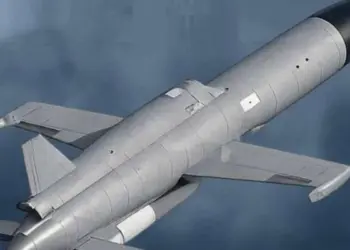
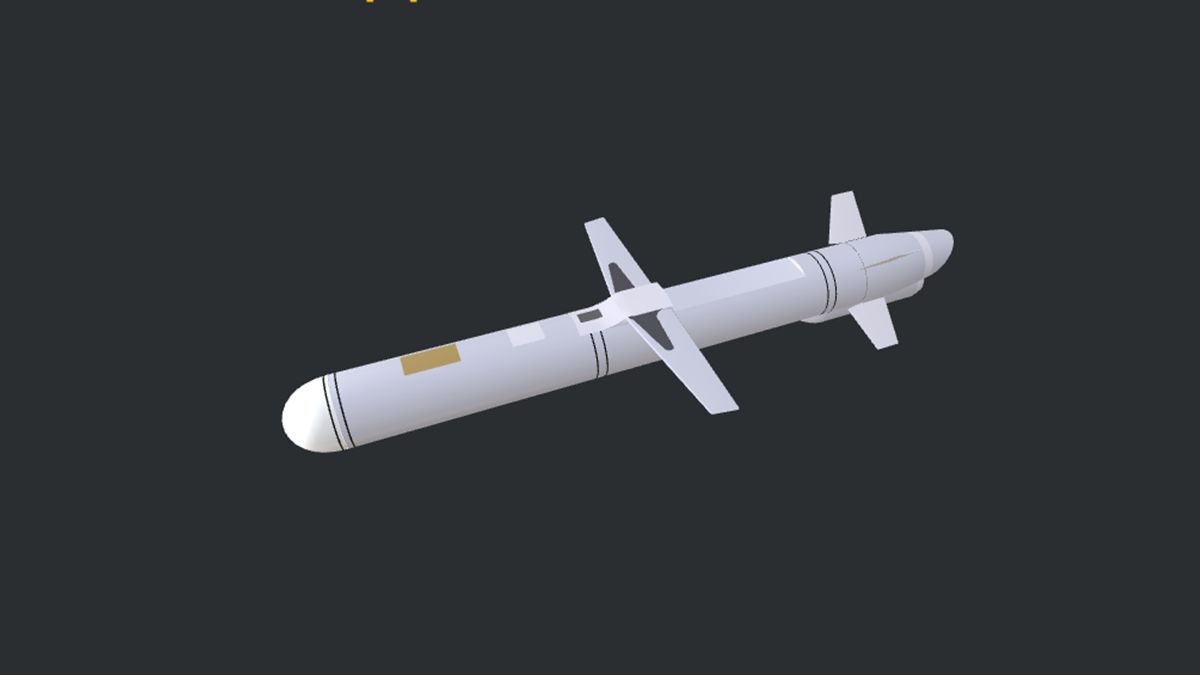
Three-dimensional models of the Izdeliye-30 missile have also been published by Ukrainian intelligence. These renderings show a cylindrical fuselage, folding wings, and an external antenna consistent with satellite navigation equipment.
Read also: Mission Control: How Ukraine Is Building a Unified Digital Brain for Drone Warfare
Design and Key Components
The missile follows a conventional aerodynamic configuration with folding wings and stabilizing surfaces. The fuselage is divided into several main compartments, including the warhead section, fuel tanks (a forward tank and additional side tanks), the propulsion unit, and the guidance and control system.
Internal Systems and Major Components
Ukrainian intelligence has published an interactive 3D model of the missile along with a list of more than twenty identified components and their manufacturers. Several of the most notable elements include the following:
- Warhead (800 kg). The warhead is reportedly manufactured by GosNIIMash. It is equipped with contact target sensors and a dedicated control unit designated BUBS-30, produced by ZIP. The unit is described as using a fully domestic component base, including the 1986VE1AT microcontroller developed by Milandr.
- Engine (“Izdeliye-64R”). Propulsion is provided by a compact dual-circuit turbojet developed by UEC-Saturn. This engine is reported to enable a cruise speed of approximately 720 km/h.
- Pneumatic system. The missile includes a pneumatic subsystem responsible for various mechanical operations. Identified elements include a pyrovalve, DP4-3M pyrotechnic cartridges produced by MPZ AT, a pneumatic cylinder used for wing deployment, nitrogen storage modules, and a pressure regulator.
- Fuel system. The fuel system consists of a forward tank and two lateral tanks, along with a fuel metering unit that regulates the supply to the engine.
- Navigation system. Guidance appears to rely on a combined satellite-based navigation architecture. A key element is the hardened GNSS receiver with a digital antenna array Kometa-M12, produced by VNIIR-Progress. Additional components include a processing unit built around the NAVIS NR9 platform developed by Navis Design Bureau and an interface module BS-M84G426 produced by Temp‑Avia.
Read also: Weapons of Ukraine’s Victory: TRIDON Mk2 Mobile Air Defence Systems from BAE Systems Bofors
Foreign Electronic Components Despite Sanctions
One notable aspect concerns the origin of several electronic components identified in examined samples. Some of the elements used in the missile’s electronic architecture appear to be of foreign manufacture. These include key components such as radio-frequency transceivers, memory chips, and other integrated circuits responsible for data processing, storage, and transmission.
An analysis of markings and technical specifications suggests that a portion of these components was produced outside Russia, including by manufacturers based in the United States and Belarus.
Among the U.S. companies whose chips have reportedly been identified are Maxim Integrated, Integrated Silicon Solution Inc., and Spansion. These firms manufacture a broad range of semiconductor components, including microcontrollers, analog integrated circuits, flash memory, and high-speed interface modules. Components of this type are widely used in telecommunications equipment, control systems, radio electronics, and various military and aerospace applications.
Additional components identified on several circuit boards were manufactured by Integral, a Belarusian state-owned enterprise and one of the largest microelectronics producers in the post-Soviet region. The company has historically maintained close links with the regional defense industry.
The presence of such components in military equipment used under conditions of international restrictions raises questions about the mechanisms through which they were obtained. Following the introduction of extensive sanctions against Russia’s defense-industrial sector, direct exports of advanced electronic components to Russia were significantly restricted or prohibited. Nevertheless, available evidence indicates that similar microchips continue to reach Russian manufacturers through indirect supply routes.
These supply chains may involve forms of parallel import or intermediary networks operating in third countries. In such cases, components can be purchased by commercial entities that are formally unrelated to defense programs and subsequently resold through multiple layers of distributors. Another possible mechanism involves the use of intermediary companies registered in jurisdictions with less stringent export-control regimes. As a result, electronic components originally intended for civilian markets may eventually appear in military or dual-use systems.
The identification of microchips produced by Maxim Integrated, Integrated Silicon Solution Inc., and Spansion alongside products from Integral therefore provides indirect evidence that sanctions have not fully eliminated access to critical electronic components. More broadly, this illustrates the globalized nature of the semiconductor market and the difficulty of completely controlling the movement of high-technology components within international supply chains.
Read also: All About Starship V3: Technological Platform for the Next Spaceflight Era
Guidance System and Accuracy
The Izdeliye-30 cruise missile is equipped with a hybrid navigation system that combines an inertial navigation system (INS) with periodic corrections from satellite navigation signals. The core INS relies on gyroscopes and accelerometers to calculate the missile’s position, speed, and flight direction autonomously, based on initial launch parameters. While this system is immune to external radio interference, positional errors accumulate over time.
To mitigate these deviations, the missile integrates course corrections using satellite signals, primarily from the Russian GLONASS system, with optional support for GPS signals. Periodic updates from satellite data significantly improve long-range accuracy and compensate for the drift inherent in the inertial system.
A key component of this navigation architecture is the specialized Kometa‑M12 digital antenna, designed to receive satellite signals under conditions of active electronic countermeasures. The antenna uses multi-channel signal processing and digital beamforming to suppress interference sources and extract the intended signal from noise. In practice, this enhances the missile’s resilience against electronic warfare (EW) systems attempting to jam or spoof navigation signals.
Modern versions of such antennas may also incorporate spatial filtering, allowing the system to identify the direction of incoming interference and electronically exclude it from reception. This capability helps maintain navigation accuracy even in areas with intensive jamming activity.
Another notable feature of the Izdeliye-30 navigation system is partial standardization with other products from Tactical Missiles Corporation (KTRV). Software, electronic modules, and some hardware elements are shared or compatible with other missile types, enabling reuse of established solutions.
Unlike the Kh-101 cruise missile, where certain navigation components have a more specialized design, Izdeliye-30 emphasizes standardization. This approach simplifies production, reduces the number of unique components, and facilitates maintenance and upgrades.
The unification of electronic and navigation modules allows the manufacturer to scale missile production more efficiently, leveraging existing production lines and proven components. In a wartime context, this is particularly advantageous, as it shortens manufacturing timelines and reduces reliance on highly specialized parts.
Read also: Everything About the P1-Sun – SkyFall’s Ukrainian Interceptor Drone
Launch Platforms and Method
The Izdeliye-30 missile is designed for launch exclusively from the internal bomb bays or external ejector racks of strategic bombers, specifically:
- Tupolev Tu-95MSM
- Tupolev Tu-160M
Each aircraft is capable of carrying multiple missiles, although exact numbers have not been publicly disclosed. Compatibility with the AKU-5M ejector system allows for rapid rearming of the bomber fleet without requiring significant modifications to the aircraft.
Read also: Weapons of Ukraine’s Victory: Tempest Air Defense System with AGM-114L Longbow Hellfire Missiles
Operational Use in Ukraine
The first documented launches of Izdeliye-30 occurred in late 2025. By February–March 2026, the missile was reportedly used in several large-scale strike operations. Analysis of debris recovered on Ukrainian territory enabled the Main Directorate of Intelligence (HUR) to identify the system and release technical details.
Reported targets have included civilian infrastructure, with strikes recorded in Kharkiv and other regions. The missile’s low-altitude flight profile complicates detection and interception by air defense systems.
Comparison with Other Russian Missiles
The primary advantage of Izdeliye-30 is its larger warhead at a lower cost, which enables a higher number of strikes to be conducted.
Read also: Weapons of Ukraine’s Victory: MICA Air-to-air Missile
Prospects and Threats
The Izdeliye-30 enables Russia to increase the intensity of strikes without rapidly depleting its stock of Kh-101 missiles. If production is scaled up fully, the number of missiles deployed in salvoes could rise significantly. For Ukraine, this underscores the need to strengthen low-altitude air defense systems and continue analyzing recovered debris to identify potential vulnerabilities, such as propulsion and navigation components.
The missile also illustrates the evolution of Russian cruise missile development – from expensive, high-end systems to mass-produced, powerful, and relatively low-cost munitions. The release of detailed technical information by Ukrainian intelligence has compromised Russian operational secrecy, providing both tactical advantages for countermeasures and strategic leverage in diplomatic contexts, including the potential for new sanctions.
Read also: