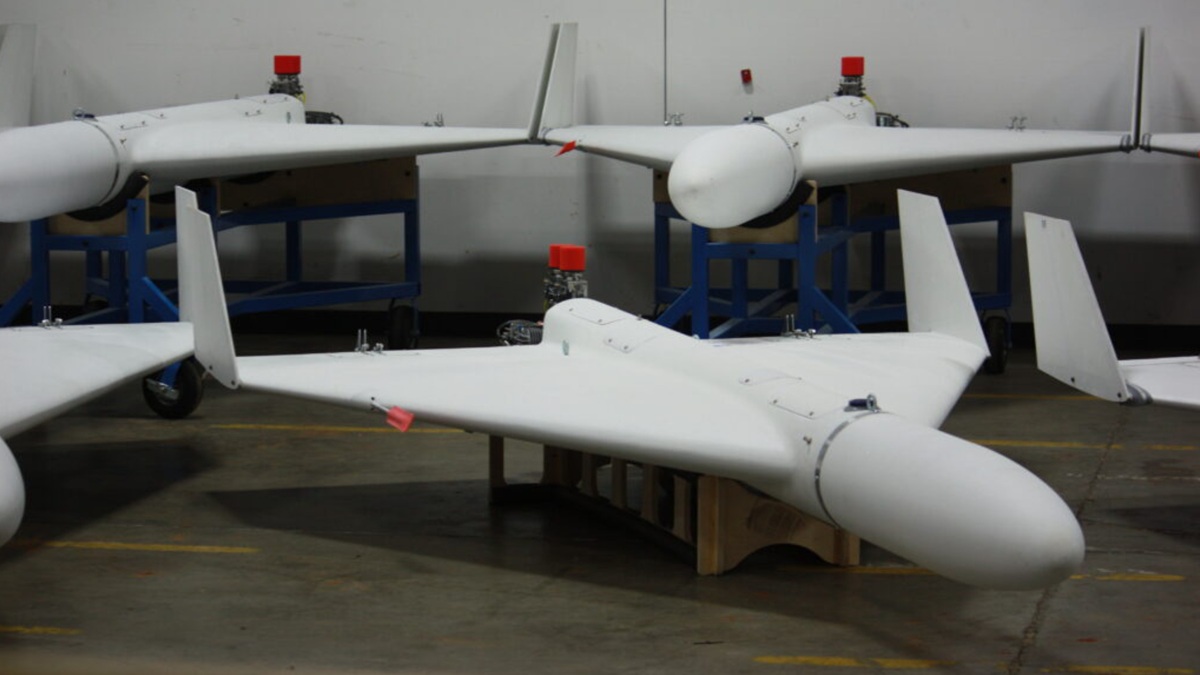
This article examines the MQM-172 Arrowhead loitering munition, developed by Griffon Aerospace, which represents the U.S. response to the era of mass-produced drones. The introduction of the MQM-172 Arrowhead signals a shift in U.S. thinking regarding inexpensive, widely available unmanned aerial systems. For many years, U.S. doctrine emphasized high-tech, costly drones focused on intelligence gathering and precision strikes. However, the conflict in Ukraine and the proliferation of drones such as the Shahed-136 have highlighted a different class of threat: simple, serially produced, and relatively low-cost strike platforms. The MQM-172 Arrowhead was developed in response to this emerging operational environment.
Read also: Weapons of Ukraine’s Victory: Tempest Air Defense System with AGM-114L Longbow Hellfire Missiles
TABLE OF CONTENT:
Program Origin and Concept
The U.S. Air Force announced a competition to develop an unmanned aerial vehicle designed to replicate the characteristics of the Iranian Shahed-136. This initiative goes beyond the creation of a new training target and represents a structured effort to reproduce one of the key tools of modern asymmetric warfare – a mass-produced, low-cost strike drone. The primary objectives of the program include training air defense units, refining interception tactics, and testing countermeasures under conditions where defensive systems are saturated by multiple targets.
Griffon Aerospace was among the first companies to respond, presenting the Arrowhead system based on the MQM-172 platform. Formally, the aircraft is positioned as an evolution of existing aerial target drones and was first introduced in this role in 2025. However, from the outset it was evident that the Arrowhead extends well beyond the traditional scope of a training target.

In terms of its characteristics, the MQM-172 Arrowhead functions as a multi-role platform. Depending on its configuration, it can simulate adversary strike drones, serve as a realistic target for air defense testing, carry a payload, or be used as an experimental platform for evaluating electronic warfare and intelligence-related solutions. Its modular architecture allows the system to be adapted to different operational scenarios without changes to the underlying airframe.
In practical terms, the MQM-172 Arrowhead represents an attempt to create a universal “drone chassis” that is low-cost, scalable, and flexible in application. This approach reflects a broader shift in U.S. military doctrine, with increasing emphasis on balancing technological sophistication, cost, and the ability to scale in response to mass unmanned threats.
Read also: Weapons of Ukraine’s Victory: Paveway IV Guided Bombs
Design and Aerodynamic Configuration
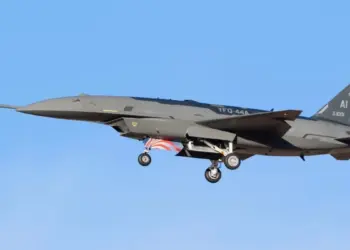
The MQM-172 Arrowhead uses a delta-wing configuration typical of this class of aircraft. This layout is not a stylistic choice but a pragmatic engineering solution that provides several practical advantages. Most notably, it supports simplified manufacturing through a reduced number of complex components, avoids costly aerodynamic features, and enables rapid scaling of serial production.
The delta-wing design also provides stable handling at low to medium speeds, which is essential for an aircraft intended to replicate the flight profile of slow-moving strike drones. This stability allows the system to follow realistic trajectories, maintain predictable in-flight behavior, and operate in regimes characteristic of loitering munitions.
Another important consequence of the selected aerodynamic configuration is reduced operating cost. The simplified design lowers requirements for maintenance, repair, and turnaround between launches, which is particularly relevant for a platform intended for large-scale use and frequent employment in training and test scenarios.
The MQM-172 Arrowhead airframe is constructed from composite materials. This choice reduces overall weight while simplifying serial production, without compromising structural strength. The use of composites aligns with the broader concept of the system as a low-cost, technically uncomplicated, and easily reproducible platform.
At the same time, the Arrowhead is not designed with low observability in the traditional stealth sense as a primary objective. The absence of specialized shaping or coatings to reduce radar signature represents a deliberate trade-off in favor of lower cost and greater scalability. For a platform in this class, affordability and mass deployment are considered more critical than advanced signature reduction.
In terms of overall dimensions, the MQM-172 Arrowhead is comparable to the Iranian Shahed-136. This similarity makes it a practical tool for modeling a specific category of threat. In this configuration, the Arrowhead can be used as a realistic simulator of the type of strike drones that modern air defense systems encounter in real operational conditions.
Read also: Weapons of Ukraine’s Victory: Windracers Ultra Mk 2 heavy logistics UAV
Propulsion System
The drone is powered by a piston internal combustion engine operating on aviation fuel or compatible alternatives. This choice is driven not only by cost considerations but also by tactical requirements. The cruise speed is estimated at 300–350 km/h, with a practical ceiling of up to 6,000 meters and an endurance of up to three hours.
The piston engine produces a characteristic acoustic signature, which is important for realistically simulating strike drones during air defense training. At the same time, it provides reliable performance over extended distances and consistent flight characteristics throughout the mission profile.
An additional advantage is ease of maintenance. Piston engines do not require complex support infrastructure and are well suited to high-frequency, large-scale use, which directly influences the overall operating economics of the platform.
Read also: Everything About the P1-Sun – SkyFall’s Ukrainian Interceptor Drone
Modularity as a Key Feature
A central feature of the MQM-172 Arrowhead is its modular payload bay. This design element fundamentally changes the role of the aircraft, transforming it from a specialized training target into a flexible, multi-role platform. The payload module effectively forms the core of the Arrowhead concept, around which its versatility is structured.
Modularity allows the payload to be swapped or reconfigured without major alterations to the airframe. This enables rapid adaptation to specific missions without the need to develop separate UAV variants for each scenario. The approach significantly reduces operating costs and simplifies logistics, particularly in environments with frequent or intensive use.
In its training configuration, the MQM-172 Arrowhead carries an inert payload module, allowing it to function as a full-scale target for air defense units. In this mode, the drone replicates the flight profile, speed, and behavior of strike UAVs without posing a real destructive threat, while maintaining a high degree of realism for training purposes.
If required, the same payload bay can be fitted with a warhead, such as a high-explosive or fragmentation type. In this configuration, the Arrowhead moves beyond a purely training role and approaches the category of strike-capable unmanned systems. This does not require changes to the aerodynamic layout or propulsion system, highlighting the versatility of the underlying design.
Another application area involves the integration of reconnaissance sensors. In this role, the drone can be used for auxiliary or experimental data collection tasks while remaining within the same platform architecture. Similarly, the modular bay enables the installation of equipment to simulate electronic warfare effects or complex electronic signatures, which is important for testing and tuning modern air defense systems.
Read also: Weapons of Ukraine’s Victory: Sting UAV Interceptor
Launch and Operation
The MQM-172 Arrowhead does not require a conventional runway, placing it outside the standard requirements for fixed aviation infrastructure. This design choice is not merely a technical feature but a deliberate decision intended to improve mobility and operational flexibility.
The drone can be launched using a ground-based catapult. This method allows for rapid preflight preparation, deployment from a wide range of suitable locations, and minimal time between setup and launch. Catapult launch aligns with the concept of mass use, where launch speed and repeatability are prioritized over operational convenience.
An alternative launch option involves the use of a RATO-type rocket-assisted takeoff booster. This approach provides reliable acceleration immediately after launch and enables operation across a wider range of conditions, including confined areas or non-standard platforms. The availability of this launch method further emphasizes the Arrowhead’s focus on versatility and adaptability to different operational scenarios.
In practical terms, this significantly simplifies the deployment of the system. Eliminating the need for a prepared runway reduces logistical requirements, lowers engineering support demands, and allows positions to be changed quickly. These characteristics make the MQM-172 Arrowhead suitable for field operations where establishing full-scale infrastructure is impractical or inefficient.
Additionally, this launch approach enables operation from unconventional platforms, including ships or temporary sites. Combined with its modular architecture, this reinforces the Arrowhead concept as a mobile and scalable system capable of functioning in environments where conventional aviation solutions would be too complex or costly.
Read also: All About Project Suncatcher: Google’s Space Experiment
Technical specifications
The following specifications are indicative and partly estimated, as the manufacturer has not disclosed full details:
- Length: approximately 3.5 m
- Wingspan: approximately 2.5 m
- Takeoff weight: approximately 200–240 kg
- Wing type: delta wing
- Engine: piston engine (4-cylinder)
- Maximum payload: up to approximately 45 kg
- Cruise speed: approximately 185 km/h
- Range: up to approximately 1,000 km or more
- Launch system: ground catapult or rocket-assisted takeoff (RATO)
Read also: Weapons of Ukrainian Victory: Multi-Purpose Helicopter UH-60 / S-70A Black Hawk
MQM-172 Arrowhead as an Air Defense Training Tool
The MQM-172 Arrowhead is of particular interest in the context of air defense training. Modern air defense systems increasingly face scenarios that involve not isolated targets, but coordinated attacks by large numbers of relatively simple and low-cost unmanned aerial vehicles. Such scenarios place sustained pressure on detection, command, and interception systems.
In this environment, the Arrowhead functions not merely as a training target, but as a practical tool for modeling real-world threats. The platform enables simulation of mass drone launches, the creation of complex and combined flight profiles, and the evaluation of air defense effectiveness against low-cost targets without the need to expend expensive specialized targets or interceptor missiles.
This has significant economic implications. Intercepting Shahed-type drones with long-range surface-to-air missiles is highly inefficient in terms of the cost ratio between the target and the interceptor. As a result, the ability to repeatedly train for such scenarios using relatively low-cost platforms becomes a critical factor in the effective preparation of modern air defense forces.
Similarity to the Shahed-136 as Functional Rather Than Formal
Although the MQM-172 Arrowhead is not officially positioned as a direct analogue of the Iranian Shahed-136, their similarity is evident at a practical level. This includes comparable dimensions, similar speed, a broadly equivalent range, and a matching operational profile. Taken together, these characteristics allow the Arrowhead to be used as a realistic simulator for this specific category of threat.
In effect, the MQM-172 Arrowhead represents a U.S. interpretation of the mass strike drone concept, adapted to NATO standards and multi-role requirements. Rather than replicating a specific system, it reflects the underlying logic of how such platforms are employed in contemporary conflicts.
Read also: Weapons of Ukraine’s victory: Zozulya Deep Strike Drone
A Shift in the U.S. Approach to Unmanned Warfare
The MQM-172 Arrowhead illustrates a broader shift in the U.S. approach to unmanned warfare. The focus is gradually moving away from exclusive reliance on highly advanced technologies toward a balance between cost, scalability, and operational effectiveness. This reflects an acknowledgment that even the most sophisticated systems are constrained by economic considerations.
In this context, the MQM-172 Arrowhead is more than a training target. It is a multi-purpose platform that reflects the evolving reality of drone warfare, where outcomes are shaped not only by technical performance, but also by the ability to scale rapidly and adapt to environments characterized by the widespread use of unmanned systems.
The introduction of this platform sends a clear signal: the United States is no longer overlooking lessons from recent conflicts and is deliberately preparing to operate in environments dominated by mass unmanned threats, where the economic aspects of warfare are as important as technological capabilities.
Read also: