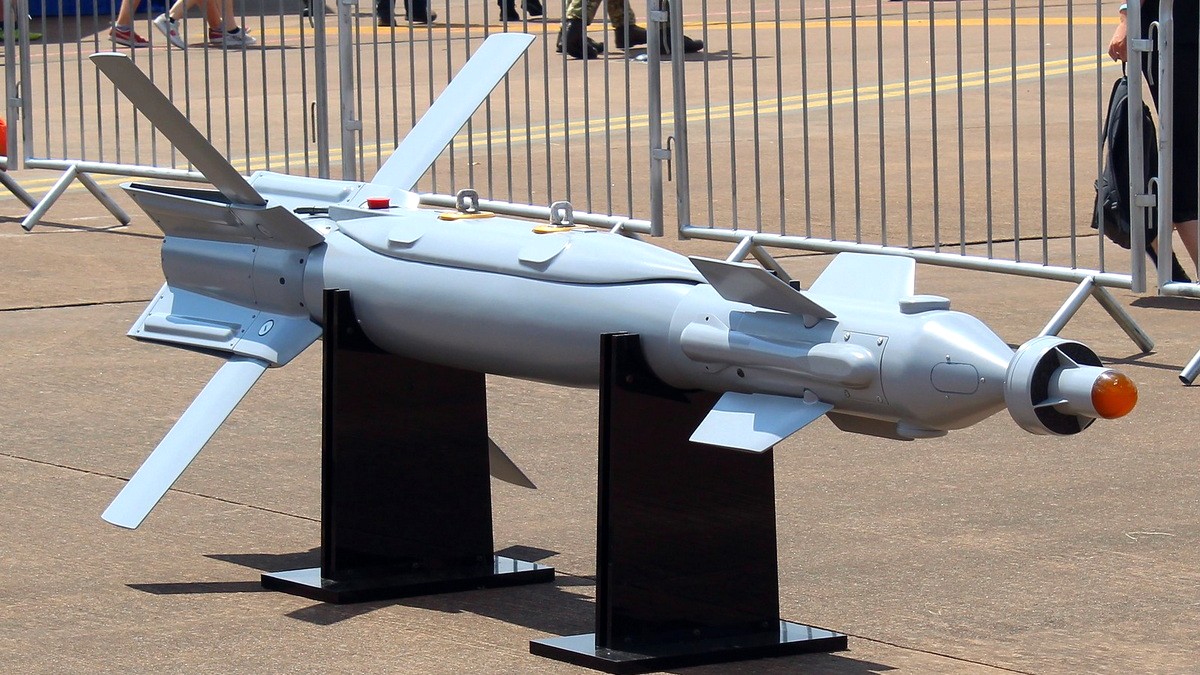
The arsenal of high‑precision air‑to‑surface weapons used by our aviation has been expanded with another Western‑origin system – the Paveway IV guided aerial bomb. What is this munition, and what are its key characteristics?
TABLE OF CONTENT:
A Bomb for the Royal Air Force
In the 1990s, NATO air forces conducted several large-scale air campaigns in the Balkans, culminating in Operation Allied Force against the Federal Republic of Yugoslavia (March 24 – June 10, 1999). A defining feature of these operations was the steadily increasing use of precision-guided munitions, primarily guided aerial bombs, for engaging ground targets. This approach made it possible to reduce unintended civilian casualties while also significantly lowering the number of combat sorties required to achieve mission objectives. The outcomes of these campaigns were closely analyzed by military specialists, including those from the United Kingdom, as the Royal Air Force played an active role in the strikes.
The conclusions were not particularly encouraging. U.S.-manufactured laser-guided bombs Paveway II and Paveway III, deployed from British Tornado and Harrier fighter-bombers, reportedly missed their targets in 35–50% of cases. There was a clear need for guided bombs with substantially higher accuracy and the ability to engage targets under poor weather conditions – an established weakness of the previous generation of laser-guided munitions.
Based on this assessment, the UK Ministry of Defence announced a tender in 2001 for a new guided aerial bomb. Five contenders submitted proposals. Alenia Marconi Systems, in cooperation with Boeing, offered the JDAM with a Diamondback wing kit; Israel’s Elbit Systems proposed munitions from the Lizard family; Leigh Aerosystems presented the Long Shot guided bomb; Raytheon offered a new generation of Paveway; and SAGEM submitted the AASM. In all cases, these were guidance kits designed to convert conventional unguided bombs into precision-guided munitions. The competition progressed relatively quickly: in 2002, two finalists were selected (JDAM and Paveway IV), and in 2003, Raytheon’s solution was declared the winner. Production was subsequently established by the company’s UK subsidiary, Raytheon UK.

In 2007, Paveway IV bombs entered service with the UK’s military aviation, making their combat debut during Operation Herrick in Afghanistan. They were later employed in combat operations in Libya, Syria, and during strikes against Houthi forces in Yemen. Within the Royal Air Force, Paveway IV was initially carried by Harrier GR.9 and Tornado GR.4 aircraft (both types have since been retired), and it is now deployed from Typhoon fighter-bombers.
In 2015, Paveway IV underwent trials on the F‑35 Lightning II, becoming the first non‑U.S. weapon system to be integrated with these fifth‑generation fighters. In 2020, the munition was also integrated with the Protector RG.1 unmanned aerial vehicle, the UK variant of the U.S. MQ‑9B SkyGuardian.
Outside the United Kingdom, Paveway IV has seen limited adoption. To date, these guided bombs have been supplied only to Saudi Arabia – whose air force used Paveway IV during the intervention in Yemen that began in 2015 – and to Qatar. Ukraine can now be added to this list, though that requires separate discussion later on.
Read also:
- Weapons of Ukraine’s Victory: SDB Guided Bomb
- Weapons of Ukraine’s Victory: Modern Long-Range ERAM Missiles
Design
Paveway IV represents the fourth generation of the Paveway family, which has been developed in the United States since the 1960s. The first three generations relied on semi‑active laser seekers. With each successive iteration, the seeker was refined, but the core guidance principle remained the same: homing on laser energy reflected from the target. This required continuous target illumination using a laser designator, which could be carried by the launch aircraft itself, another aircraft or helicopter, or a ground-based system – for example, a portable designator used by special forces operating close to the target. However, the need for laser designation was not the only limitation of such guided bombs; weather conditions such as fog or low cloud cover could also significantly degrade their effectiveness.
Paveway IV addresses these limitations by adding a combined inertial and satellite navigation system alongside the semi‑active laser seeker, allowing the weapon to operate independently of weather conditions. Similar guidance concepts are used in other modern munitions, including the SDB and AASM families, which are familiar to Ukrainian aviation. The laser seeker is retained because it provides higher accuracy against small or moving targets. For this reason, both the SDB and AASM families also include variants equipped with laser guidance as a supplementary option.
Paveway IV consists of a guidance and control module based on the Enhanced Computer Control Group (ECCG), derived from the Enhanced Paveway II family widely used by the U.S. armed forces, and a modified 500‑lb (227 kg) Mk 82 general‑purpose bomb with improved penetration capability. The ECCG incorporates a Height of Burst (HOB) sensor, enabling airburst detonation above the target, as well as a SAASM (Selective Availability Anti‑Spoofing Module) designed to improve GPS receiver resilience against spoofing.
The inclusion of an inertial navigation unit (IMU – Inertial Measurement Unit) allows the guided bomb to be employed in a fully autonomous mode, although GPS guidance significantly improves accuracy. Laser guidance in the terminal phase of flight can be used both in inertial‑only mode and in satellite‑guided mode along the main trajectory.
Paveway IV for Ukraine
The first information about a possible transfer of Paveway IV guided bombs to Ukraine appeared on April 24, 2024, when a UK Ministry of Defence official confirmed that Paveway IV had been “included in a package of 1,600 munitions whose delivery to Ukraine was announced this week by the Prime Minister.” However, no confirmed reports of these guided bombs being used by the Ukrainian Air Force were published after that.
On December 22, 2025, a post appeared on the Telegram channel Soniashnyk, which is directly associated with Ukrainian military aviation, offering clarification: “This ‘treat’ [Paveway IV] was first mentioned in the media in spring 2024, but for some reason it did not progress beyond a single statement at the time. Why? The reason was straightforward – we did not yet have the specialized equipment or the operational capability. Still, we were able to examine it, assess it, and discuss it with colleagues.”
This message clearly correlates with a photo published on December 9 by X (formerly Twitter) user OSINTtechnical, showing a Ukrainian F‑16A fighter equipped with a Sniper/PANTERA targeting pod. One of the key components of this pod is a laser designator, which enables target illumination for munitions with semi‑active laser seekers. In the current operational context, the Sniper pod is most visibly used to guide 70 mm APKWS II rockets employed in counter‑drone missions. However, it can also be used to illuminate ground targets and guide Paveway IV guided bombs.
How might Paveway IV be employed by the Ukrainian Air Force? To fully exploit its capabilities, these guided bombs would ideally be used against high‑value moving targets. Individual tanks are unlikely to fall into this category, whereas targets such as railway echelons do. Another potential target set includes small, stationary objects.
There is, however, an important limitation. Using Paveway IV with laser guidance in the terminal phase requires the launch aircraft to enter the engagement zone of Russian air defense systems. As a result, this mode of employment would likely be feasible only after air defenses in a specific sector have been suppressed. The primary mode of use is therefore expected to be inertial/satellite guidance, similar to how SDB, JDAM, and AASM munitions are currently employed.
Compared to the SDB, Paveway IV offers a warhead roughly twice as powerful, allowing it to engage better‑protected targets. Under certain conditions – such as attacks on area targets – the airburst (HOB) mode may also prove useful.
Read also: