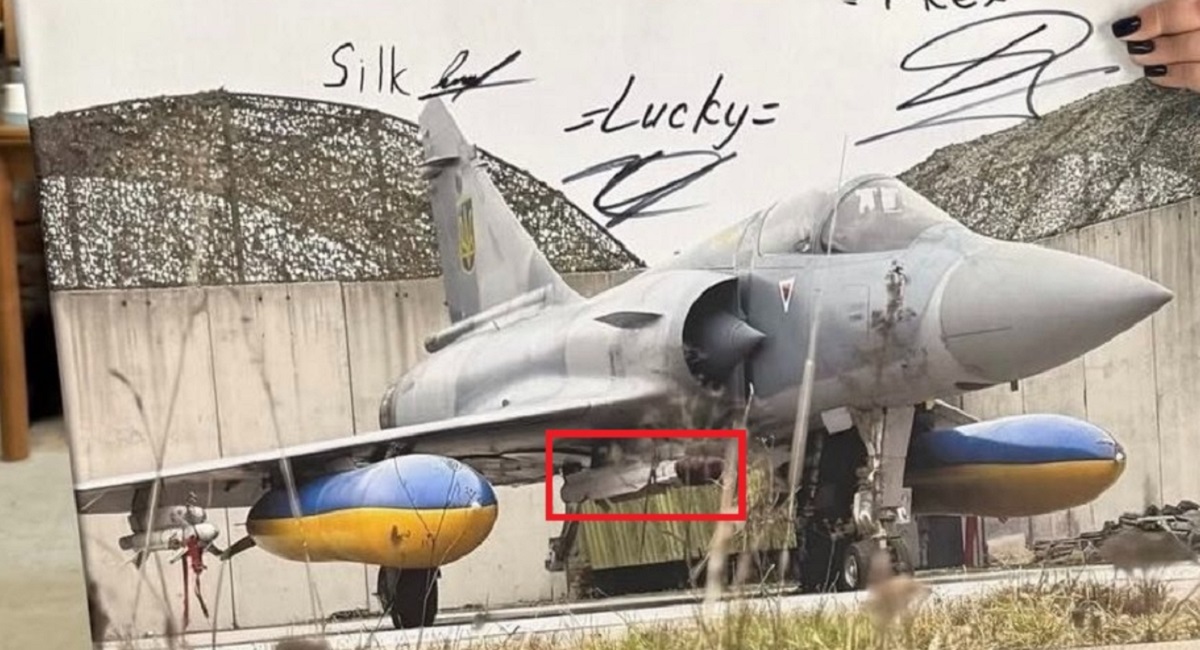
Ukrainian Mirage 2000 fighters, unlike the F-16, have revealed far less information about their operational armament. While F-16 “Fighting Falcons” are frequently photographed carrying a wide range of external weapons, Ukrainian Mirages until recently had been observed with only a single type of air-to-air missile: the Magic 2.
Only in early January of this year were photographs published showing another air-to-air missile mounted under the fuselage of a Ukrainian Mirage 2000-5F – the MICA. Its appearance was neither unexpected nor surprising, as the MICA is a standard weapon for French-built fighter aircraft. Nonetheless, its confirmed presence provides a clearer picture of the aircraft’s potential capabilities and warrants closer examination.
TABLE OF CONTENT:
Development Background
In the late 1970s and early 1980s, Western countries began developing a new generation of air-to-air missiles. In the United States, this primarily concerned the medium-range AIM-7 Sparrow and the short-range AIM-9 Sidewinder, which were to be replaced by the AIM-120 and AIM-132 respectively.
At the same time, France faced a similar need to replace its existing missiles: the medium-range Super 530D and the short-range Magic 2. Rather than developing two separate systems, French designers opted for a different approach. They developed a single missile platform produced in two variants, differentiated by their guidance systems: one using active radar homing, comparable to the AIM-120, and the other using infrared guidance, similar in principle to the AIM-132.
Development of the MICA missile (Missile d’Interception et de Combat Aérien, “interception and air combat missile”) began in 1982. Initially, the program was carried out by Matra as a private initiative and funded internally by the company. Full-scale development under contracts from the French Air Force and Navy did not begin until 1987. MICA was conceived as the primary air-to-air weapon for the future Rafale fighter, while also being intended for integration with upgraded Mirage 2000 variants. This dual-platform approach influenced both the missile’s design and its intended operational role.
Flight testing of the MICA missile started in 1991. The infrared-guided variant, MICA-IR, entered service in 1998, followed by the radar-guided MICA-EM variant in 1999.
Read also:
- Weapons of Ukraine’s Victory: Paveway IV Guided Bombs
- Weapons of Ukraine’s Victory: Magic 2 Air-to-Air Missile
Design Characteristics
The MICA missile combines features typical of different air-to-air missile classes. As a short-range missile, it has a relatively low launch mass, high maneuverability, a gas-dynamic control system, and compatibility with launch rails originally designed for AIM-9 missiles. At the same time, like medium-range missiles, MICA incorporates an inertial guidance system and offers a comparatively long engagement envelope for its class.
MICA is built according to a conventional aerodynamic configuration. It features a cruciform, wide-chord wing with small span. In the forward section of the missile body, rectangular destabilizing control surfaces are installed, contributing to maneuverability and flight stability.
The mid-section houses a solid-propellant rocket motor manufactured by Protac. The motor uses a low-smoke composite propellant and provides a maximum flight speed in the range of approximately Mach 3.5 to 4.
In the rear section, the missile houses the aerodynamic control fins, the thrust vector control (TVC) system, and the data-link receiver. The TVC system is activated immediately after launch and, together with the aerodynamic control surfaces, enables high maneuverability, with load factors of up to approximately 50 g.
The warhead is a high-explosive fragmentation type, fitted with an active radar proximity fuze.

For guidance, the missile uses a combined control system: command-inertial guidance during the initial phase of flight and autonomous homing in the terminal phase. Depending on the variant, the missile is equipped either with an active pulse-Doppler radar seeker (MICA-EM) or an imaging infrared seeker (MICA-IR).
The MICA missile can be employed in several modes:
-
Beyond-visual-range launch with midcourse guidance, where the seeker acquires the target during flight based on inertial navigation data, while receiving course-correction commands from the launch aircraft if the target’s trajectory changes.
- Beyond-visual-range launch without a data link, in which the seeker acquires the target autonomously during flight. In this mode, the missile operates on a “fire-and-forget” principle, and the midcourse trajectory is optimized to achieve maximum range.
-
Launch with pre-launch target lock, where the missile’s seeker acquires the target while still on the aircraft, using data from the carrier’s fire-control systems. After launch, the aircraft can disengage and operate independently.
-
Launch against a visually observed target, with seeker lock achieved prior to launch using a helmet-mounted targeting system on the aircraft.
During the terminal homing phase, the MICA-EM variant is guided by the AD4A active pulse-Doppler radar seeker operating in the 12–18 GHz band. The AD4A seeker was developed by Dassault Electronique in cooperation with GEC-Marconi. It is capable of autonomous target acquisition in flight and supports all-aspect engagements, day and night, under both favorable and adverse weather conditions, in the presence of heavy electronic countermeasures, and against targets flying over land or sea. The seeker is installed in the missile’s nose section beneath a radar-transparent ceramic radome. A modified version of the AD4A seeker is also used in the Aster surface-to-air missile employed by the SAMP-T and PAAMS air defense systems.
The MICA-IR variant is equipped with a dual-band imaging infrared seeker operating in the 3–5 µm and 8–12 µm spectral ranges, developed by Sagem Defense Sécurité. Its cooling system allows autonomous operation of the seeker for up to ten hours. High sensor resolution combined with advanced processing algorithms enables effective target tracking at extended ranges and reliable discrimination against infrared countermeasures. The seeker supports lock-on after launch, operates in conjunction with the inertial guidance system and the data link, and allows engagements at longer ranges and at off-boresight angles exceeding the mechanical limits of the seeker gimbal. The seeker is based on a digital architecture, which permits reprogramming of its operating algorithms.
The MICA missile has a launch mass of approximately 110 kg, of which 12 kg is accounted for by the warhead. For comparison, the previous-generation medium-range Super 530D missile had a mass of about 270 kg. MICA is 3,100 mm long, with a body diameter of 160 mm and a wingspan of 560 mm. Its maximum engagement range is reported to reach up to 60 km, compared to approximately 40 km for the Super 530D.
Variants
Under France’s 2019–2025 defense development program, work was initiated on an upgraded version of the missile designated MICA NG (New Generation). As with the original system, it is being developed in two variants: infrared-guided (IR) and radar-guided (EM). A specific requirement of the program was that the missile contain no U.S.-origin components, thereby avoiding potential export restrictions imposed by the United States.
While most of the missile’s internal systems are being redesigned, the aerodynamic configuration, mass, center of gravity, and external dimensions are intended to remain unchanged from the earlier MICA variants. This approach is meant to preserve compatibility with existing aircraft and launch systems.
Miniaturization of electronic components has freed internal volume, allowing the integration of a dual-pulse rocket motor. This change increases overall range while maintaining maneuverability of up to 50 g in the terminal phase, even at maximum engagement distances. Reported maximum ranges are approximately 80 km for the IR variant and up to 100 km for the EM variant.
The MICA NG IR seeker incorporates a highly sensitive imaging sensor designed to engage low-observable targets such as aircraft, unmanned aerial vehicles, and cruise missiles, while improving resistance to advanced infrared countermeasures. The seeker is integrated with the helmet-mounted sight of the Rafale F4, enabling full exploitation of lock-on-after-launch capabilities.
Deliveries of MICA NG missiles are scheduled to begin in 2026.
In addition, a surface-launched variant, VL-MICA, was introduced in 2009 for use with ground-based or naval vertical launch systems. The development history of this air defense system constitutes a separate topic in its own right. Work has also been reported on a submarine-launched version of the MICA missile, intended to be fired from torpedo tubes using a dedicated launch container.
MICA in Global Service and in Ukraine
MICA missiles are currently in service with the air forces of more than ten countries, including France. Large procurement batches – on the order of one thousand missiles or more – have been acquired by the Republic of China (Taiwan) and India. Smaller quantities are operated by Greece, Egypt, Qatar, the United Arab Emirates, Morocco, and Croatia.
In most cases, MICA missiles are deployed on Mirage 2000 and Rafale fighters, for which they were originally designed. However, integration with other platforms has also been demonstrated. In Morocco, MICA missiles were integrated with upgraded Mirage F1 fighters, while in India they were tested on the Su-30MKI. Ongoing and future export contracts for the Rafale are expected to further expand the global user base of the MICA family.
MICA missiles were delivered to Ukraine together with a batch of Mirage 2000-5F fighter aircraft. The first indications of their operational use appeared on March 7, 2025, when images were published showing the launch of an air-to-air missile identified as a MICA against a Russian X-101 cruise missile. Photographs of a Ukrainian aircraft carrying a MICA missile externally were released later, on January 6, 2026.
Beyond their use by the Ukrainian Air Force, the French missile – specifically the VL-MICA variant – is also expected to enter service with the Ukrainian Navy as part of the armament of Hetman Ivan Mazepa–class corvettes currently under construction in Turkey. In the longer term, the potential introduction of land-based VL-MICA air defense systems in Ukraine cannot be ruled out.
Read also: