Although Curtiss won the 1931 competition for a new attack aircraft, its A-8 did not enter mass production. The main issue was its liquid-cooled engine, which proved vulnerable to enemy fire. Air-cooled engines offered much better survivability and were therefore chosen for the production attack aircraft.
Read also:
- First American Attack Aircrafts: Development Path, Part 1
- First American Attack Aircrafts, Part 2: Alternative Projects of the Early 1920s
- American Attack Aircraft, Part 3: The First Production Variants
- First American Attack Aircraft, Part 4: On the Eve of the 1930s
TABLE OF CONTENT:
Construction
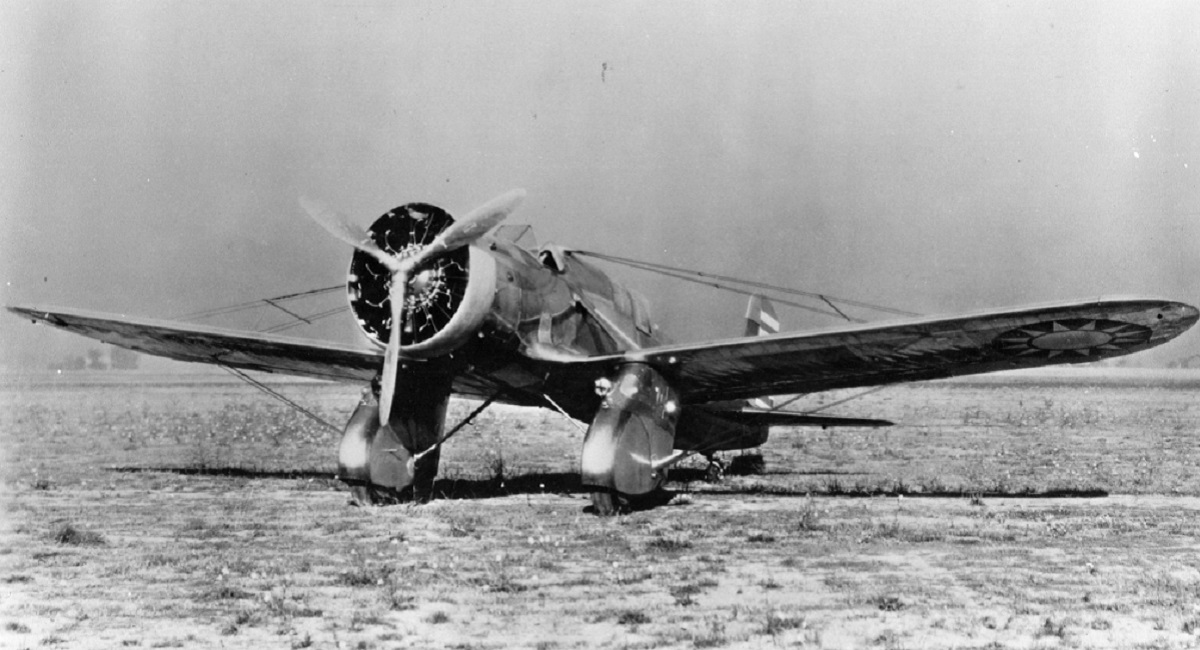
The production version of the Shrike, designated A-12 (Model 60), was developed from the YA-10, but it replaced the “Hornet” engine with a more powerful 690 hp, 9-cylinder Wright R-1820-21 “Cyclone” engine. Another notable change was the elimination of the widely separated crew compartments. To improve coordination between the pilot and observer, the observer’s position was moved forward. The observer’s cockpit featured a sliding canopy that did not fully enclose it, while the pilot’s cockpit had only a front windscreen.

The fuselage consisted of two sections. The forward section, ending just before the observer’s position, featured a welded tubular structure with two wing struts, each supported by two sturdy braces on either side. The rear section was a monocoque with smooth duralumin skin, frames, and T-shaped stringers. The two sections were joined using tubular spar braces that fit into U-shaped channels in the rear section and were secured with five 8-mm bolts at each of the four connection points. The engine mount was attached to the forward section with four conical bolts.
The wing consisted of a cantilever center section and two outer panels, additionally reinforced with double front and rear struts connecting to a truss above the fuselage behind the pilot’s cockpit, as well as double front and rear braces extending to the landing gear. Slotted leading-edge slats rotated on ball bearings and deployed automatically at high angles of attack, equipped with dampers for smooth extension and retraction. The trailing-edge flaps were hinged to the wing with horn brackets and deployed manually by the pilot, with a maximum deflection angle of 35°. The wing spars were made from rolled duralumin sheets, and the wing skin was smooth duralumin. The ailerons had a metal framework covered with fabric and were fitted with trim tabs on the trailing edge, adjustable on the ground.
Read also:
- American Attack Aircraft, Part 3: The First Production Variants
- First American Attack Aircraft, Part 4: On the Eve of the 1930s
The cantilever tail assembly had a conventional design, with a metal framework and skin, except for the control surfaces, which were fabric-covered. The stabilizer’s incidence could be adjusted in flight from +3° to -6°. The vertical fin was fixed at 2.5° left, and the rudder trim was adjustable from the cockpit.
A dedicated control lever to the pilot’s left managed the flaps and stabilizer angle. Its three selector positions allowed different modes: pushed “toward the pilot,” it controlled the flaps; “away from the pilot,” it adjusted the stabilizer; and in the central position, it controlled both the stabilizer and flaps simultaneously.
The landing gear was fixed. The main gear struts, fitted with 787 mm wheels, were fully enclosed in fairings resembling “pants” and equipped with hydraulic shock absorbers. The tailwheel was also covered with a teardrop-shaped fairing.
The A-12’s armament consisted of five 7.62 mm Browning machine guns. Four were mounted in pairs within the landing gear fairings, with the lower guns offset outward relative to the upper ones. Each gun carried 600 rounds. These four guns were operated by the pilot using the C-4 gunsight. The fifth gun was installed on a movable mount in the observer’s cockpit, supplied with six 100-round magazines.
The A-12’s bomb load could be carried internally or on external mounts. Internally, two N-2 racks located alongside the main fuel tank – positioned just behind the pilot’s seat – could hold up to ten 30-pound (13.6 kg) fragmentation bombs. For larger bombs, a P-1 under-fuselage rack could be installed, accommodating either four 122-pound (55.3 kg) bombs or an equivalent number of smaller munitions: 100-pound (45.4 kg) fragmentation bombs or 50-pound (22.7 kg) chemical bombs. The maximum bomb load was 221 kg. The under-fuselage rack could also carry a 197-liter drop fuel tank instead of bombs.
Production and service
In 1933, the Aviation Corps ordered 46 production A-12 aircraft (serial numbers 33-212 to 33-257). Given the relatively large batch, the unit cost was significantly lower than for the YA-8, at just \$19,483. Deliveries began the same year: on November 21, the first A-12 arrived at the test center at Wright Field, where it remained throughout its service until being retired on October 8, 1936, after logging 312 flight hours.
Two more A-12s were allocated for testing purposes: by the end of November 1933, they were delivered to the Edgewood Arsenal and the Aberdeen Proving Ground, respectively. On December 14, the first A-12s were assigned to the 3rd Attack Group. By February 20, 1934, the unit had received 43 aircraft, though two were lost during familiarization with the new type: serial 33-240 crashed on January 20 during landing, and serial 33-243 made a forced landing in swampy terrain on January 28, sustaining damage beyond repair.
Read also:
- Weapon of Ukrainian Victory: Saab ASC 890 Early Warning and Control Aircraft (Saab 340 AEW&C)
- Weapons of Ukraine’s Victory: AASM/HAMMER Precision-Guided Bombs
The introduction of the A-12 coincided with the so-called “Air Mail Scandal.” In February 1934, the U.S. government, seeking better terms, canceled all contracts for mail transport with private companies. By that time, air mail had become critical to the country’s communication system, and as a temporary measure, the military was called in to carry the mail. The Aviation Corps deployed hundreds of aircraft, also taking the opportunity to train their crews. This included nearly all of the A-12s: 41 aircraft from the 3rd Attack Group, along with one plane each from Aberdeen and Edgewood.
Most of these aircraft operated in the Central Air Mail Zone, with the exception of six planes sent to the Western Zone; the A-12 did not fly in the Eastern Zone. Intensive use led to losses: on February 16, during a mail flight in challenging weather in Utah, serial 33-244 crashed, killing both crew members. On March 30, near Clinton, Iowa, serial 33-246 was lost, resulting in the pilot’s death. Another aircraft, 33-257, was damaged on April 2 but was later repaired and returned to service in November.
The government’s pressure on private airlines proved effective, and they made concessions. In May 1934, the 3rd Group’s attack aircraft were able to return to their permanent base, where they were assigned to three squadrons: the 8th, 13th, and 90th. In February 1935, a number of A-12s participated in the U.S. Army’s winter maneuvers. During these exercises, F-1 skis were tested on the attack aircraft, allowing them to operate from snow-covered airfields. However, this practice did not become widespread, as the U.S. military preferred to clear their airfields and continued flying on wheels even in winter.
On March 1, 1935, the Aviation Corps introduced a new organizational structure. To coordinate with the three field armies, three air wings were established. The 3rd Attack Group, together with the 20th Pursuit Group, became part of the 3rd Air Wing, headquartered at Barksdale Field, Louisiana. The 1st Wing, based at March Field, California, included the 17th Attack Group, formed by reorganizing the 17th Observation Group, but it immediately received the new A-17 attack aircraft. The 2nd Wing, headquartered at Langley Field, Virginia, initially had only a single attack squadron, the 37th, as part of the 8th Pursuit Group, and the A-12 was not used there. The only unit outside the 3rd Group to operate the Shrike was the 26th Attack Squadron in Hawaii, part of the 18th Composite Group. In 1936, it received 15 A-12 aircraft that had been retired from the 3rd Attack Group.
By mid-1936, the A-12 aircraft had been completely withdrawn from the 3rd Group. Apart from the planes sent to Hawaii, nine Shrikes were assigned to the Aviation Corps Tactical School at Maxwell Field, Alabama, ten served as advanced training aircraft at Kelly Field, and one was sent to the Edgewood Arsenal to replace a retired aircraft. In 1937, four A-12s from Maxwell Field and one from Aberdeen were transferred to Kelly Field, and the following year the Tactical School retired its remaining five Shrikes, sending them to reinforce the Hawaiian squadron, along with the aircraft from Edgewood.
As of December 7, 1941, nine A-12s were still based at Hickam Field in Hawaii, though they no longer took part in combat. Interestingly, the airbase was named after Colonel Hickam, commander of the 3rd Air Group, who was killed on November 5, 1934, in an A-12 crash (serial 33-250). On the U.S. mainland, the Shrikes continued to be used as training aircraft until the end of 1942.
Export
In an effort to attract foreign buyers, Curtiss offered an export version of the Shrike. In 1936, 20 of these aircraft (factory numbers 12155–12174, unit price $24,328.45) were sold to China. They carried the same armament as the A-12 but were equipped with more powerful Wright SR-1820-F52 engines (takeoff power 890 hp, maximum continuous 775 hp) and were fitted with an aerial camera.
The aircraft were assigned to the 9th Air Group, formed in Hangzhou on August 16, 1936, which included the 26th and 27th Squadrons. By the start of the war with Japan on August 13, 1937, the 9th Air Group had 18 Shrikes. On that day, the group was relocated from Xuchang (Henan Province) to Cao’e (Zhejiang Province) near Shanghai. On August 15, as the Chinese Shrikes prepared for their first combat sortie against Japanese forces, enemy aircraft suddenly appeared over the airfield. Pilots of the 26th Squadron engaged in battle, and in the ensuing dogfight, five Shrikes were severely damaged. Pilot Liu Weiquan, the squadron deputy commander Tang Yuanliang, and three other crew members were wounded. The mission ended in failure. Chinese command reported that the 26th Squadron’s pilots had shot down four Japanese aircraft, though they did not disclose their own losses.
In the following days, the group continued combat operations. On August 25, it received orders to strike enemy ships at the mouth of the Yangtze River. Since bombs had not yet been delivered, the attack was carried out using only machine guns. The mission ended tragically for the Chinese: two Shrikes were shot down, killing all four crew members, and the remaining aircraft involved in the operation suffered serious damage. As a result, the 9th Group was disbanded “due to faulty tactical employment.” The surviving Shrikes were consolidated into the 27th Squadron. In September 1937, this squadron was assigned to the so-called “Auxiliary Detachment” and sent north to participate in combat in Shanxi Province. The fate of the last Chinese Shrikes remains unknown.
Meanwhile, in the U.S., work on developing attack aircraft with higher performance continued alongside the production and operation of the A-12. These experiments will be discussed next time.
Read also: