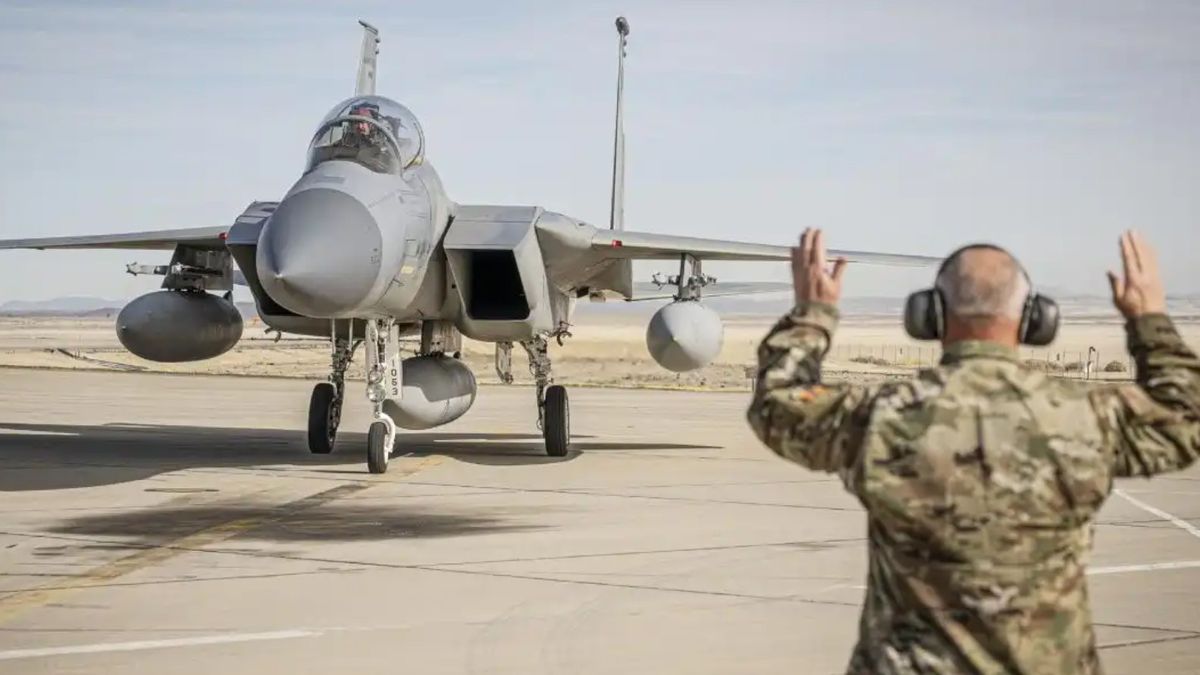
Two retired U.S. Air Force F-15 fighter aircraft have officially joined the research fleet at NASA’s Armstrong Flight Research Center in Edwards, California. The transferred aircraft are two F-15D models previously operated by the 173rd Fighter Wing of the Oregon Air National Guard, based at Kingsley Field. They will now support NASA’s aerospace research activities.
Both F-15s will be integrated into the Flight Demonstrations and Capabilities program, with a particular role in supporting supersonic testing under the Quesst mission, which centers on the X-59 Quiet Supersonic experimental aircraft. One of the fighters will be restored to full flight-ready condition and used as an active research platform, while the second will serve as a source of spare parts to support long-term fleet maintenance.

“These two aircraft will support effective data collection and provide chase aircraft capabilities for the X-59 throughout the duration of the Low Boom Flight Demonstrator project,” said Troy Asher, Director of Flight Operations at the center. “They will also enable us to renew cooperation with a range of external partners, including the Department of Defense and commercial aviation companies.”
NASA has a long history of operating this type of aircraft. “NASA has used F-15 aircraft since the introduction of the first models in the early 1970s,” Asher noted. “Over the decades, dozens of research experiments have been conducted using NASA’s F-15s, making a substantial contribution to the advancement of aeronautics and high-speed flight research.”
The F-15 platform is well suited for operations at high speeds and altitudes. The aircraft can carry experimental equipment under the wings or on the centerline hardpoint, and its design allows for extensive modification to meet specific research requirements. Following integration into NASA’s fleet, the Armstrong Center team will adapt the software, onboard systems, and flight controls to support research missions.
A further advantage of the F-15 is its substantial ground clearance, which enables the installation of instruments and experimental modules that would not physically fit beneath many other aircraft. NASA currently operates two modified F-15s certified for safe flight at altitudes of up to 18,200 meters – the upper limit of the X-59’s operational envelope, with the experimental aircraft expected to cruise at approximately 16,700 meters. The newly activated F-15 will receive similar modifications.
The transfer of F-15 aircraft to NASA is taking place against the backdrop of a broader modernization effort within the U.S. Air Force. The USAF is gradually retiring its aging fleet of F-15C/D Eagle fighters, many of which have been in service for more than 40 years. These aircraft are being replaced by the F-15EX Eagle II. While the F-15EX retains the general airframe architecture of the original Eagle, it incorporates substantial upgrades, including a modern electronic warfare suite, a fully digital cockpit, updated software architectures, and the capability to carry hypersonic weapons. Boeing has invested heavily in this platform, positioning the F-15EX as one of the most capable multirole fighters currently in production.
The U.S. Air Force’s reliance on the F-15EX is largely driven by practical constraints. Instead of the originally planned 381 F-22 Raptor aircraft, only 186 were ultimately procured, an insufficient number to fully replace the F-15C/D fleet. As a result, more than 200 legacy F-15s remained in service well beyond their intended operational lifespan, until airframe wear and maintenance costs made further operation economically impractical.
Read also:
- Historic Launch Approaches: NASA’s Artemis II Mission Rocket Arrives at Launch Pad
- NASA Continues Efforts to Restore Communication with the MAVEN Spacecraft
Source: theaviationgeekclub