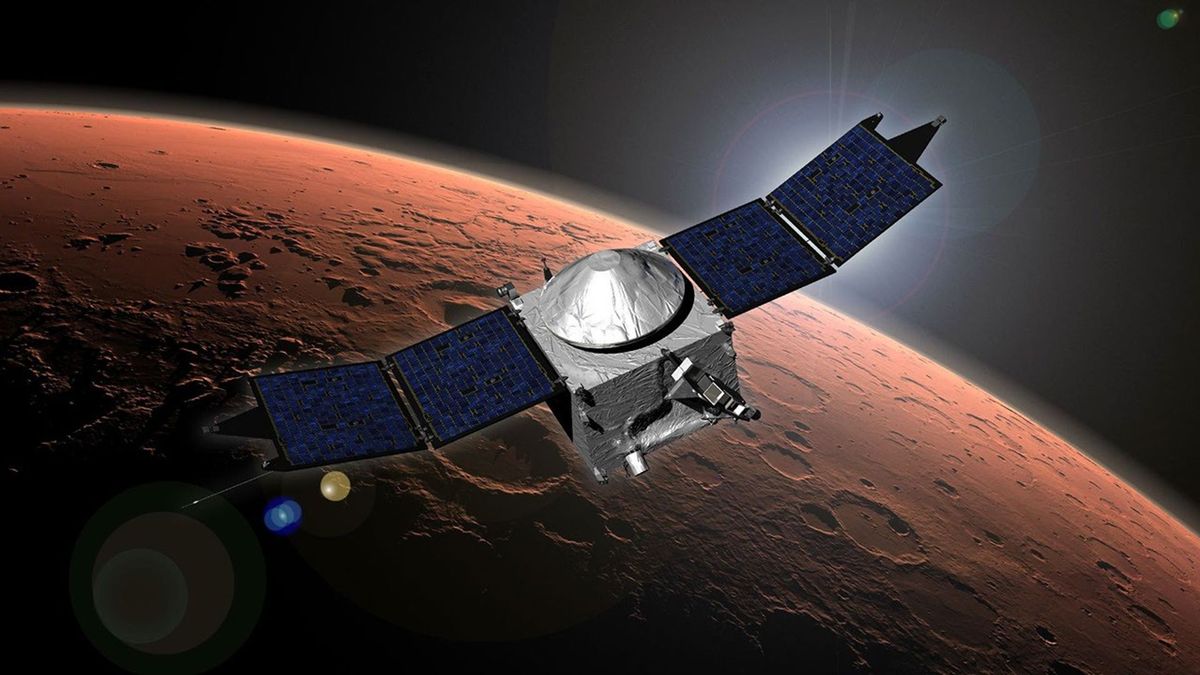
NASA is continuing efforts to restore communication with the MAVEN spacecraft, which is currently in orbit around Mars. Contact with the probe was lost approximately a week and a half ago, and attempts to reestablish communication have so far been unsuccessful. The mission team is working closely with the Deep Space Network, analyzing all available telemetry and signal data to identify the likely cause of the incident and to determine possible options for regaining control of the spacecraft.

Although no telemetry has been received from MAVEN since December 4, the team was able to obtain a brief segment of tracking data recorded on December 6 as part of a scientific radio experiment. Analysis of this signal suggests that the spacecraft was rotating in an atypical manner at the moment it emerged from behind Mars. In addition, the detected signal frequency may indicate a change in MAVEN’s orbital trajectory. Engineers are now examining these data in detail, attempting to reconstruct the most plausible scenarios that could have led to the loss of communication. In parallel, the team continues its efforts to reestablish contact with the spacecraft.
Telemetry received prior to the incident indicated that all subsystems were operating normally before MAVEN passed behind the Red Planet. However, when the spacecraft reemerged from Mars’ occultation, the Deep Space Network did not detect a signal.
At the same time, the agency is taking steps to limit the impact of the MAVEN situation on the operations of the Perseverance and Curiosity rovers. In total, four spacecraft orbiting Mars, including MAVEN, are used to relay communications between the planet’s surface and Earth. At present, NASA’s Mars Reconnaissance Orbiter and Mars Odyssey, along with the European ExoMars Trace Gas Orbiter, remain fully operational. To support surface operations over the next two weeks, NASA is scheduling additional communication sessions using these spacecraft, and the Perseverance and Curiosity teams have adjusted their daily activity plans to allow scientific work to continue without interruption.
MAVEN was launched in November 2013 and entered orbit around Mars in September of the following year. The primary objective of the mission is to study the planet’s upper atmosphere, ionosphere, and its interaction with the Sun and the solar wind. These investigations are intended to improve understanding of how and why Mars gradually lost much of its atmosphere, as well as to help reconstruct the planet’s climatic history, the presence of liquid water, and its past potential habitability.
In addition to its scientific objectives, the spacecraft also serves as a communications relay for surface rovers. Last year, the mission marked the tenth anniversary of MAVEN’s arrival in Mars orbit, which makes the current situation particularly significant for the scientific community and the engineering teams involved. Efforts are continuing to preserve the spacecraft as an operational element of Mars’ orbital communications infrastructure.
Read also:
- All About Project Suncatcher: Google’s Space Experiment
- Secret SpaceX Satellites Caught Transmitting Signals in a Restricted Frequency Band
Source: nasa