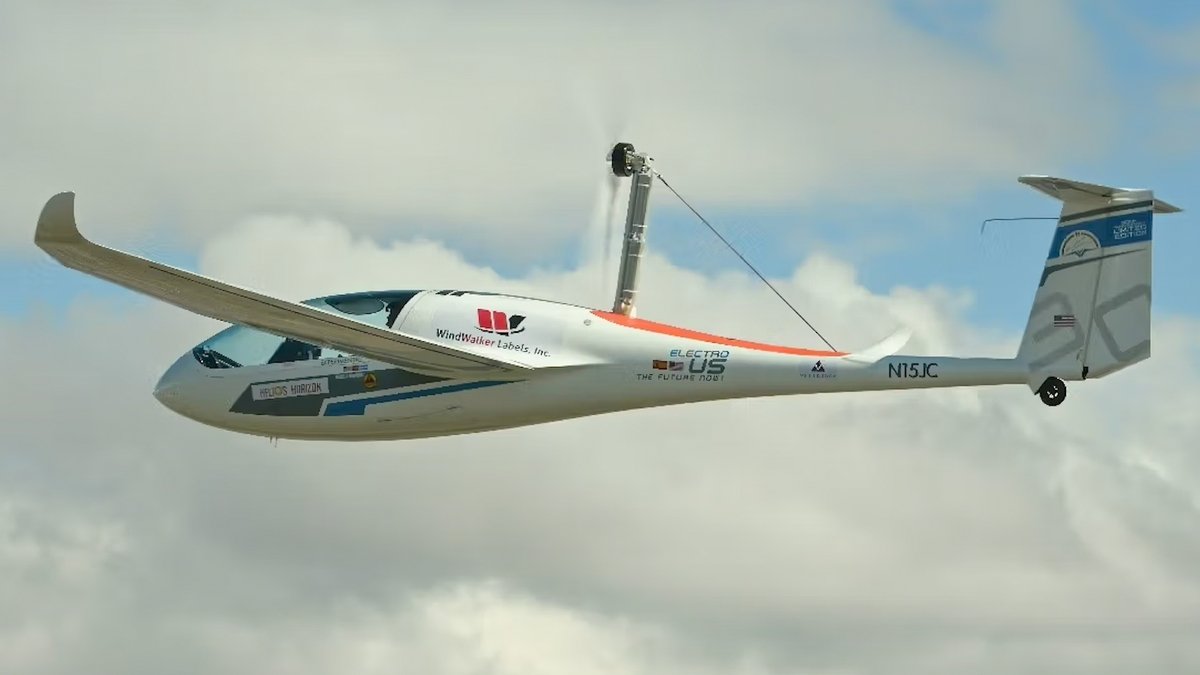
The non-profit organization Helios Horizon, based in Florida, USA, announced the successful completion of what it describes as the first piloted flight of an electric aircraft powered by solid-state battery cells.
On June 5, project lead and test pilot Miguel Iturmendi conducted a series of short test hops at the Zephyrhills Municipal Airport in central Florida. The tests were performed using a modified Pipistrel Taurus, which had been reconfigured for the project and renamed Helios Horizon. The flights were described as brief and experimental in nature, focusing on initial validation of the aircraft’s electric propulsion setup rather than sustained flight performance.

Previously, the aircraft operated on lithium-ion batteries with a specific energy density of approximately 260 Wh/kg. The internal power system was later reconfigured to use solid-state energy storage units with a reported energy density of around 410 Wh/kg. According to representatives of the organization, these new power modules are more compact than conventional lithium-ion battery packs used in modern electric vehicles, while offering an energy density increase of approximately 60–80%.
Helios Horizon conducted what it describes as the first flight using solid-state energy storage systems. In solid-state batteries, the flammable liquid electrolyte typical of standard lithium-ion cells is replaced with a solid material. This design is intended to improve thermal stability and resistance to mechanical stress, including puncture events. The organization also states that the aircraft can replenish energy in flight using integrated solar panels, as well as by operating the propeller in a wind-turbine mode during unpowered flight phases.
According to data provided by representatives of Helios Horizon, the solid-state battery system is capable of recharging from near-zero to 80% capacity in under 15 minutes. The organization also expects further progress over the next two years, targeting an additional increase in energy density of approximately 40%.
Project lead Miguel Iturmendi stated that, for the first time, aviation now has access to a battery technology that combines sufficient range and recharge speed to potentially support commercial passenger electric aviation, while maintaining a level of safety expected for such applications.
He also noted that the use of energy recovery techniques, such as gliding and windmilling the propeller during descent, can significantly extend the aircraft’s operational range. The June 5 test flights were primarily intended to evaluate weight distribution and aircraft balance following the installation of the updated power system, according to reporting from Robb Report. The new propulsion setup reportedly demonstrated higher efficiency under continuous operation than initially projected, although the developers did not disclose maximum speed or range figures.
Previously, the glider operated by Helios Horizon reportedly reached a maximum altitude of 7,315 m in its class. The team is now developing plans to reach the stratosphere later this year, aiming to exceed 12,192 m – a height above the typical cruising altitude of commercial passenger aircraft. Miguel Iturmendi has expressed confidence that the capabilities of solid-state battery systems will make it possible to complete these missions on a single charge.
At the current stage, the aircraft developed by Helios Horizon functions as a technology demonstrator intended to provide empirical validation of potential improvements in endurance and range for electrically powered aircraft. Although the prototype was not designed for immediate transition into serial commercial production, the project illustrates ongoing progress in the development of practical electric aircraft capable of addressing some of the fundamental limitations of current energy storage and safety systems. This development takes place within broader industry efforts focused on viable electric and hybrid propulsion systems for aviation. Solid-state battery technology has long been considered a potential breakthrough due to its expected improvements in performance and safety compared to conventional electrochemical systems. The flight tests conducted by Helios Horizon represent an applied step toward evaluating these technologies in piloted aircraft environments.
Read also:
- End of an Era: The Retirement of the American AV-8B Harrier II
- Airbus Tests Aircraft Capable of Nearly 24 Hours of Continuous Flight, Marking a Potential Shift in Civil Aviation
Source: interestingengineering