Poland has officially taken another step toward enhancing the combat capabilities of its FA-50 aircraft fleet by confirming the integration of the AIM-9X Sidewinder missile on the FA-50PL variant. A corresponding agreement with the United States has been concluded to secure U.S. support for the weapons integration process. This decision is expected to strengthen Poland’s air policing capabilities, particularly on NATO’s eastern flank. At the same time, it has been confirmed that deliveries of the new aircraft variant have been delayed by nearly two years and are now scheduled for the 2027–2029 period.
Poland recently signed a formal document with the U.S. government that enables the full integration of the AIM-9X Sidewinder on the FA-50PL. Although this missile had been considered a core element of the aircraft’s future armament from the outset, the signing of this agreement provides official confirmation and allows the integration process to proceed in a structured manner.

The AIM-9X is already the standard short-range air-to-air missile for Poland’s F-16 and F-35 fleets, with the country having procured the latest Block II variant. In contrast, the initial FA-50 aircraft delivered to Poland in the FA-50GF configuration were not equipped to carry this missile and instead relied on older Sidewinder variants as an interim solution.
The AIM-9X Block II is regarded as one of the most advanced short-range air-to-air missiles in U.S. service. It features an imaging infrared seeker, a data link, thrust vector control, and the ability to acquire targets at high off-boresight angles. The missile is compatible with helmet-mounted display systems, enabling engagement across a wide range of flight conditions. Its Lock-On After Launch capability allows it to engage targets even behind the launch aircraft, and in the Block II and Block II+ versions, it also offers a limited capability for use against ground targets.
The integration of the AIM-9X will enable the FA-50PL to effectively carry out air policing missions, the importance of which has grown significantly for Poland in recent years. The AIM-9X will become the single standardized short-range air-to-air missile across all Polish fighter aircraft, substantially simplifying logistics, maintenance, and pilot training.
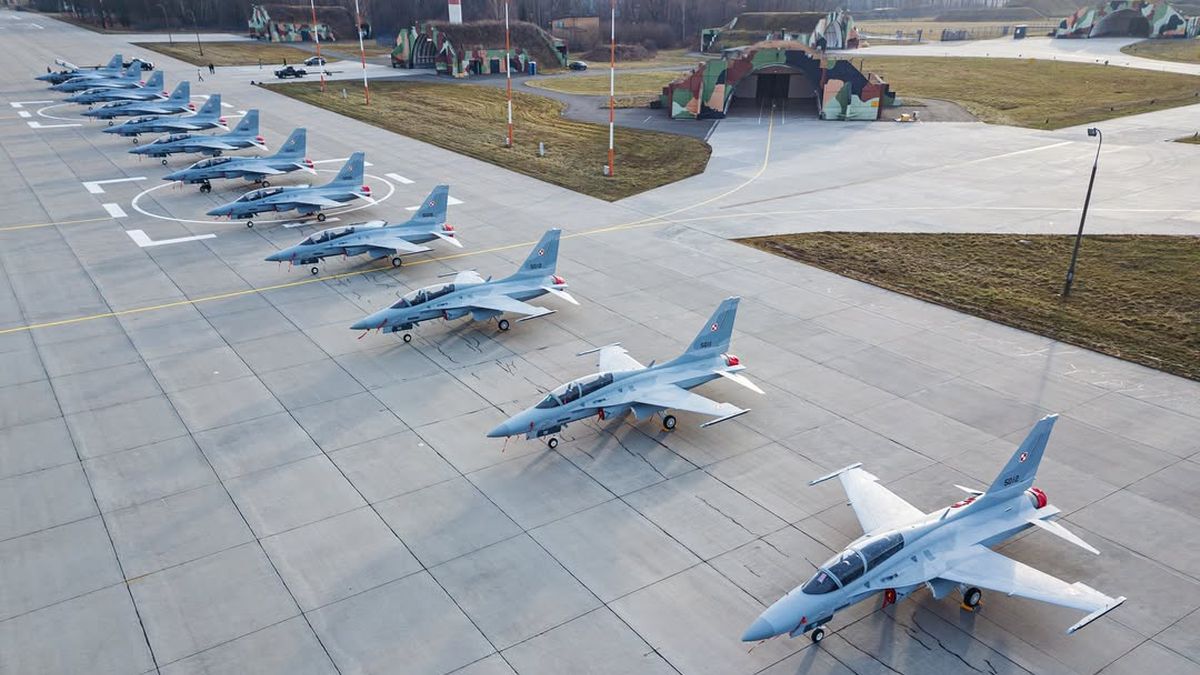
At present, the Polish Air Force operates 12 FA-50GF aircraft delivered in 2023 as an interim solution to rapidly replace aging MiG-29 fighters. These aircraft have limited combat capabilities, as they were never intended to represent the final configuration of the platform. To ensure a minimum level of operational readiness, Poland initially leased legacy AIM-9P missiles and later procured AIM-9L/I-1 variants, along with 20 mm ammunition for the internal M197 cannon. From the outset, all of these measures were considered temporary, pending the arrival of the fully capable FA-50PL variant.
The FA-50PL is being designed as a significantly more capable platform, tailored to Poland’s specific operational requirements. The aircraft will be equipped with the Raytheon PhantomStrike AESA radar, an in-flight refueling capability, the AN/AAQ-33 Sniper targeting pod, a helmet-mounted display system, increased fuel capacity through external tanks, and support for precision-guided munitions such as GBU-12 laser-guided bombs. For air-to-air combat, the FA-50PL will be integrated with the AIM-9X Sidewinder and AIM-120C AMRAAM missiles.
An earlier concept involved upgrading the interim FA-50GF aircraft to an intermediate FA-50GL standard. However, the Polish military leadership ultimately determined that this approach would be economically inefficient and operationally unjustified. As a result, the Polish Air Force will operate two distinct FA-50 variants in the near term, with the FA-50PL serving as the fully capable, long-term configuration.
An additional agreement to the base contract between the Armament Agency and Korea Aerospace Industries has recently been signed, formally revising the delivery schedule for the FA-50PL. Whereas deliveries were previously planned for the 2025–2028 period, the first aircraft is now expected in mid-2027, with completion of all 36 units shifted to early 2029. The delay is attributed to a combination of supply chain disruptions, the complexity of integrating advanced avionics and U.S.-supplied weapons, and broader geopolitical factors.
Notably, the FA-50PL prototype has yet to conduct its first flight, which had earlier been scheduled for November 2025. Significant flight testing, certification, and weapons integration activities remain ahead, although some subsystems – such as the aerial refuelling capability – are already undergoing trials on an older flying testbed.
The acquisition of the FA-50 has been one of Poland’s major defence contracts following the start of Russia’s full-scale invasion of Ukraine. In total, Poland ordered 48 aircraft, comprising 12 FA-50GF units and 36 FA-50PL variants. The Polish Air Force is in the process of transitioning from a fleet based on Soviet-designed aircraft and F-16C/Ds toward a more modern force structure centred on the F-35A, upgraded F-16C/Ds, and the FA-50.
Read also:
- NASA to Receive Two F-15 Fighter Aircraft for Supersonic Flight Research
- World’s First Hydrogen-Powered Drone Begins Combat Missions in Ukraine
Source: theaviationist