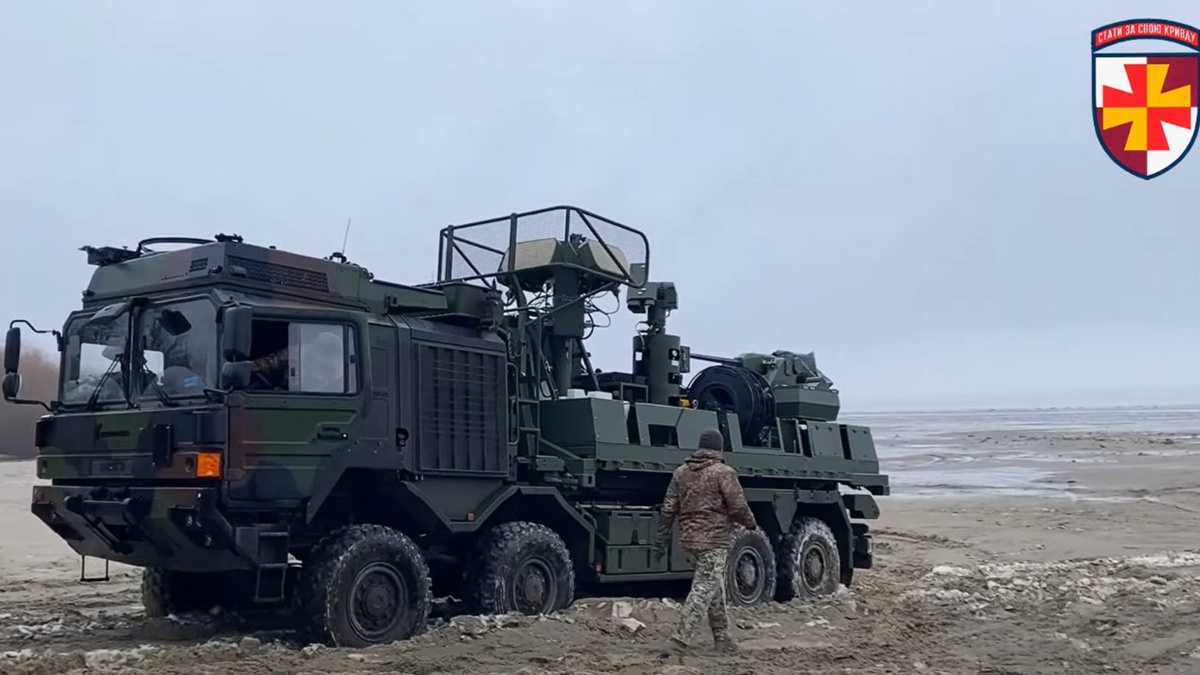
The 156th Anti-Aircraft Missile Regiment of the Ukrainian Air Force has been equipped with British Terrahawk Paladin anti-aircraft artillery systems. These systems are part of a recently announced package of military-technical assistance from the United Kingdom. London is focusing on enhancing Ukraine’s capabilities specifically against drone threats, which is logical given the high intensity of strike drone use in modern warfare.
The deployment of the Terrahawk Paladin aims to fill one of the most critical gaps in Ukraine’s air defense – countering massed attacks by low-altitude, slow-moving, and hard-to-detect targets. The system offers rapid response capabilities and can be integrated into existing defense networks, providing an additional layer of protection for critical infrastructure.
However, alongside its clear advantages, analysts note several limitations. The system’s specific architecture and exposed design indicate that the Terrahawk Paladin functions more as a precision force multiplier than as a universal solution for large-scale air defense. Its effectiveness will largely depend on deployment conditions, the protection of its positions, and how successfully it is integrated into the broader air defense network.
Thus, the introduction of the Terrahawk Paladin in Ukraine is significant but not decisive. It represents a step toward building a layered UAV defense system rather than a revolutionary boost to the country’s air shield.
Let’s examine the details more closely.
Read also: Weapons of Ukraine’s Victory: Sting UAV Interceptor
TABLE OF CONTENT:
History of the Terrahawk Paladin
When cheap loitering munitions and kamikaze drones began to appear on the battlefield, traditional air‑defense systems proved too slow, too expensive, and too unwieldy to counter swarms of small aerial targets effectively. The British defense industry recognized this problem early. That was when MSI-Defense Systems Ltd. (MSI-DS) realized it had a unique advantage: decades of experience building naval close‑in automated weapon stations. And that expertise could serve as the foundation for an entirely new class of ground-based weaponry.
It all started not with a concept, but with a clear understanding of the threat. For many years, MSI-DS had produced naval combat modules under the Seahawk family, installed on Royal Navy vessels and the ships of allied fleets. These systems were designed for environments where decisions must be made in seconds and where automation is absolutely critical. That body of experience gave rise to a simple idea: if a naval turret can successfully repel fast, sudden attacks at sea, why not bring the same approach to land – where a different adversary now dominates the sky: drones?
In 2020–2021, British engineers began experimenting with adapting their naval technologies for ground‑based missions. This was not a “cosmetic” port. They essentially had to design a new platform from scratch – one that preserved the speed and precision of shipborne systems while being rugged enough to operate in complex, unpredictable terrain on land.

The first prototypes were given the name Terrahawk. The idea behind them was straightforward: to create a highly mobile, rapidly deployable weapon capable of protecting critical sites from close‑range aerial threats. This marked the transition from the naval Seahawk to the land‑based “hawk of the earth” – the Terrahawk.
In parallel, engineers focused on two key directions:
- Simplifying logistics, so the system could be delivered and set up almost anywhere, even in the middle of a field.
- Strengthening the sensor suite, ensuring it could reliably detect and track small UAVs.
During this period, MSI‑DS was deliberately betting on the future counter‑drone market – even before it fully materialized.
After 2022, drone threats were no longer “potential” – they became systemic. Loitering munitions and attack UAVs fundamentally changed the nature of modern warfare. At that point, MSI‑DS accelerated development of the next generation of its system, which would eventually be named Terrahawk Paladin.
The name “Paladin” is deliberate, referencing a knight standing guard over a fortress. The system was designed to perform a similar protective role, covering power plants, storage facilities, airfields, command posts – essentially, sites that are primary targets for drone attacks.
The developers aimed to make the system as autonomous, modular, and remotely operable as possible, allowing operators to work from a safe distance. Engineers integrated radar, optical sensors, and a weaponized turret into a single closed-loop system, enabling it to detect, track, and engage targets with minimal human intervention.
In 2023, MSI-DS publicly demonstrated the Terrahawk Paladin for the first time at the international DSEI 2023 exhibition. The system drew immediate attention within the industry, as it appeared to address a previously unmet need: a simpler, lower-cost, and rapid-response solution to drone threats. The conflict in Ukraine, however, became the primary catalyst for its operational deployment. The United Kingdom opted to include the Paladin in a military aid package, effectively authorizing its use in active service.
The development of the Terrahawk Paladin reflects a clear evolution: from a naval turret to a ground-based air defense system, from an experimental module to a tool intended for active combat.
MSI-DS did not aim to create a general-purpose air defense platform. Instead, the company developed a specialized response to a specific threat, one that is increasingly relevant for modern militaries. As a result, the Terrahawk Paladin is now regarded not as a supplementary system, but as a key component within a layered approach to countering drone threats.
Read also: Tomahawk Cruise Missiles – What You Need to Know
Design Features of the Terrahawk Paladin
The Terrahawk Paladin is a ground-based short‑range anti‑aircraft artillery system designed specifically to counter modern small aerial threats. It is transported as a single integrated module and intended for long-term operation from a prepared static position. At the same time, both its external appearance and overall architecture set it apart from other contemporary anti‑aircraft artillery systems with comparable weapon configurations. MSI‑DS has clearly prioritized ease of deployment, modularity, and a highly compact layout.
The core of the system is a standard-size platform pallet, compatible with conventional truck transport. Deployment on a position requires a crane or truck-mounted boom, as the Paladin does not have self-installation capabilities. This design choice reflects a deliberate trade-off to reduce both weight and cost. Once positioned and connected to the necessary cabling, the system is immediately operational.
At one end of the platform sits a low base for the combat module, supporting the gun mount, actuators, and auxiliary components. The center of the platform houses the cable reel and technical support modules. The opposite end features two sensor masts, carrying the electro-optical station and radar unit. The radar antenna is protected during transport by a metal lattice cover when folded.
One of the key components of the system is the compact SKYctrl radar developed by the Polish company Advanced Protection Systems. The station uses four miniature FIELDctrl Advance AESA antennas mounted on an elevating mast to provide full 360‑degree coverage. Its performance corresponds to a typical short‑range radar: it can detect large aerial targets at distances of up to 30 km, low‑flying helicopters at roughly 10 km, and small drones at distances of 2–3 km, depending on conditions.
Next to it is the SATOS electro‑optical station developed by MSI‑DS. It provides short‑range target detection, identification, and tracking, and enables fire control in all lighting conditions. SATOS includes day and night channels, a thermal imager, and a laser rangefinder – forming a complete sensor suite for accurately engaging small aerial targets.
The Terrahawk Paladin is equipped with the remotely operated Terrahawk LW combat module, a heavily modified ground adaptation of the Seahawk LW A2 naval turret. The module features a fully rotating mount with a universal cradle that can accommodate different types of guns. In its standard configuration, it is fitted with the 30 mm Mk 44 Bushmaster II automatic cannon produced by Northrop Grumman. The weapon uses a dual‑feed system, allowing rapid switching between ammunition types, including airburst munitions. For this purpose, the cannon is equipped with a contactless programmable fuze setter.
The cannon has a selectable rate of fire of 100 or 200 rounds per minute. With a muzzle velocity exceeding 1,000 m/s, it can effectively engage targets at ranges of 2.5–3 km, which corresponds to the operational envelope of most strike drones that the system is designed to counter.
All components of the system are integrated into a single digital fire‑control architecture. It provides radar and electro‑optical surveillance, automatic or semi‑automatic target tracking, and control of the weapon system. The Paladin is operated from two remote consoles that can be positioned away from the installation, improving operator safety and enabling integration into a broader site‑protection network.
The Terrahawk Paladin represents an attempt to create a simple, modular, and rapidly deployable anti‑aircraft gun system tailored specifically to counter drones rather than to serve as a general‑purpose air‑defense asset. This focused design makes it a relevant solution for current operational environments, where the lower tier of air defense has become increasingly important.
Terrahawk Paladin: a Compact Next‑Generation Gun System
The Terrahawk Paladin, a forthcoming anti‑aircraft artillery system from the UK‑based MSI‑DS, stands out not only because of its intended role. Its unusual, almost avant‑garde architecture is immediately noticeable. The engineers opted to place the entire set of sensors, control systems, and weapons on a standard pallet. This approach is unconventional for modern gun‑based air‑defense systems; no other manufacturer has previously offered a fully autonomous module in such a compact format. The underlying idea appears straightforward: achieve maximum mobility without the cost and complexity of a dedicated self‑propelled chassis, and enable deployment virtually anywhere that a conventional truck can reach.
In all other respects, the Terrahawk Paladin is a conventional representative of its class. There is no exotic engineering here: it uses standard radar components, a typical suite of electro‑optical sensors, and a proven 30 mm weapon module compatible with common NATO ammunition. The emphasis is on established, reliable technologies rather than experimental solutions. This approach gives the system predictable performance, a clear and manageable maintenance cycle, and avoids the early‑stage issues that often appear in overly innovative designs.
Still, the Terrahawk Paladin should not be underestimated. With its combination of a modern radar, an electro‑optical suite, and a digital fire‑control system, it can detect, track, and engage various types of aerial targets within the short‑range envelope. The radar provides early threat detection, the optical sensors deliver precise visual confirmation, and the 30 mm cannon with programmable ammunition allows effective engagement even against low‑visibility UAVs. Remote operation adds another important advantage: improved crew survivability and the ability to deploy the system in isolated locations without exposing personnel to unnecessary risk.
However, the system also has clear limitations. The most significant drawback is the complete lack of inherent mobility. The Terrahawk Paladin cannot reposition on its own, and both deployment and teardown require time – something that is often the most valuable resource on the battlefield. Once detected, the system becomes a vulnerable target: it has no armor, no ability to maneuver, and no chance to relocate during incoming fire.
For this reason, the system cannot operate independently. Its capabilities are fully realized only as part of a layered air‑defense structure, where it acts as the final line of defense – intercepting drones and other low‑altitude targets that have passed through earlier defensive tiers. At the same time, it must be positioned as close as possible to the assets it protects, due to its limited engagement range and the inherent characteristics of gun‑based weaponry.
The Terrahawk Paladin represents a deliberate compromise between mobility, cost, and combat effectiveness. It is not an ideal solution, but it is a notable one within its specific niche. The system illustrates the broader trajectory of modern short‑range counter‑drone defense: greater versatility, reduced mechanical complexity, and maximum functionality delivered on a minimal platform.
Read also: Weapons of Ukraine’s Victory: The Heavy Cruise Missile “Flamingo”
Technical specifications and features of the Terrahawk Paladin
- Caliber: 30 mm (Mk44 Bushmaster II)
- Ammunition type: standard and programmable airburst
- Range: up to 2000 m
- Target speed: small drones, FPV, low- and medium-speed UAVs
- Sensors: 360° radar + optoelectronic station
- Radar type: AESA, circular view
- Target detection: automatic, with AI support
- Optical channels: day, night, thermal imaging
- Fire control system: digital, automated, with ballistic compensation
- Number of operators: 2
- Control: remote, remote control up to 100 m
- Power supply: autonomous generator
- Deployment: mobile platform or container module
- Additional armament (optional): laser-guided missiles (APKWS type)
- Purpose: destruction of kamikaze drones, FPV and reconnaissance UAVs at close range
Read also: Weapons of Ukraine’s victory: Zozulya Deep Strike Drone
Why the Terrahawk Paladin Has Become a Significant Asset for Ukrainian Air Defense
The introduction of the British Terrahawk Paladin in Ukraine is more than just another addition to military aid. It addresses one of the key challenges of modern warfare: the widespread use of strike and reconnaissance drones, which are increasingly shaping the course of combat operations.