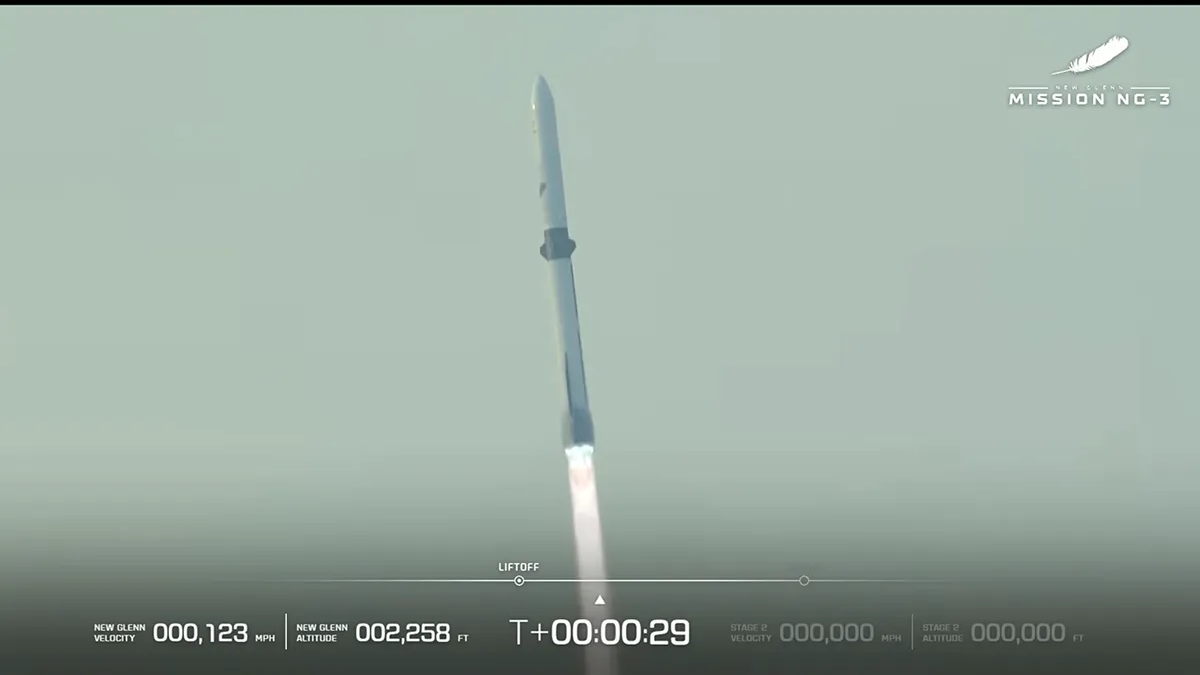
Jeff Bezos’s space company, Blue Origin, achieved a notable milestone in reusable rocket technology, but at the same time encountered a significant setback during its latest mission. On the morning of April 19, 2026, the third launch of the heavy-lift New Glenn rocket, designated NG-3, took place.

For the first time, the company conducted the launch using a previously flown first-stage booster, which had earlier been used on the NG-2 mission, although it was fitted with new engines for this flight. The primary payload was the large BlueBird-7 satellite, intended to provide direct mobile internet connectivity and planned for deployment into low Earth orbit. Despite a successful initial phase, the spacecraft did not reach its intended destination.
The launch took place at 07:25 local time from Launch Complex 36 at Cape Canaveral. The initially scheduled liftoff time of 06:45 was delayed due to a technical hold shortly before engine ignition. Approximately 3.5 minutes after liftoff, the first stage separated from the upper portion of the rocket and, about six minutes later, completed a successful landing on the floating platform Jacklyn in the Atlantic Ocean.
Blue Origin engineers reported that, prior to the flight, the thermal protection system at the base of the rocket had been upgraded and the navigation system refined to better withstand the stresses associated with atmospheric reentry. This landing marked only the second successful recovery of a New Glenn first stage, representing an important step toward the company’s stated objective of reusing each booster at least 25 times.
The primary failure of the mission concerned the BlueBird-7 satellite operated by AST SpaceMobile. This large spacecraft, featuring an antenna with an area exceeding 220 square meters, was intended to serve as a key element of the Block 2 constellation. Although separation from the second stage proceeded nominally and initial signal acquisition was successful, Blue Origin later reported that the payload had been inserted into an off-nominal orbit.
Subsequently, the satellite operator confirmed that the achieved altitude was too low to be corrected using onboard propulsion. As a result, the spacecraft is expected to undergo controlled deorbiting and burn up in the atmosphere. The associated financial losses are anticipated to be covered by insurance.
The New Glenn rocket, standing 98 meters tall, is positioned as a direct competitor to SpaceX’s Falcon Heavy and Starship. It is powered by BE-4 engines using methane and liquid oxygen – a propellant combination also employed in SpaceX’s Super Heavy booster. This launch was intended to demonstrate the vehicle’s reliability in the context of NASA’s Artemis program. Blue Origin plans to deliver its cargo lunar lander, Mark 1, to the Moon by the end of summer 2026. However, the incident involving incorrect orbital insertion may affect this timeline. At present, both private companies are competing for roles in future crewed lunar missions, undergoing a series of technical validations, including in-orbit refueling and docking operations scheduled for 2027.
Read also:
- Air launch systems and hypersonic missiles: Ukraine outlines new developments in space mission capabilities
- SpaceX Prepares Its Most Powerful Starship: New Version Passes Key Test
Source: space