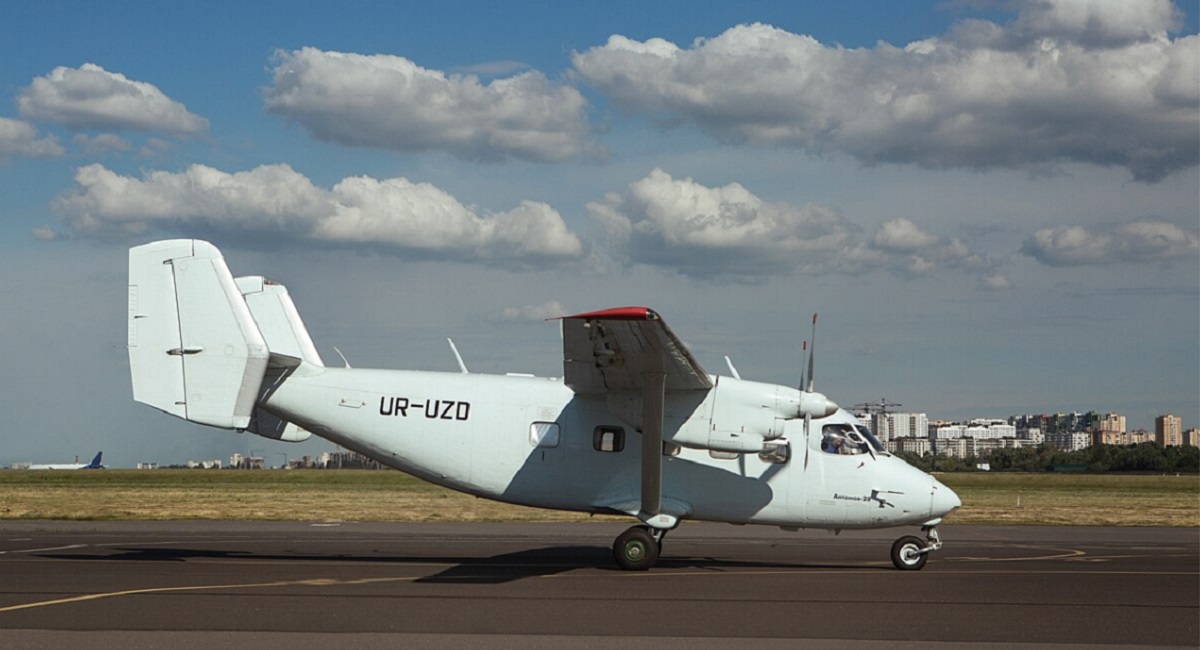
This morning a striking photo of an An-28’s nose surfaced online, its fuselage marked with some seventy victory tallies – “Shaheds,” “Gerberas,” and a single silhouette that resembles an Iranian Mohajer-6. Until now there had been no public information about using such aircraft as hunters for Shaheds, but Ukrainian specialists have repeatedly shown exceptional ingenuity in adapting and improving weapons. So it’s not surprising that they might have repurposed an An-28 for this new role.

TABLE OF CONTENT:
History of creation
So what kind of aircraft is the An-28? Although relatively unknown in Ukraine, in my view it’s one of the most interesting creations of the design team led by Oleg Antonov – yet also an aircraft with a rather complicated fate. Its story traces back to the mid-1960s, specifically to August 6, 1964, when a decree of the USSR’s Central Committee and the Council of Ministers authorized the development of a 15-seat twin-engine aircraft designated the An-14M – a further evolution of the well-known An-14 “Pchelka” (“Little Bee”), but larger in size and powered by GTD-550AS turboprop engines rated at 640 hp each instead of piston engines.
The experimental An-14M made its first flight on April 30, 1969, and underwent state trials in March–April 1971. However, it never entered serial production. Instead, in 1972, its design became the foundation for a completely new aircraft – the An-28.
The An-28 received more powerful TVD-10 engines (950 hp each), an elongated fuselage, and a redesigned tail unit. It was designed to carry 15–18 passengers or up to 1,750 kg of cargo. One of the main requirements for the new aircraft was maximum operational simplicity and the ability to fly from unprepared airfields – a goal that was fully achieved.
To simplify maintenance, the landing gear was made non-retractable (as on the An-14 and An-14M), which significantly reduced the complexity of the aircraft’s hydraulic system. The use of advanced wing mechanization allowed for very short takeoff and landing runs: only about 260 meters for takeoff at full load and 170 meters for landing.
The An-28 prototype made its maiden flight on May 5, 1975. It successfully passed all stages of testing, including comparative trials against its rival – the Be-30 aircraft developed by G. Beriev’s design bureau in Taganrog. Following the tests, the An-28 received certification confirming compliance with airworthiness standards and was recommended for serial production.
However, no suitable manufacturing facility was available in the USSR, as civilian aircraft were considered secondary to military programs. Only in 1978 was an intergovernmental agreement signed between the governments of the USSR and Poland to begin An-28 production at the WSK PZL Mielec aviation plant. This enterprise already had extensive experience cooperating with the Antonov Design Bureau – it had long produced An-2 biplanes in large quantities.
Read also:
- Weapons of Ukraine’s victory: Zozulya Deep Strike Drone
- Ministry of Defense Announces Delivery of Gripen Fighters to Ukraine
Production and modifications
The introduction of the An-28 into production at the Polish plant proved challenging. The first batch of four aircraft was assembled in Mielec only in July 1984. By 1989, Poland had produced 72 An-28s, most of which were delivered to the USSR. Starting in 1988, the aircraft also entered service with the Polish Air Force. In total, 167 An-28s were built in Mielec, although initial plans had envisioned deliveries of up to 1,200 units to the Soviet Union.
In cooperation with engineers from Kyiv, Polish specialists developed several specialized variants: the Arctic version An-28A, the firefighting An-28P, the photogrammetric An-28FK, the medical evacuation An-28S, the geophysical research An-28GF, and the float-equipped seaplane An-28PV. Most of these versions never progressed beyond the design stage, with only two examples of the An-28A ever completed.
In the 1990s, Polish aircraft manufacturers began promoting a “westernized” version of the An-28 on the global market – the M-28 Skytruck. This model featured Western-made engines and avionics. It was positioned as a light military transport aircraft, and Poland achieved some success in this area – the Skytruck was even supplied to the U.S. Air Force Special Operations Command. However, the story of this aircraft merits a closer look on its own.
An-28 in Ukraine
Despite its Ukrainian origin, the An-28 did not become widely used in Ukraine. The Armed Forces and other components of the Defence Forces did not operate these aircraft. The current State Register of Civil Aircraft of Ukraine lists only three An-28s – two in private ownership and one at the State Enterprise Antonov. Several additional airframes are held in storage.
The aircraft shown in the photo – a purported “Shahed” hunter – is likely one of the privately owned examples. The grey livery is somewhat unusual: Ukrainian civil An-28s were typically white. That said, repainting an airframe employed on combat missions to a more suitable colour is straightforward and common practice.
On 4 February, French television channel TF1 aired a report dedicated to the combat operations of the Ukrainian An-28 crew. What is most striking is their significantly increased combat record: 114 drones shot down!
The aircraft is armed with a 7.62 mm M134 Minigun mounted in the left-side door. It also has a thermal imaging camera that transmits images to the operator’s laptop.
Read also: