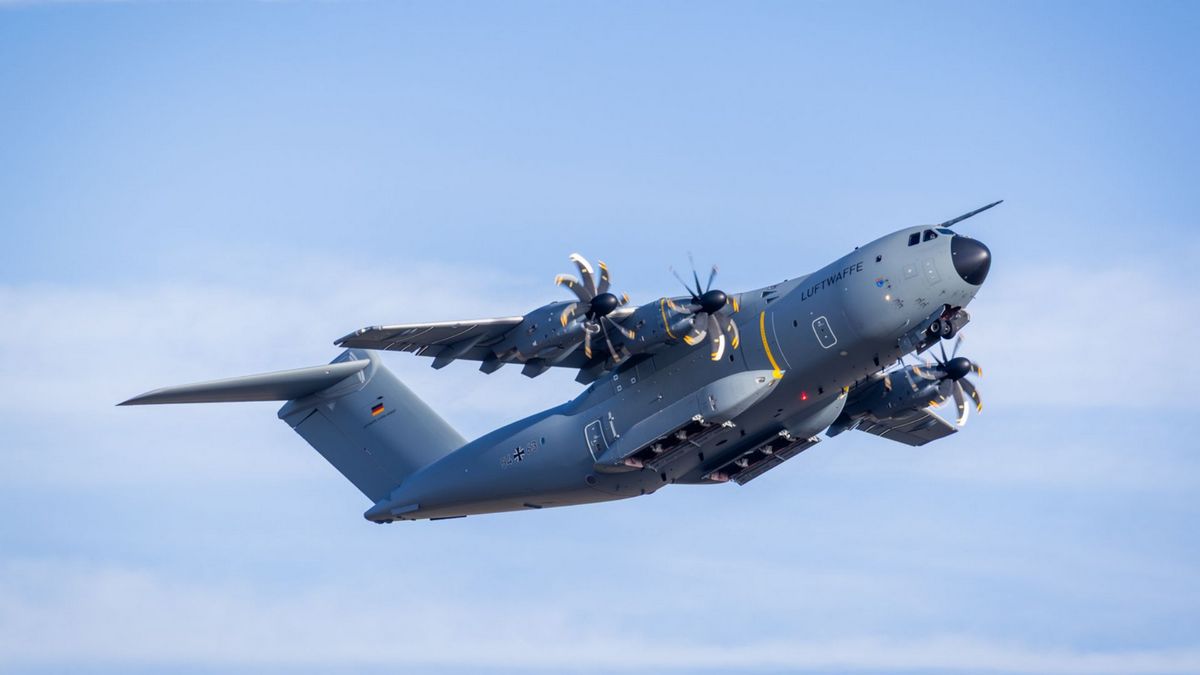
Airbus has presented an ambitious concept to convert its A400M Atlas military transport aircraft into a platform for long-range strike operations. The proposed upgrade would enable the aircraft to launch cruise missiles and deploy large numbers of unmanned aerial systems while remaining outside the engagement range of enemy air defense networks. The concept reflects a broader trend in modern military aviation toward the use of long-range precision weapons, reducing dependence on manned fighter aircraft that are required to operate within contested and high-risk airspace.

Traditionally designed for logistical missions, the A400M is being adapted toward a “mothership” role capable of providing long-range fire support. The concept is based on the use of palletized mission systems installed inside the cargo hold instead of external weapon hardpoints. This configuration is intended to allow the aircraft to carry up to twelve cruise missiles or approximately fifty medium-sized unmanned aerial vehicles, depending on the mission profile. Because all payloads are carried internally, the aircraft is expected to retain its operational range, fuel efficiency, and aerodynamic performance without significant degradation.
According to available information, the development is being carried out for a European customer that has not been publicly identified. The work builds on earlier trials conducted by the French and German air forces, including drone deployment tests and aerodynamic evaluations. The A400M already supports modular cargo configurations, with a maximum payload capacity of approximately 37–40 tonnes. Its cargo bay, with a volume of around 340 cubic meters, can accommodate up to nine standard military pallets, making it a candidate platform for this type of role expansion.
For integration purposes and dimensional benchmarking, Airbus selected the Taurus KEPD 350 long-range cruise missile, in service since 2006 and designed for engaging hardened targets deep behind enemy lines. The munition is over 5 meters in length and has a launch mass of approximately 1,400 kg. It is equipped with a dual-stage penetrating warhead intended to defeat reinforced structures such as bunkers or runways prior to detonation. The missile’s range exceeds 500 km, enabling launch profiles from outside the engagement envelope of typical surface-to-air missile systems.
A full payload of twelve missiles would have an estimated total mass of around 16.8 tonnes, leaving additional capacity for support systems and palletized launch infrastructure. The internal carriage concept avoids aerodynamic penalties and does not require major structural modifications to the aircraft. The proposed launch mechanism is based on pallet extraction through the rear cargo ramp. This approach is conceptually similar to systems previously tested on transport aircraft, where payloads are deployed from standardized platforms. Each missile would be secured on a pallet equipped with sequencing and release control modules to manage ejection timing and spacing.
During deployment, a parachute system would extract the pallet from the aircraft, initiating a controlled descent. Once stabilized in the airflow, the missiles would separate sequentially at defined intervals to prevent collision. After clear separation, each missile would ignite its propulsion system and proceed toward its designated target. This method eliminates the need for external pylons or bomb bays. It also allows the system to be installed or removed relatively quickly, enabling rapid reconfiguration of the aircraft’s operational role.
However, there are several technical challenges. Since the rear ramp is designed for a load of approximately 32 tonnes, the payload must be evenly distributed across multiple pallets. In addition, airflow turbulence generated by the aircraft’s high-power turboprop engines requires precise control of timing and orientation during pallet extraction and release.
The upgraded A400M is also intended to operate as part of an integrated digital battlespace network. It may be equipped with secure satellite communications, allowing the crew to monitor missile status and receive updated targeting data after launch. While full real-time weapon control has not been confirmed, the system is expected to support limited in-flight data updates. This effectively turns the aircraft into a command node capable of coordinating strikes with other military assets.
In operational scenarios, a formation of several A400M aircraft could execute coordinated missile salvos. For example, four aircraft configured in this manner could theoretically launch up to 48 missiles in a single sortie, providing strike mass comparable to a dedicated combat aviation formation.
In addition to missile-based configurations, Airbus is also examining other potential applications of the same modular architecture. These include unmanned aerial vehicle carrier variants, electronic warfare platforms, communications relay aircraft, aerial refueling tankers, and even firefighting configurations capable of releasing up to 20 tonnes of water. Thanks to its high-power propulsion system and flexible cargo management architecture, the A400M is being developed toward a broader multifunctional role that extends beyond its original purpose as a transport aircraft.
Read also:
- World’s First Combined Passenger–Cargo Boeing 737 Enters Service
- Business Jet in Uniform: How Pilatus PC-24 Enters the Military Market
Source: interestingengineering