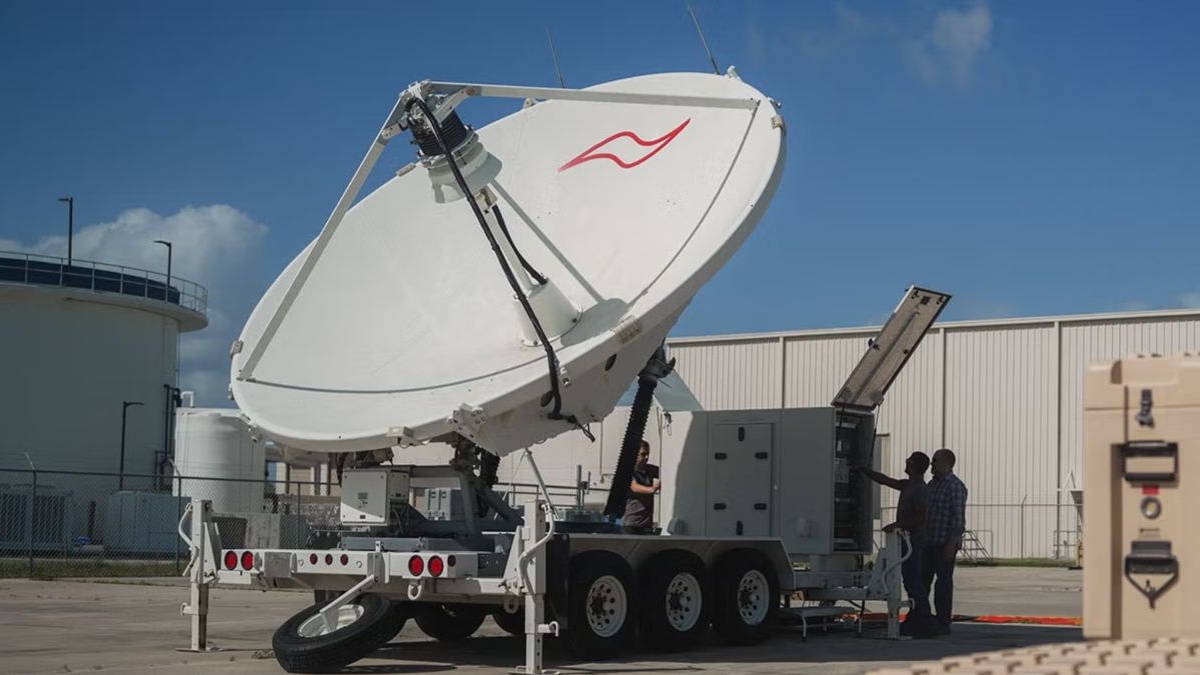
The U.S. Space Force has begun deploying the Meadowlands system developed by L3Harris. The new electronic warfare capability is designed to disrupt adversary satellites by transmitting high-power electromagnetic signals.
The U.S. Space Force has opened a new chapter in the contest for control of orbit – not with missiles or lasers, but with a trailer-mounted antenna. Recently fielded, the Meadowlands system does not physically destroy enemy satellites. Instead, it temporarily disrupts their communications and operations, denying them the ability to function when uninterrupted connectivity is most critical.
Read also: First Shot Without a Pilot: What the YFQ-44A Flight Tests Mean for the Future of Air Combat
TABLE OF CONTENT:
The Invisible Battle
The space warfare of the 21st century bears little resemblance to Hollywood depictions of explosions and laser beams cutting through the darkness. The real struggle for control of orbit takes place at a level invisible to the naked eye – the level of radio-frequency signals. Regardless of how technologically advanced a satellite may be, it remains fundamentally a communications relay: it receives commands, processes data, and transmits information back to Earth. Denying it access to its signals is comparable to depriving a person of both hearing and speech while leaving the body physically intact.
This principle underpins the new American electronic warfare system known as Meadowlands, which was officially accepted into service by the U.S. Space Force on June 8, 2026. Developed by L3Harris Technologies, the system is presented as a logical extension of the existing Counter Communications System (CCS) family of capabilities – systems designed not to physically destroy satellites, but to temporarily disrupt their ability to communicate with ground-based operators.
Також цікаво: Project Freyja: How Fire Point Aims to Close a Gap in Ukraine’s Air Defense
Two Channels, One Target
The technical principle behind Meadowlands is simple to describe, although complex to implement. The system does not target the satellite itself as a physical object; instead, it attacks the two communication channels without which the spacecraft loses its operational value.
The first is the uplink channel, through which a ground station transmits commands, software updates, and new mission instructions. If a powerful, directional jamming signal overwhelms this link, the satellite continues to travel along its orbit, but it can no longer receive instructions from its own operator.

The Second Target: The Downlink Channel
The second target is the downlink channel, through which a satellite transmits collected data back to Earth: intelligence imagery, intercepted communications, weather information, or routine military traffic. The spacecraft may continue collecting data over a designated area, but if the resulting information never reaches analysts, the satellite’s presence in orbit becomes largely symbolic.
According to the manufacturer’s description, effective operation of Meadowlands requires knowledge of the target’s operating frequencies, transmission characteristics, and precise location. The satellite must also be positioned within a suitable geometric relationship relative to the ground-based transmitter. The company does not disclose the system’s effective range, radiated power, or supported frequency bands. This information should therefore be treated with caution: the system’s claimed versatility in promotional materials likely exceeds the practical operational limitations imposed by orbital geometry, atmospheric conditions, and adversary countermeasures.
Read also: Middle Strike: How Ukraine Is Building a New Class of Medium-Range Strike Systems
Reversibility as a Military Advantage
The key difference between Meadowlands and traditional anti-satellite weapons lies not in raw power, but in the philosophy of its use. An interceptor missile that strikes a target in orbit destroys it permanently, while simultaneously creating a debris cloud. Each fragment, traveling at several kilometers per second, can damage other spacecraft – including satellites operated by neutral states or even crewed space stations. The most aggressive anti-satellite warfare scenarios, such as a nuclear detonation in orbit or repeated kinetic intercepts, do not distinguish between military and civilian infrastructure. They pose a long-term threat to entire orbital regions, potentially affecting space operations for years.
Meadowlands promises a different outcome: a temporary and reversible effect. Once the transmitter stops jamming, communications with the satellite are expected to be restored, and the spacecraft can return to normal operations, according to the developer. From a military perspective, this enables a fundamentally different concept of operations – not the permanent destruction of an adversary’s asset, but the ability to disable it during a specific operational window, while aircraft enter an engagement area, missiles approach their targets, or ground forces conduct maneuvers. This approach is less visually dramatic than an orbital explosion, but it leaves behind neither a crater nor debris, and provides no immediate physical evidence of an attack – an aspect that can significantly complicate political escalation and attribution during a conflict.
Read also: Weapons of Ukraine’s Victory: FP-1 – A Drone Capable of Reaching Moscow
From CCS 10.2 to Meadowlands: Evolution, Not Revolution
Meadowlands is not an entirely new development; rather, it represents the next stage in the evolution of a family of satellite communications countermeasure systems that the U.S. Space Force has operated for more than two decades. The previous version, CCS Block 10.2, deployed in 2020, remained relatively bulky and offered less software flexibility.
L3Harris received a contract to modernize the system in 2021, and in February 2025 the company secured a separate $33.5 million agreement specifically for the development of Meadowlands – a more compact, automated version built around an open software architecture.
The first production unit was delivered to the U.S. Space Force in late 2025, while formal acceptance of the system into operational service took place in June 2026. This distinction reflects a common practice in the U.S. defense acquisition process, where the physical delivery of equipment and authorization for operational use are treated as separate milestones. Available information indicates that L3Harris plans to achieve a production rate of approximately one system per month. The final Meadowlands inventory is expected to consist of around 32 units – twice the number of the previously reported 16 systems from the earlier CCS generation. These systems are intended to be deployed at strategic locations and operated by units of the U.S. Space Force and the National Guard.
Mobility as a Condition for Survival
In the logic of modern electronic warfare, mobility is not merely a matter of convenience – it is a prerequisite for the system’s survival. A powerful fixed transmitter can be relatively easy to detect, geolocate, and eventually target with an adversary’s missile strike. By contrast, a system mounted on a wheeled trailer and designed for transport aboard military cargo aircraft can appear at a temporary deployment location, perform its mission, and relocate before the adversary has time to organize a retaliatory strike.
Meadowlands: Mobility by Design
Meadowlands was developed around this operational concept: lighter and more compact than its predecessor, it enables deployment both at forward positions under demanding conditions and through remote operation from a relatively safer rear-area location. This reduces risks to personnel while making it more difficult for an adversary to locate the source of interference. At the same time, the limits of this advantage must be recognized. A high-power jamming signal is itself a revealing signature, and an adversary may attempt to track the transmitter, target its command infrastructure, or infer system activity indirectly by monitoring changes in the behavior of its own satellite after an unexpected loss of communications.
Read also: Weapons of Ukraine’s Victory: The “Shvidun” Interceptor Drone
One Operator, Multiple Targets
The manufacturer places particular emphasis on Meadowlands’ ability to engage a greater number of targets simultaneously compared with earlier versions of the CCS, as well as on the system’s open software architecture. The latter is not merely a secondary technical feature, but a key factor in maintaining long-term operational effectiveness.
In electronic warfare, the adversary is not a passive target. It continuously adapts by changing operating frequencies, encryption methods, and communication protocols. A system whose software cannot be rapidly updated in response to evolving target behavior risks losing effectiveness long before its physical components reach the end of their service life.
From this perspective, Meadowlands’ open architecture represents less a single engineering achievement and more an acknowledgment that electronic warfare is a continuous technological competition. How quickly operational units will be able to adapt the system to emerging countermeasures in real-world conditions remains an open question – one that will be answered not by corporate presentations, but by the first months of practical deployment.
Read also: Mission Control: How Ukraine Is Building a Unified Digital Brain for Drone Warfare
A Broader Architecture: Bounty Hunter and a Distributed Network
Meadowlands was not designed as a standalone capability; rather, it represents one component of a broader space electronic warfare architecture currently being developed by the U.S. Space Force. In parallel, the Bounty Hunter system is being developed to detect and locate sources of interference targeting U.S. communications links. This effort is complemented by smaller, remotely deployable modular terminals intended to create a more distributed and resilient electronic warfare network – one capable of maintaining effectiveness even if individual nodes are disrupted or destroyed.
The Logic of Functional Distribution
The logic behind this division of capabilities is straightforward: one system identifies the adversary’s transmitter, another protects U.S. satellite communication channels, and a third – such as Meadowlands – is responsible for suppressing the opponent’s signal. No antenna can determine the outcome of a confrontation in space on its own. It operates only as part of a broader system that includes satellite positioning data, intelligence on the communication channels being used, air defense capabilities, and coordination with air, cyber, and intelligence units. Therefore, the effectiveness of Meadowlands depends not only on the technical characteristics of the antenna itself, but also on the quality of the supporting information infrastructure that enables the system to be activated at the precise moment when it is required.
The Limits of Confidence in Claimed Capabilities
Despite the technological appeal of the concept, public statements from the manufacturer and the customer should be viewed with a degree of critical caution. The system’s actual operational range, radiated power, supported frequency bands, and – most importantly – its effectiveness against modern satellite communication systems employing techniques such as frequency hopping or directional antennas remain classified. This level of secrecy is entirely expected for a military capability. However, the same lack of transparency makes it extremely difficult to assess Meadowlands’ true combat value beyond official company and government announcements.
The same caution applies to claims regarding the complete reversibility of its effects. The assertion that satellite communications automatically recover once jamming stops is valid for standard, fully functional systems. However, it does not account for scenarios in which prolonged disruption of command links could itself lead to secondary consequences, such as loss of operational orientation, depletion of onboard power resources due to missed energy-management commands, or other cascading effects that public descriptions of a “non-destructive” weapon may tend to understate.
Read also: Everything About the P1-Sun – SkyFall’s Ukrainian Interceptor Drone
A Shift in the Space Force’s Strategic Philosophy
Behind the technical details of Meadowlands lies a broader development: a shift in the priorities of the entire U.S. military space doctrine. For previous decades, the primary missions of space organizations focused on monitoring objects in orbit, identifying potential threats, and protecting national space infrastructure – an approach that was largely defensive and observational in nature. Recent official documents and public statements from senior leadership have increasingly emphasized the ability to achieve active space superiority. The U.S. Space Force is expected not only to detect and assess an adversary’s use of satellite capabilities, but also to possess tools capable of immediately denying those capabilities when required.
This shift follows logically from the growing dependence of modern military forces on orbital infrastructure. As navigation, intelligence, communications, and targeting increasingly rely on satellites, the loss of access to space-based capabilities can disrupt operations across land, sea, and air domains faster than many conventional military setbacks. Within this framework, an adversary’s satellite is no longer viewed merely as an object of observation, but as a concrete operational target. Meadowlands represents the first publicly acknowledged capability designed to temporarily neutralize such a target without physically destroying it.
A Quiet Weapon in a Quiet War
Meadowlands does not alter the balance of power in space simply by existing – just as a single antenna cannot determine the outcome of a terrestrial military operation. However, the system reflects an important technological and doctrinal shift: the struggle for orbital superiority is increasingly moving away from kinetic destruction and toward control of the electromagnetic spectrum, where success is measured not by the number of satellites destroyed, but by the duration and precision of the periods of denial imposed on an adversary at the moment when access to space-based data is most critical.
Whether this concept will prove effective in an actual conflict remains an open question – one that will be answered not by L3Harris presentations, but by the system’s first operational employment. Until then, Meadowlands should be viewed more as an indicator of strategic intent than as a fully validated combat capability: a demonstration of the U.S. Space Force’s ambition to move from passive observation of the orbital environment toward active, reversible, and – particularly in an era of growing concern over space debris – relatively “clean” control of it.