For six decades, aspiring U.S. Air Force fighter pilots have completed advanced jet training in the supersonic Northrop T-38 Talon before transitioning to frontline combat aircraft. During that time, several generations of fighters have entered service: the third-generation F-4 Phantom II gave way to the fourth-generation F-16 Fighting Falcon, while today the Air Force is steadily transitioning to the fifth-generation F-35 Lightning II. Even the Talon’s long-serving companion, the Cessna T-37 Tweet primary trainer, has long since retired, with its role assumed by the turboprop T-6 Texan II. The Talon, however, remained irreplaceable. Today, it is training the grandchildren of the very first cadets who flew it.
Read also: Interview with Bell Textron: Investing in the future in Ukraine
TABLE OF CONTENT:
The T-X Program
Over its decades of service, the T-38 underwent numerous upgrades. Even so, the technological gap between a design originating in the mid-20th century and the capabilities of modern military aviation continued to widen. The aircraft’s age also became an increasingly significant factor – the newest T-38s rolled off the production line in 1972. As a result, the U.S. Air Force began exploring a replacement for the Talon as early as 2003. However, the program remained stalled for more than a decade due to prolonged bureaucratic and congressional delays. It was not until March 2015 that the Air Force released the requirements for a new advanced trainer under the provisional designation T-X. The formal request for proposals followed even later, on December 30, 2016.
The program initially called for the procurement of 351 aircraft, with an option to increase the order to 475. These aircraft were intended to replace a fleet of approximately 500 T-38 Talons. The acquisition package also included 46 full-mission simulators. At the time, the Air Force planned to achieve initial operational capability with the new trainer in 2024.
According to the Air Force’s requirements, the new trainer had to prepare student pilots for the transition to fifth-generation combat aircraft. In addition to traditional advanced flight-training tasks – such as aerobatics, formation flying, and navigation – the aircraft was also expected to support more modern training requirements, including operations with night vision goggles and data-link employment. The requirements also specified an aircraft availability rate of 80%, meaning that four-fifths of the fleet should be mission-ready at any given time. A higher availability target was deliberately avoided, as it would have resulted in disproportionately higher operating and maintenance costs. The program likewise emphasized total life-cycle cost rather than acquisition price alone, making long-term affordability a key evaluation criterion.
The U.S. Air Force sought a dedicated trainer rather than a dual-role platform capable of performing light fighter or attack missions, although proposals to incorporate such capabilities surfaced at various stages of the program.

Several companies and industry teams competed for the contract. Some offered adapted versions of existing trainer aircraft, while others proposed entirely new designs that, at the time, existed only on paper or, at best, as prototypes. Three contenders emerged as the leading candidates: two based on proven aircraft and one all-new design. These included the Leonardo T-100, an Americanized version of the Italian M-346; the Lockheed Martin–KAI T-50 Golden Eagle, derived from the South Korean trainer of the same name; and the Boeing–Saab T-X, a completely new U.S.–Swedish design developed specifically for the competition. On September 27, 2018, the U.S. Air Force selected the Boeing–Saab T-X as the winner of the T-X program.
An American–Swedish Partnership
Boeing and Saab officially launched their joint advanced trainer aircraft program on December 6, 2013. Development progressed at an unusually rapid pace, aided by the extensive use of modern digital engineering and design tools. The prototype was unveiled to the public on September 13, 2016, and completed its maiden flight on December 20 of the same year – just three years after the program was formally launched.
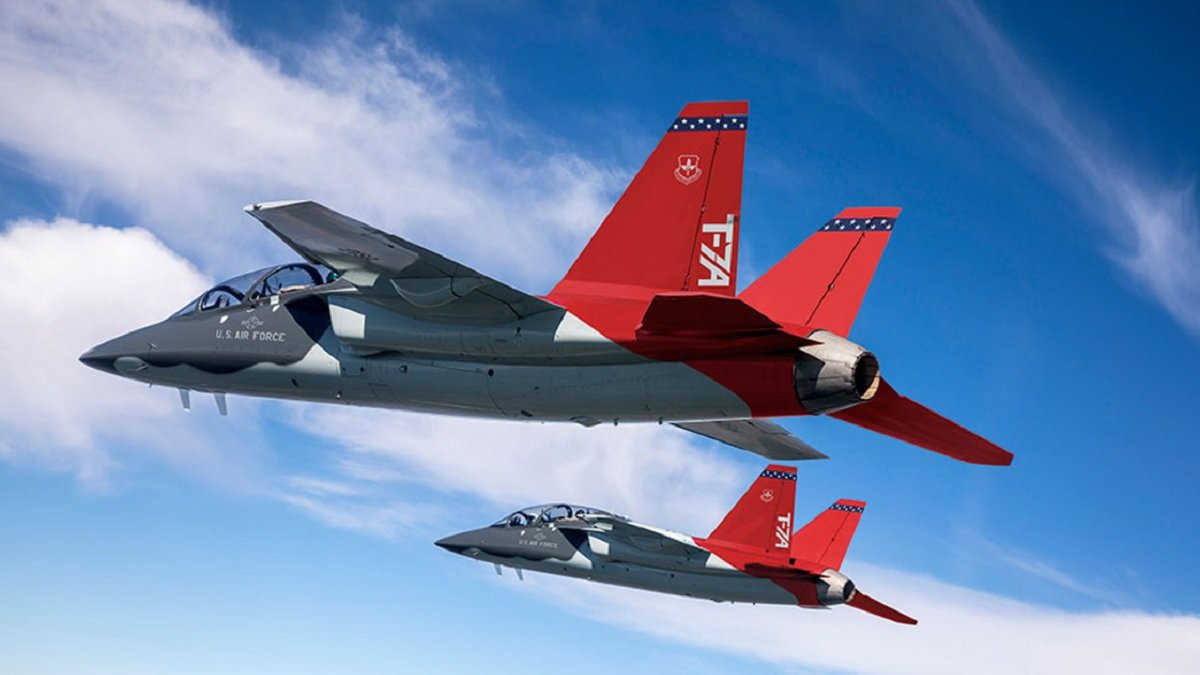
In September 2019, the aircraft officially received the designation T-7A and the name Red Hawk. The name honors the Tuskegee Airmen, the first group of African American military pilots in U.S. history. Their aircraft were distinguished by red-painted tails, while the Curtiss P-40 Warhawk was the first fighter type they flew in combat.
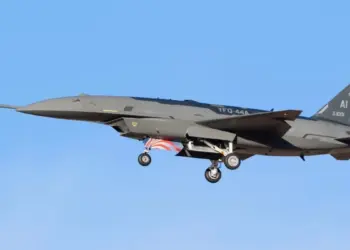
The T-7A is a single-engine, two-seat advanced trainer with tandem seating, a high-mounted trapezoidal wing, and side-mounted air intakes. In overall appearance and aerodynamic configuration, it closely resembles other modern trainers such as the T-50. One notable distinction, however, is its twin-tail vertical stabilizer arrangement – a feature that has become uncommon among dedicated trainer aircraft. In this respect, the T-7A bears some resemblance to the F/A-18 fighter.
Power is provided by a General Electric F404 turbofan, an engine that has become a de facto standard for modern high-performance trainer and lead-in fighter aircraft. The same engine family is used in both the T-50 and the Turkish Hürjet. Unlike those aircraft, however, the T-7A is designed as a transonic rather than a supersonic platform. Its maximum speed is Mach 0.975, which the U.S. Air Force considers fully sufficient for advanced pilot training.
The aircraft features a full-authority digital fly-by-wire flight control system, a fully digital glass cockpit, and next-generation ACES 5 ejection seats. Its onboard systems are built around a modular architecture, while the airframe has been designed with maintainability as a primary objective. This maintainer-friendly approach is intended to minimize downtime and reduce operating costs throughout the aircraft’s service life.
Program Progress
The T-7A test program included two prototype aircraft and three pre-production examples. The last of these was delivered on December 5, 2025, to the 12th Flying Training Wing at Joint Base San Antonio–Randolph, Texas. In May 2026, the first instructor pilots from the wing’s 99th Flying Training Squadron were certified to fly the aircraft. This milestone did not mark initial operational capability, however, which had originally been scheduled for 2024. Achieving that status requires the delivery of the first production batch of aircraft, yet the initial low-rate production order – covering 14 T-7As – was not approved until April 23, 2026. What, then, caused the program’s delays?
The T-7A program has faced a number of technical and organizational challenges. Early development was affected by issues involving the ejection seat and the aircraft’s flight-control software. These were compounded by supply chain difficulties that slowed production and testing.
As flight testing progressed, engineers also encountered handling issues at high angles of attack. Even today, not all deficiencies have been fully resolved. For example, the T-7A is currently restricted from flying in rainy conditions because several external panels do not provide adequate sealing, allowing water to penetrate internal aircraft systems. During environmental testing, engineers reportedly had to temporarily seal portions of the airframe with tape. The ground-based full-mission simulator also fell short of performance expectations. Boeing expects these shortcomings to be corrected on production-standard aircraft.
Initial operational capability – which will allow the U.S. Air Force to begin training student pilots on the T-7A – is now projected for 2027–2028, rather than the original 2024 target. Even that revised schedule may prove optimistic, as production of the first full-rate aircraft is not expected to begin until 2027.
Prospects
Beyond fulfilling the U.S. Air Force’s requirements, the developers of the T-7A are actively pursuing additional customers in both the United States and international markets. An adapted version of the aircraft has been offered to the U.S. Navy as part of its competition to replace the T-45 Goshawk, with a contract award expected later this year.
On July 21, 2026, BAE Systems, Boeing, and Saab signed an agreement to explore the establishment of a T-7A final assembly facility in the United Kingdom, should the aircraft be selected by the Royal Air Force to replace its Hawk T.2 trainers. Licensed production could also be established in Japan, where the country is seeking a successor to the Kawasaki T-4. Other potential export customers frequently mentioned include Australia, Brazil, and Serbia.
The aircraft’s long-term export prospects, however, remain uncertain. Boeing has projected a potential production run of as many as 2,700 T-7 aircraft, although such estimates appear highly optimistic. On the international market, the T-7 will compete against well-established platforms such as the T-50 Golden Eagle and the M-346, both of which continue to receive upgrades and secure new export orders. The Turkish Hürjet has also begun attracting international interest, having recently secured its first foreign customer.
A key distinction is that all of these competitors are designed as lead-in fighter trainers with light combat capabilities, whereas the T-7A was developed as a dedicated training aircraft. For many prospective operators, this multi-role capability represents a significant competitive advantage. Consequently, it cannot be ruled out that Boeing may eventually offer an export-oriented version of the T-7 equipped for weapons employment
T-7A Specifications
- Wingspan, m: 9.32
- Aircraft length, m: 14.3
- Aircraft height, m: 4.11
- Engine type: F404-GE-103
- Engine thrust, kgf: maximum 5,000; with afterburner 7,800
- Empty weight, kg: 8,165
- Take-off weight, kg: 9,980
- Maximum Mach number: 0.975
- Range, km: 1,830
- Service ceiling, m: 15,000
Read also: Project Freyja: How Fire Point Aims to Close a Gap in Ukraine’s Air Defense