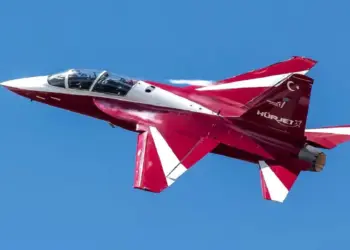
I recently covered the Turkish Hürjet trainer-light attack aircraft, whose first export customer turned out to be Spain. But four decades earlier, Spain had nearly developed an aircraft of the same class itself. The project, known as the CASA AX, appeared to be a realistic proposition. So why did the Spanish effort ultimately fail?
TABLE OF CONTENT:
Concept
In the mid-1980s, Spain’s Ministry of Defence began shaping its defense policy for the following two decades. A central element of these plans was the modernization of the Spanish Air Force. At the time, the service operated four types of combat aircraft: the McDonnell Douglas F-4C, the AMD Mirage III, the Mirage F1, and the Northrop SF-5A/B. All of them were scheduled for replacement over the next twenty years, and successors had already been selected for the first three.
To replace the F-4C and Mirage III, Spain ordered 72 McDonnell Douglas F-18A/B fighters from the United States. The more modern Mirage F1 was expected to remain in service for a longer period before eventually giving way to the EF2000. Development of the future Eurofighter by the international consortium of companies from the United Kingdom, West Germany, Italy, and Spain was only just beginning. The replacement for the SF-5A/B, however, remained an open question.
Between 1969 and 1972, the Spanish Air Force received 70 SF-5A/B aircraft, including 36 single-seat SF-5As and 34 two-seat SF-5Bs, most of which were license-built by CASA. This unusually balanced mix of combat and trainer variants – almost a one-to-one ratio – was due to the fact that the type replaced not only the North American F-86F fighter but also the Lockheed T-33A trainer in Spanish service. The SF-5B was used to train pilots destined for every frontline combat aircraft type before they transitioned to the Phantom or Mirage. As a result, any successor to the SF-5A/B would have to combine the characteristics of both a light fighter/attack aircraft and an advanced jet trainer.
In 1987, the Spanish Air Force officially launched the AX program to develop a new combat aircraft. CASA was selected as the sole contractor without a competitive tender, as no other Spanish company possessed the capabilities required to undertake such a project. By today’s standards, the initial development budget was relatively modest, totaling 2.165 billion pesetas – equivalent to approximately €13 million today.
The original requirement called for the procurement of 72 aircraft, but this was later increased to 100. The AX was expected to achieve operational readiness by 1997.
Read also:
- First One Down: The Shenyang J-8 Fighter’s Career Comes to an End
- “Free Bird” from Türkiye: Everything About the TAI Hürkuş Trainer and Light Attack Aircraft
Evolution
The first discussions on the design of a new light combat and advanced trainer aircraft took place in 1984, involving representatives from CASA, the Ministry of Defence, and the Spanish Air Force. At that stage, the aircraft was envisioned as a derivative of the C-101 trainer, powered by a more capable propulsion system, potentially with twin engines. However, during the preparation of the feasibility study in 1986, CASA proposed an entirely new design.

The aircraft was envisioned as either a supersonic or transonic design. The transonic flight regime covers speeds between Mach 0.8 and 1.2, where airflow around the aircraft becomes uneven. In some areas, such as over the upper surface of the wing, the airflow accelerates beyond the speed of sound, creating localized shock waves, while other regions, including those around the nose, may still experience subsonic flow. In supersonic flight, by contrast, the entire aircraft travels faster than its own sound waves. A primary shock wave forms ahead of the nose, while the airflow surrounding the fuselage remains fully supersonic.
The AX was intended to feature an avionics suite based on an open-architecture design, making future upgrades considerably easier. At this stage, it was still too early to define the exact equipment fit, but the aircraft was expected to receive a radar, a laser rangefinder/designator, multifunction cockpit displays, and a fly-by-wire flight control system. Power was to come from a non-afterburning version of the EJ200 engine being developed for the EF2000 fighter. The airframe was expected to make extensive use of composite materials, aluminum-lithium alloys, and titanium. Spanish engineers also sought to capitalize on the expertise gained through participation in the Airbus and Eurofighter programs. At the same time, the project aimed to maximize the involvement of domestic industry, including university research centers. To coordinate these efforts, a dedicated AX project office was established, bringing together representatives from the Ministry of Defence, the Air Force, industry, and academia.
According to the approved schedule, the aircraft’s final configuration was to be completed by June 1989. This would allow full-scale development to begin the following year, the prototype to make its maiden flight in 1992, and the AX to enter service in 1996. In retrospect, this timeline appears highly optimistic and would likely have proven difficult to achieve. However, the AX program enjoyed one significant advantage over projects such as the Eurofighter: it was a purely national effort rather than an international one, eliminating the need to reconcile the often conflicting priorities of multiple partner nations.
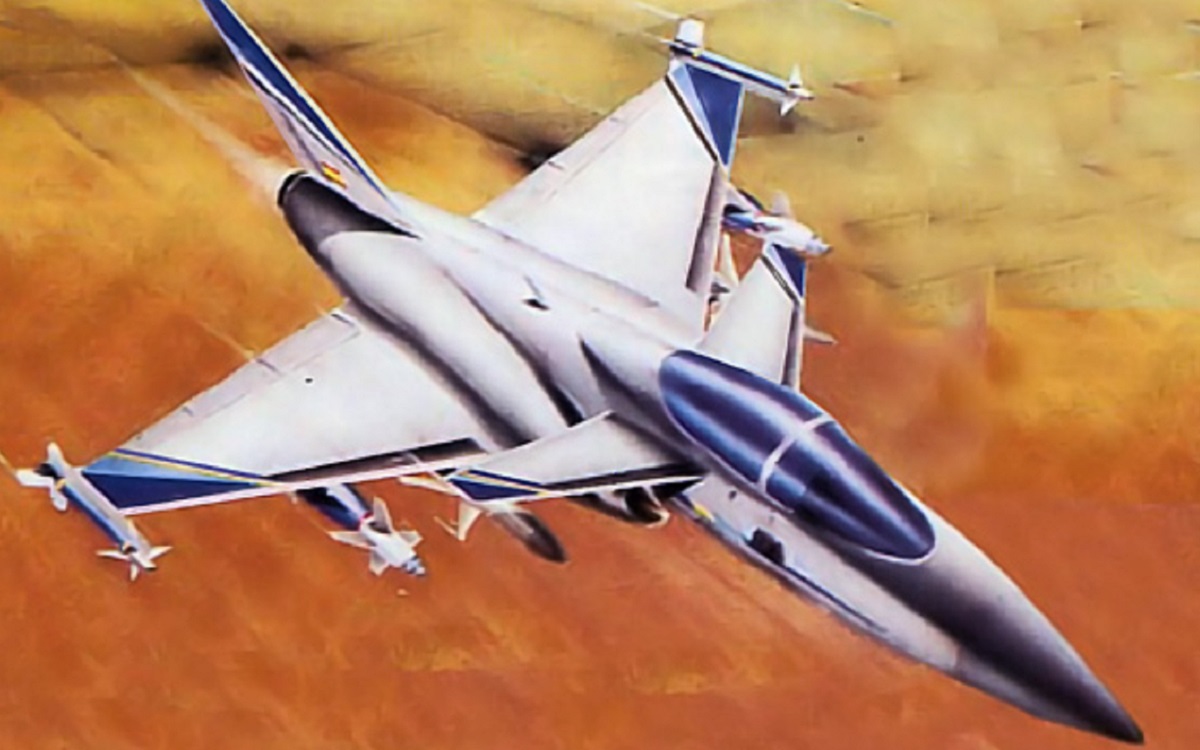
By the late 1980s, conceptual drawings of the AX began appearing in the aerospace press. They depicted an aircraft with a delta wing, a single vertical stabilizer, and canards – a configuration strongly reminiscent of the EF2000, which was itself still under development at the time. The most notable differences were the use of a single engine instead of two and side-mounted air intakes. Whereas the EF2000 employed a ventral intake beneath the fuselage, the AX adopted lateral intakes to reduce the risk of foreign object ingestion, making the aircraft better suited for operations from lower-quality or damaged runways. On the international market, the AX was expected to compete with the Italian-Brazilian AMX, while offering a more advanced powerplant, avionics suite, and aerodynamic design.
“Half a Hornet”
Around the same time, the AX program underwent a major shift in design philosophy. In an effort to reduce development costs, the project was reoriented to incorporate as many components from the F/A-18 Hornet as possible, including the General Electric F404 engine, radar, mission computer, navigation system, cockpit equipment, and other onboard systems. Ironically, this cost-saving strategy had the opposite effect: the projected price of the AX rose to nearly the same level as that of an F/A-18.
Development continued through the end of 1991, but funding was terminated in 1992. In hindsight, this decision appears well justified. At the time, Spain was already committed to two major multinational programs – Eurofighter and EuroFLAG, the latter eventually leading to the Airbus A400M military transport aircraft. Both projects demanded enormous financial and industrial resources. Although it was not yet apparent in the early 1990s, both would later suffer from significant cost overruns and schedule delays. Under those circumstances, it is difficult to imagine the Spanish Ministry of Defence sustaining another large-scale development program.
This brings us back to the original problem that had prompted the AX project in the first place: finding a replacement for the SF-5A/B. That process ultimately stretched over four decades. The single-seat SF-5A fighters were replaced relatively quickly when Spain acquired 24 refurbished and upgraded F/A-18A+/B+ aircraft from the United States in 1995. The two-seat SF-5B advanced trainers, however, underwent several rounds of modernization and overhaul and remain in service to this day, awaiting the arrival of the first Hürjet aircraft.
Read also: