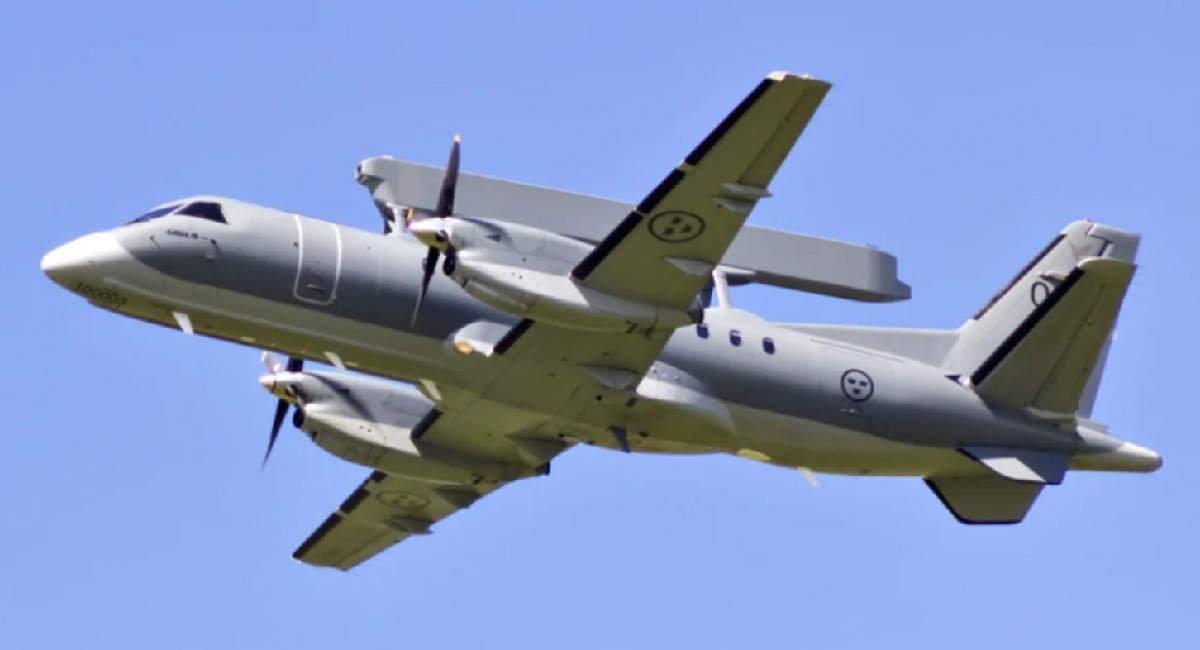
Recently, it was announced that Sweden provided Ukraine with a Saab ASC 890 (Saab 340 AEW&C) early warning and control aircraft as part of a military aid package. Regarding this, the Swedish government stated that such an aircraft is expected to help Ukraine strengthen its air defense capabilities: “Sweden is transferring an ASC 890 radar surveillance and control aircraft to Ukraine, thereby enhancing Ukraine’s air defense capabilities.”

For Ukraine, receiving the ASC 890 will mean entirely new capabilities in aerial radar reconnaissance and combat control of targets in the air and at sea. Additionally, Ukraine’s ability to detect and engage targets at considerable distances will increase, as the equipment and technologies of this aircraft can distinguish objects and ships better than traditional radar. Let’s take a closer look at the Saab ASC 890 (Saab 340 AEW&C) early warning and control aircraft.
Read also:
- First American Attack Aircrafts: Development Path, Part 1
- First American Attack Aircrafts, Part 2: Alternative Projects of the Early 1920s
- American Attack Aircraft, Part 3: The First Production Variants
TABLE OF CONTENT:
History of Saab ASC 890 (Saab 340 AEW&C)
The Saab 340 AEW&C is an airborne early warning and control aircraft developed by the Swedish aerospace and defense company Saab. It is primarily used by the Swedish Air Force and the Royal Thai Air Force. Recently, two such aircraft were ordered by Poland, and now Ukraine will also be receiving one.
The Saab 340 AEW&C was created with the idea of providing a Swedish-modified alternative to the more expensive Boeing E-3 AWACS. The Swedish Air Force had previously used the Saab 340B for VIP transport of personnel, making this aircraft a suitable base for a new air defense radar. By the mid-90s, the first aircraft was delivered to the Swedish Air Force. A total of six aircraft were ordered: four with the radar already installed and two without the radar, prepared for radar installation if needed, and used as VIP transport during peacetime. Notably, Saab claims that the radar can be installed within 24 hours if required.
As mentioned earlier, the Saab 340B AEW&C is based on the commercial airliner Saab 340B, which serves as a reliable platform for such purposes due to its design characteristics, avionics, and performance. The development of this airliner began in the 1970s, when a new powerplant was chosen that was more economical than the then-prevailing jet engines. Reportedly, the aftermath of the 1973 oil crisis led the company to opt for a turboprop power system for cost-effectiveness.
The U.S. Airline Deregulation Act of 1978 further spurred the development of the base model. This aircraft was designed and built jointly with Fairchild Aircraft, primarily because Saab believed that its own manufacturing capabilities might be insufficient. Consequently, from 1980 to 1987, Fairchild was tasked with producing the wings, tail assemblies, and engine nacelles. Saab, on the other hand, was responsible for manufacturing the main fuselage, covering 75% of the costs for development, system integration, and certification. The first Saab 340 took flight in 1983, with the first commercial service aircraft entering operation in 1984. After Fairchild ceased operations, Saab began producing the Saab 340 independently.
Currently, the Swedish Air Force has a total of six Saab ASC 890 (Saab 340 AEW&C) units in service. Out of these, four are equipped with radar systems, while the remaining two serve as VIP transports and are prepared for radar installation if needed.
The production of the Saab ASC 890 (Saab 340 AEW&C) was completed in 1999. A total of 12 early warning and control (AEW&C) aircraft were built: 6 for the Swedish Air Force (Flygvapnet), 2 for the Royal Thai Air Force, 2 for the Pakistan Air Force, and another 2 are in service with the UAE Air Force. Additionally, 2 modified aircraft were delivered to the Greek Air Force between 2000 and 2003. Greece also separately received two Embraer RJ-145 AEW&C aircraft equipped with the same Ericsson Erieye radars. Consequently, both Poland and Ukraine will receive used aircraft.
Read also: Weapons of Ukrainian Victory: Long-range AASM Hammer bombs
Saab ASC 890 design
The design of the Saab 340B AEW&C is based on the commercial airliner Saab 340B. The aircraft remains largely the same except for the radar mounted on its fuselage and the additional electronic equipment installed inside. The aircraft features a dihedral wing design, meaning the wings are angled upwards from the base. The Saab ASC 890 (Saab 340 AEW&C) is equipped with two turboprop engines and a fuselage made entirely of aluminum. Interestingly, the design incorporates similar solutions found in other military aircraft by Saab, such as using bonded joints instead of rivets, which reduces the overall weight of the aircraft. It also has wider horizontal stabilizers, a vibration control system in the cabin to reduce engine noise, and more powerful engines (two General Electric CT7-9B turboprops, each with 1870 hp).
The wing and horizontal control surfaces, or stabilizers, are trapezoidal in shape, with the angle of the former being greater than that of the main wings. Both the wings and the horizontal stabilizers are very thin, as they simply do not have such a large area. The engines are located a quarter of the way along the main wings, close to the cockpit. The main wings are positioned in the middle of the aircraft, while the fuselage itself has a tubular shape. Its nose section has a shape that changes depending on the angle of view or perspective. From above, it has a parabolic nose cone. The tip of the nose, when viewed from the side, is tilted downwards, while the section from the location of the front landing gear to the tip is slightly tilted upwards. The central section has a cylindrical shape.
The tail is of a conventional type with a “double delta” configuration. Ventral fins are located directly under the horizontal control surfaces. At the rear of the aircraft, there is an elongated fairing. The landing gear has a tricycle configuration, with the front landing gear positioned under the pilot’s cockpit, and the other two gears under the engines.
The Saab ASC 890 (Saab 340 AEW&C) aircraft has a length of 19.73 meters, a height of 6.97 meters, and a wingspan of 21.44 meters. Extended wingtips in several variants increase the wingspan to 22.75 meters.
The aircraft is equipped with early warning systems and the advanced Erieye radar, which I suggest exploring in more detail.
Read also: “The Drone Drops a Grenade” – or How the Pentagon Was Embarrassed
Erieye AEW/AEW&C radar
The Saab Erieye radar, known as Airborne Surveillance and Control (ASC) 890 in Sweden, is a comprehensive AEW&C (Airborne Early Warning and Control) system that provides various capabilities for different missions, meeting the requirements of both military and civilian sectors. Swedes often refer to it as “Odin’s Eye”.
Essentially, it is a multi-mode pulse-Doppler microwave radar system, the Ericsson Erieye PS-890, with an active electronically scanned array (AESA), which makes this aircraft an excellent platform for early warning and control, given its capabilities.
Work on the radar began in 1985 after the Swedish Defense Materials Administration tested a prototype of a phased array antenna on the future platform. The Saab Erieye radar consists of 200 solid-state modules installed in the antenna, operating in the S-band frequency range at 3 GHz, with a field of view of 120° in each direction and a range of 300-400 km at an altitude of 6096 meters. It reaches a height of 20 km, but blind spots remain in the nose and tail areas. This drawback is compensated by the radar’s ability, particularly with such a design, to provide enhanced detection and tracking thanks to electronic beam scanning. This allows scanning of other areas while focusing on a single target.
The PS-890 Erieye can detect and track fighters, helicopters, cruise missiles, and even very small targets at sea, as it also has a maritime surveillance mode. Additionally, sectors deemed critical can be scanned in different modes simultaneously. They are capable of operating in electronically congested environments and as all-weather devices, and they can differentiate between friend and foe using their IFF capabilities and devices.
As such, Erieye AEW/AEW&C can perform air and maritime surveillance, command and control, reconnaissance, control of own assets, surveillance and control of national borders, national assets and national economic zones, search and rescue, alert and air patrol missions. The system is compatible with NATO on-board systems and standards.
The Erieye PS-890 radar also features other electronic functions such as adaptive wave generation, pulse-coded electronic frames, signal processing and target indication, tracking device during scanning, low and medium pulse repetition frequency modes, target radar cross-section display, as well as air-to-air and maritime surveillance modes.
The Erieye radar provides 360° coverage with optimal performance in azimuthal sectors of 150° on each side of the aircraft. The radar can detect fighters at a distance of 350 km in dense enemy electronic warfare environments, in conditions of strong radar interference, and also detect targets at low altitudes.
Read also: History and Achievements of SpaceX: Elon Musk’s Great Space Passion
Cockpit and avionics
The main cabin is equipped with a set of multifunctional workstations for three operators – for radar operation, fighter management, and performing tasks related to ground operations. The cabin accommodates two pilots and the aircraft commander.
The aircraft features a secure voice communication package and data transmission channels with HF and VHF/UHF links. The V/UHF data transmission channel operates at a speed of 4800 bits/s.
The main avionics compartment is located just behind the cockpit. The avionics suite includes the Tactical Instrument Landing System (TILS), the Rockwell Collins APS-85 Automatic Flight Control System, Lockheed flight data recorder, and Sundstrand ground proximity warning system. The aircraft’s navigation system incorporates an integrated Inertial Navigation System and Global Positioning System (INS/GPS).
The Rockwell Collins APS-85 Automatic Flight Control System is a fully digital autopilot and flight management system. It features a triple-redundant, fail-safe system designed for use in high-performance jet and turboprop aircraft. The system’s digital computer has two completely independent computing channels and four microprocessors, contributing to excellent flight accuracy, reliability, safety, and operational flexibility.
The system consists of a dual-channel flight control computer, dual-mode control panels, an autopilot panel, and three servos and mounts.
Thus, the Saab ASC 890 (Saab 340 AEW&C) serves as a worthy alternative to the Boeing E-3 AWACS, which will help protect Ukrainian airspace.
Saab ASC 890 variants
- Saab 340 AEW&C / S 100B Argus are aircraft equipped with the PS-890 / FSR-890 radar, operated by the Royal Thai Air Force.
- Saab 340B AEW&C 200 is a version equipped with the IS-340 Erieye radar.
- Saab 340B AEW&C 300 / S 100D Argus are aircraft equipped with the upgraded PS-890 / ASC-890 radar.
Read also: Swift Beat’s Shahed Interceptor Drone: What We Know
Technical characteristics of Saab ASC 890 (Saab 340 AEW&C)
- Wingspan: 21.44 meters
- Length: 19.73 meters
- Height: 6.97 meters
- Wing area: 41.81 square meters
- Engine: two General Electric CT7-9B turboprop engines with 1870 horsepower each, equipped with four-blade constant-speed Dowty Rotol (or Hamilton Standard) 14RF19 propellers.
- Rate of climb: 10.2 m/s
- Cruising speed: 528 km/h
- Range: 1450 km
- Service ceiling: 7620 m
- Crew: 6 members
- Avionics: Ericsson Erieye radar (PS-890), Link 16, HQII, IFF, secure voice.
This is truly a unique and highly valuable assistance from Sweden. Dreaming of such an early warning and control aircraft was beyond imagination. It will help our Armed Forces track aerial targets, missiles, UAVs, and enemy movements.
In the current conditions of intense combat with the occupiers, every precision projectile, every combat vehicle, every air defense system, every cruise missile, combat landing craft, or early warning and control aircraft is extremely necessary for us. Therefore, we sincerely want to thank our Western friends and partners for their assistance and support. There is nowhere for the aggressors to escape retribution. Glory to Ukraine! Death to the enemies! Glory to the Armed Forces of Ukraine!
Read also: