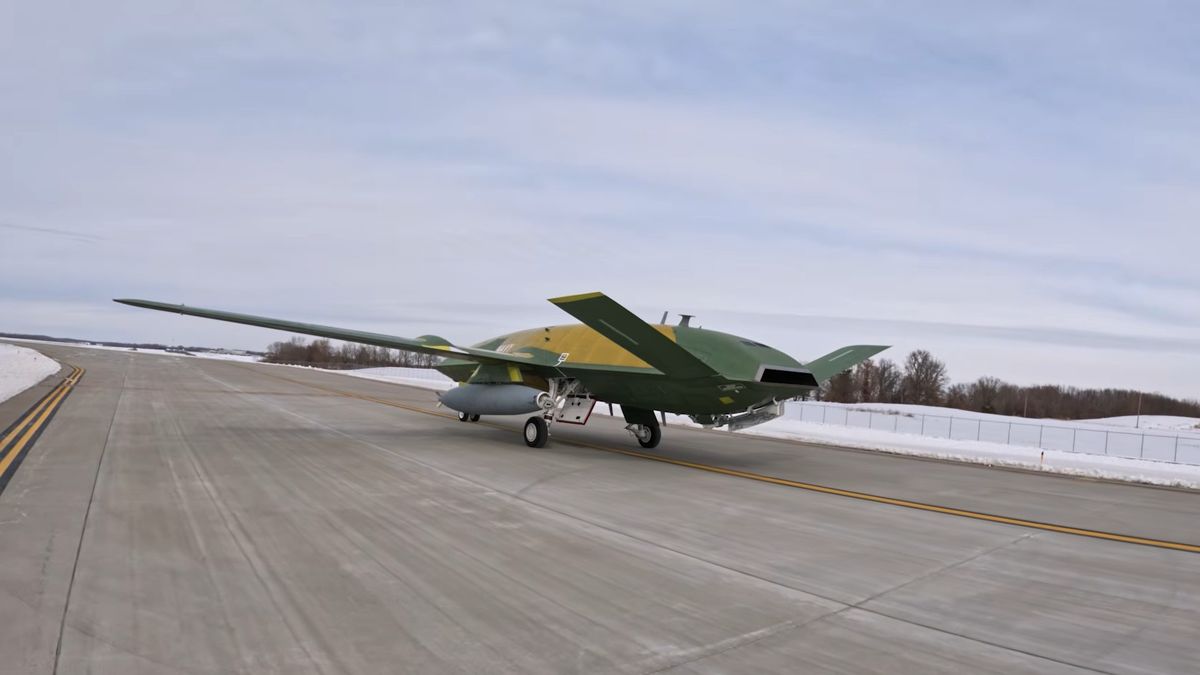
The U.S. Navy, in collaboration with Boeing, has begun ground testing of the MQ-25 Stingray unmanned aerial vehicle. This is the world’s first drone designed specifically to refuel aircraft launched from aircraft carriers. The initial taxi tests on the runway recently took place at Boeing MidAmerica in St. Louis, Missouri. This phase is a critical step toward flight testing and subsequent operational evaluations planned for later this year.

The U.S. Navy had initially planned to conduct the first tests at the end of 2025, after which the program aimed to proceed to the aircraft’s maiden flight. However, delays in the program shifted the schedule, postponing the first flight test of the production MQ-25 to a later date.
Despite this, the initial runway tests represent a significant step forward, bringing the drone closer to operational flight. Boeing and the Navy’s Naval Air Systems Command reported the successful tests in their official statements, and Boeing also released video footage of the trials.
Although the production MQ-25 Stingray has not yet flown, the program’s experimental aircraft, the MQ-25 T1, has already achieved several milestones. In July 2021, this test drone became the first unmanned aircraft in the world to perform aerial refueling.
The MQ-25 design is based on Boeing’s work under the UCLASS (Unmanned Carrier-Launched Airborne Surveillance and Strike) program. Within this initiative, the U.S. Navy initially sought a low‑observable carrier-based unmanned aircraft with intelligence, surveillance, and reconnaissance capabilities. The program’s focus was later shifted toward the development of a dedicated tanker drone capable of significantly extending the operational range of carrier-based aviation.
Under its contract with the U.S. Navy, Boeing is required to deliver nine pre-production MQ-25 aircraft. Five of these will be used for structural fatigue testing and other static evaluations. However, the MQ-25 program has faced substantial delays and cost overruns in recent years. The first pre-production batch of the Stingray was originally expected to be ready in 2022. In 2025, Navy leadership stated its intention to achieve the first flight within the same year.
“We will be flying the MQ-25 in 2025. You can quote me,” Vice Admiral Daniel Cheever, Commander of Naval Air Forces, said in January 2025. “We will be flying this platform in 2025, and in 2026 we will deploy it aboard an aircraft carrier and begin its integration.”
However, subsequent challenges once again shifted the timeline, and the first flight is now expected in 2026. Despite these delays, the U.S. Navy continues to view the MQ-25 as a key element of future carrier aviation. It is intended both to extend the operational range of combat aircraft and to serve as a foundation for the further development of unmanned carrier-based systems. In the long term, the U.S. Navy plans to procure 76 MQ-25 Stingray drones, with the first units expected to reach initial operational capability as early as next year.
Read also:
- Starlink on Russian Drones: Defense Ministry and SpaceX Work to Address the Issue
- Project NYX Initiative: The UK Selects 7 Companies to Develop Apache Drone Wingmen
Source: interestingengineering