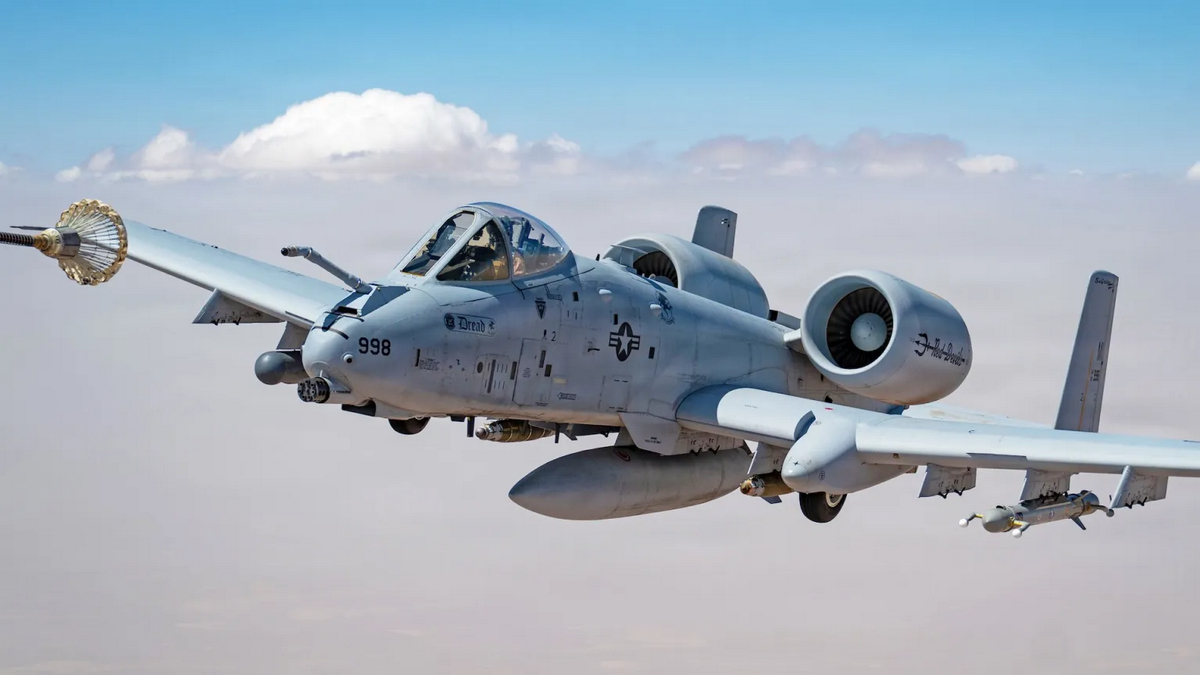
Recently published imagery confirms that the A-10C attack aircraft is now conducting missions in the Middle East equipped with a new refueling boom adapter. This capability appears to have been implemented in a notably short timeframe. As previously reported, the ability of the “Warthog” (A-10) to refuel via a boom-based system was first demonstrated in early April. The modification is being introduced as the aircraft approaches the end of its service life, following a brief extension to its planned retirement.
The U.S. Air Force has released images showing an A-10C using its Probe Refueling Adapter to receive fuel from an HC-130J Combat King II aircraft earlier this month, somewhere within the U.S. Central Command (CENTCOM) area of responsibility. The A-10Cs in question belong to the 107th Fighter Squadron, based at Selfridge Air National Guard Base in Michigan, which was deployed to the Middle East in early April.

As previously discussed, the Probe Refueling Adapter could be significant for the A-10 and for the Air Force more broadly in future combat operations in the Pacific theater. However, it is also clearly applicable to ongoing operations within the CENTCOM area of responsibility. The Air Force has previously confirmed that work on the Probe Refueling Adapter was driven by an urgent requirement from operational units.
The integration of the Probe Refueling Adapter is relatively straightforward, as it makes use of an existing fuel receptacle on the nose of the A-10. In turn, this means the A-10 loses its standard boom receptacle configuration.
As of April, A-10s without boom refueling capability could only refuel from the KC-135, since the KC-10 had been retired and the KC-46 had not yet been certified to refuel the Warthog. This limitation was linked to a long-standing issue with the “boom rigidity” system, which poses a risk of damaging receiver aircraft. The addition of the probe also means that A-10s can now refuel from KC-46 tankers equipped with both hose-and-drogue systems and a rigid boom, expanding operational flexibility.
However, the A-10 can now also receive fuel from Air Force HC-130 and MC-130 aircraft, as well as from U.S. Marine Corps KC-130 platforms and KC-130J aircraft operated by other users. Initial testing of the Probe Refueling Adapter was conducted with an HC-130J aircraft from the 418th Flight Test Squadron.
These tankers can operate from shorter runways and are capable of offloading fuel at very low altitudes, a capability that the KC-135 does not provide. Pairing the A-10 with tanker aircraft that can routinely operate from shorter airfields and offer greater flexibility gives mission planners expanded options for aerial refueling.
Operations with HC-130 and MC-130 aircraft are particularly relevant for the A-10 given its combat search and rescue “Sandy” mission set. This role involves providing escort and close air support to special operations helicopters conducting personnel recovery missions in high-threat environments. A-10 aircraft have previously performed such missions over Iran. HC-130 and MC-130 aircraft already provide aerial refueling support to rotary-wing platforms during similar operations. An A-10 equipped with a probe-and-drogue capability would increase endurance and operational range in these scenarios. The Probe Refueling Adapter also offers a degree of flexibility. The Air Force describes it as a “field-configurable solution designed to be installed by personnel directly on the flight line.”
“Units can install or remove the adapter within a few hours, allowing the aircraft to be reconfigured between boom and probe-and-drogue refueling capabilities depending on mission requirements,” the service stated.
Read also:
- The Aircraft That Never Were: Convair Kingfish
- Legendary “Warthog” Returns: U.S. Air Force Unexpectedly Cancels Retirement of A-10
Source: TWZ