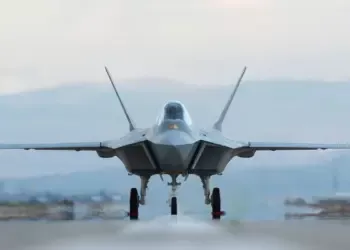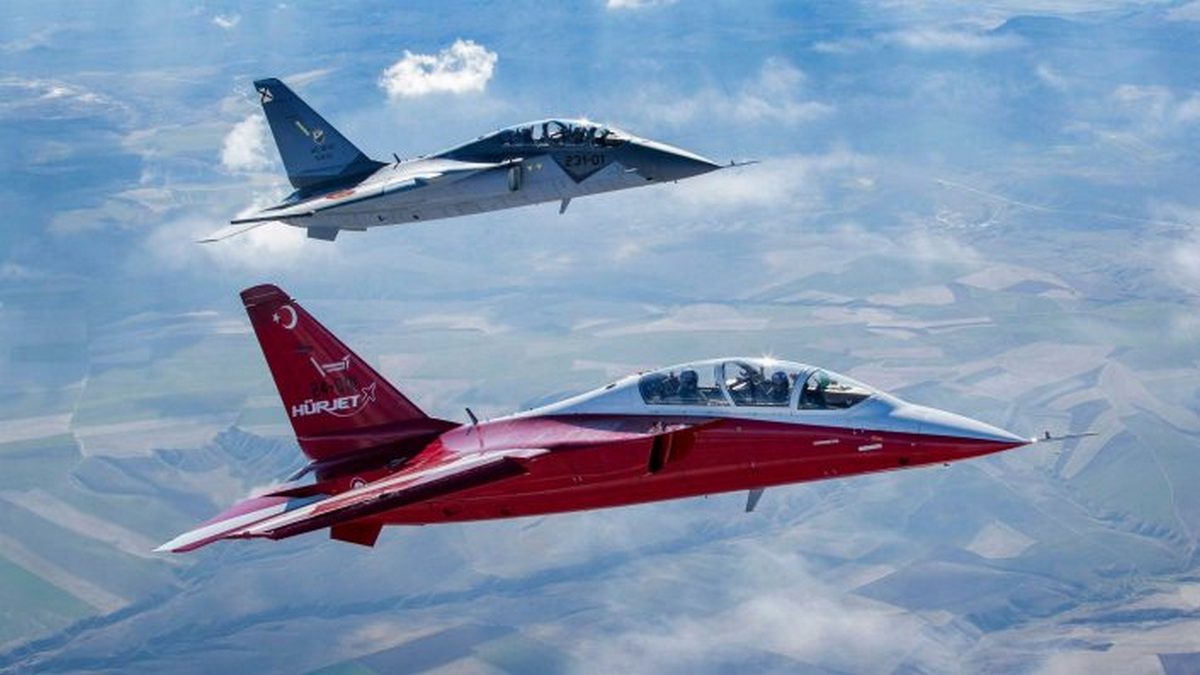
The Hürjet prototype trainer aircraft has recently been spotted in flight equipped with underwing hardpoints for external weapons carriage. This observation may indicate that Turkish Aerospace Industries (TAI) is seriously pursuing the development of a combat-capable variant aimed at the competitive international light attack aircraft market. The image of the aircraft in this configuration appeared publicly on 19 May 2026, suggesting active work on a combat-oriented modification. The photograph was taken by aviation photographer Enes Ökten, who later shared it on his Instagram account.
It can be reasonably assumed that the flight took place near Turkish Aerospace Industries’ production facilities located northwest of Ankara. The timing of the image aligns with earlier reports from the same month indicating that full-scale development of a strike variant is underway. Such developments indicate a steady, incremental transformation of a domestically developed advanced trainer into a combat-capable platform. In the light attack aircraft segment, the Turkish design will face strong competition from established platforms. Key competitors include the South Korean KAI T-50 and its combat variant FA-50, the American Boeing T-7A Red Hawk, the Italian M-346 Master, and the modernized Russian Yak-130M.

Analysis of the released image reveals several important technical details. The aircraft bearing the designation TUS-A003 has been identified as the platform equipped with external hardpoints. This particular airframe was previously seen on 21 November 2024, when it displayed an updated camouflage scheme in light and dark grey tones.
A nose-mounted pitot boom is clearly visible on the forward fuselage. The deployed landing gear, along with open airbrakes, suggests that the image was captured during landing immediately after a test flight. In addition, a pair of V-shaped video cameras can be seen mounted beneath the fuselage behind the landing gear struts. These are likely intended for recording and analyzing vibration patterns and dynamic loads induced by the newly installed wing pylons.
According to available information, the Hürjet program has now entered the serial production phase. Four prototype aircraft are currently involved in flight testing, including TUS-A003. The defense-focused outlet TurDef reports that integration of AESA radar systems from the MURAD family is planned in the near term. The aircraft is also expected to be equipped with Turkish-made air-to-air missiles, including the short-range Bozdoğan and the medium-range Gökdoğan.
These new aircraft are intended primarily to replace the aging T-38 Talon trainer fleet currently operated by the Turkish Air Force. According to the World Air Forces 2026 report, Turkey still operates 68 of these aircraft. As for the wing pylons observed on TUS-A003, official representatives of TAI have not commented, and detailed technical specifications remain unavailable in the public domain.
Beyond the domestic market, the program is also expanding internationally. The Turkish Air Force has signed a contract for 12 aircraft, while the first export customer is the Spanish Air and Space Force, which has ordered 30 units under its national defense program SAETA II. A notable feature of the Spanish contract is that 60% of the production will take place locally in Spain. The project is being managed by an Airbus-led consortium, which will be responsible for developing various subsystems and equipment adapted to national requirements. The aircraft are intended to replace 19 aging Spanish F-5M trainer jets.
The new aircraft are planned to be delivered to the 23rd Wing at Talavera la Real Air Base, where the F-5M fleet is currently stationed. Spanish pilots will use these aircraft for training before transitioning to Eurofighter Typhoon and F/A-18 fighters. The procurement is part of a broader integrated training system, which will also include modern ground-based simulators, instructional materials, and training documentation. This is intended to improve pilot preparation for operating 4.5- and 5-generation fighter aircraft in both Turkish and Spanish air forces.
Read also:
- The Aircraft That Never Were: Convair Kingfish
- $30 Billion Deal of the Year: China to Purchase 200 Boeing Aircraft Following Xi–Trump Agreement
Source: theaviationist