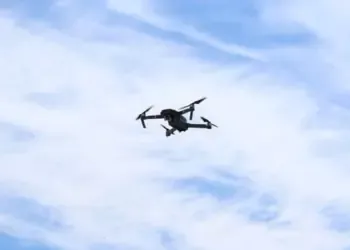
After a long period of limited use, the Bayraktar TB-2 drone has reappeared in Ukrainian operations. The twin-tailed UAV was recently deployed in a mission against Russian forces, striking a patrol boat and ground units along the Black Sea coast. Although the number of such strikes remains small, they mark the return of a platform that proved highly effective in the early days of the full-scale war, when it played a key role in destroying Russian convoys. More recently, the TB-2 has been used primarily for reconnaissance, as its vulnerability to Russian air defenses and electronic warfare had kept it away from direct strike missions on the front line.

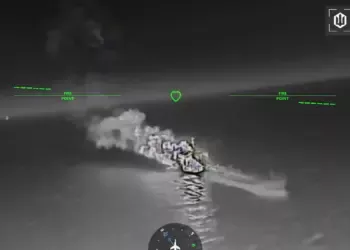
“The Navy destroyed another high-speed boat of the Russian Black Sea Fleet that was attempting to land airborne troops on the Tendriv Spit. Seven occupants were killed and four wounded,” the Ukrainian Navy reported on Telegram. While the statement did not specify the weapon used, visual markers in the released video suggest the strike was carried out with a Bayraktar drone.
A few weeks earlier, Ukraine’s Main Intelligence Directorate released footage of a TB-2 strike on a small Russian boat near Zaliznyi Port in the Kherson region. The TB-2 uses small precision-guided munitions, enabling it to hit multiple targets during a single sortie. In June, the Ukrainian Navy also published video of a Bayraktar attack on a Russian landing craft along Kherson’s western coast.
Before these recent operations, TB-2 drones had seen a long pause in strike missions. Ukraine began using the Turkish-made UAVs from Baykar even before the full-scale invasion. The first recorded strike came in October 2021, when a TB-2 destroyed a separatist D-30 122 mm howitzer in Donbas. In the early months of Russia’s invasion, the drones played a critical role in halting advancing columns toward Kyiv and later assisted in Ukraine’s effort to reclaim Snake Island.
By March 2022, at least 26 Bayraktar TB-2 drones had been destroyed, according to open-source data from Oryx. The actual number was likely higher, as Oryx records only losses confirmed by photo or video evidence. Ukrainian media noted that Russia had adapted to the threat by deploying improved electronic warfare systems and layered air defenses, making the relatively large and slow UAVs vulnerable to systems such as Pantsir-S1, Buk, and Tor. By 2023, Ukrainian forces had largely stopped using the TB-2 as a strike platform, keeping it mainly for reconnaissance and occasional attacks in less defended areas.
The return of Bayraktar drones to strike missions has been made possible by Ukraine’s ongoing attacks on Russian air defense systems in Crimea and Kherson. Ukrainian media described Wednesday’s strike as significant, noting that the Armed Forces have been systematically working to enable such operations by disabling Russian air defenses – often with the help of other drones.
The use of TB-2 drones for strike missions in this area suggests that part of the airspace has become safer for such operations. The drone’s advantages include eliminating risk to aircrews, reducing the need to expose Ukrainian aircraft, and maintaining the ability to strike moving targets. In other words, a drone can be deployed in situations too risky for manned platforms. Another factor is that TB-2 drones are now produced in Ukraine, despite repeated Russian attempts to target and disrupt local manufacturing facilities.
While occasional Bayraktar strikes do not necessarily signal a permanent return of these drones to Ukraine’s strike aviation, they highlight the military’s ability to adapt quickly, exploit gaps in Russian air defenses, and raise questions about the actual effectiveness of Russia’s air defense network.
Read also:
- Ukraine Deploys Swarms of Autonomous Drones: AI Is Changing the Battlefield
- Ukrainian Company Fire Point Announces Two Ballistic Missiles: FP-7 and FP-9
Source: twz