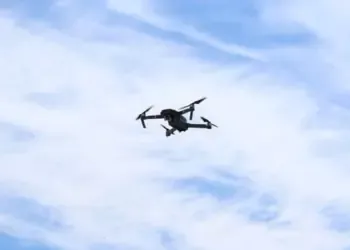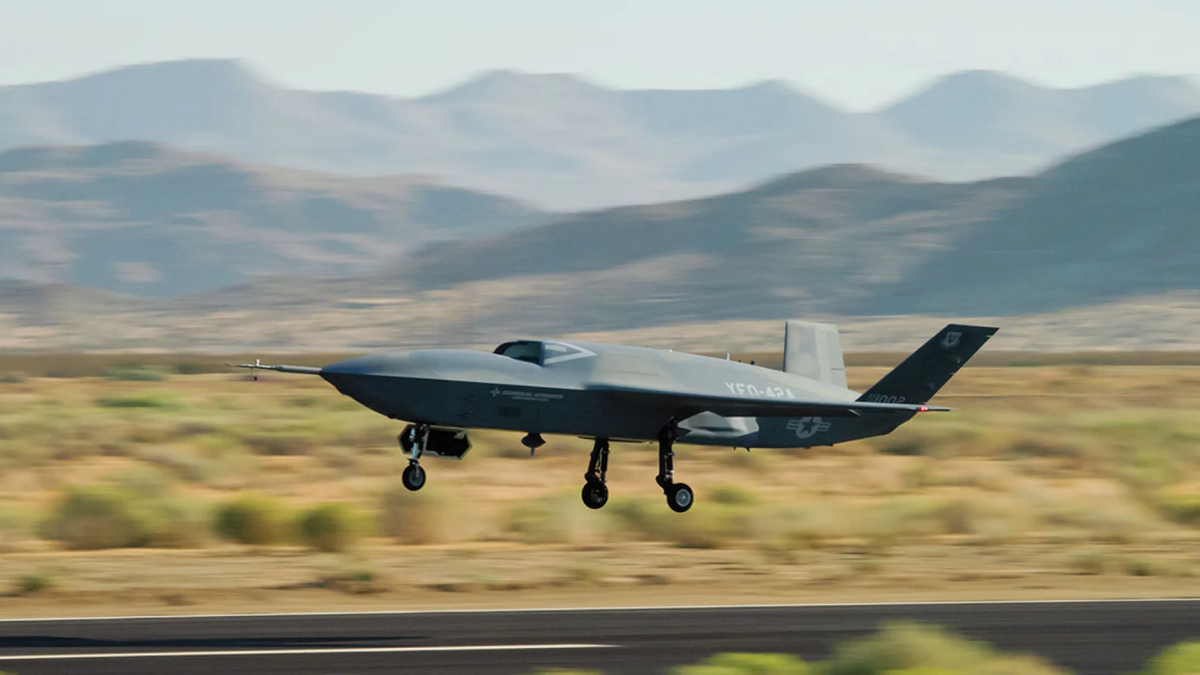
The U.S. Air Force’s first official combat drone took to the skies just a year after development and construction began. The YFQ-42A, developed by General Atomics, is currently undergoing flight testing in preparation for potential inclusion in a future fleet of thousands of autonomous aircraft. The project aims to demonstrate a new era of unmanned aviation capable of performing combat missions on par with manned aircraft while reducing risks to human crews.

The YFQ-42A, known as the Collaborative Combat Aircraft (CCA), is not the only autonomous combat drone currently in development, but it is the first of two – alongside the Anduril YFQ-44A – officially recognized as combat aircraft by major air forces. The model designation breaks down as follows: Y for prototype, F for fighter, Q for unmanned aircraft, with the numbers 42 and 44 and the series letter A indicating the specific project and generation.
The drone is intended to form part of a “Loyal Wingman” fleet of jet-powered autonomous combat aircraft capable of operating alongside fifth- and sixth-generation fighters, including the F-22 Raptor and F-35 Lightning II. These unmanned aircraft act as force multipliers, costing significantly less than manned fighters while using advanced machine-learning algorithms to enable effective human-machine collaboration. Pilots can focus on tactical objectives while relying on autonomous drones that are capable of operating independently even in combat conditions.
The YFQ-42A is built on General Atomics’ Gambit family of unmanned aircraft. Its development was accelerated through model-based digital design and autonomous avionics, which were tested over five years on the MQ-20 Avenger (formerly Predator C) and the offboard sensing platform XQ-67A (OBSS). This experience significantly shortened the timeline from concept to prototype while ensuring reliable flight control and autonomous navigation systems.
Although still at the prototype stage, the YFQ-42A already demonstrates strong capabilities. It is estimated to have a range exceeding 700 nautical miles (approximately 1,300 km), with a payload bay capable of carrying two air-to-air missiles. The fuselage is designed for a low radar and infrared signature to reduce detectability and is equipped for aerial refueling, extending both operational range and autonomy.
David R. Alexander, President of GA-ASI, highlighted the achievement: “This is a significant milestone for both the U.S. Air Force and our company. Together, we managed to design, build, and fly the YFQ-42A in just one year. It’s a notable accomplishment, and I commend the Air Force for their foresight and our engineering team for reaching this historic milestone.”
A decision is expected in 2026 on which of the two prototypes – YFQ-42A or YFQ-44A – will enter serial production for the U.S. Air Force. The program is already demonstrating a new level of integration between autonomous systems and manned platforms, laying the groundwork for future generations of combat aviation.
Source: NewAtlas