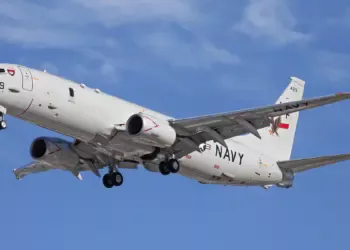
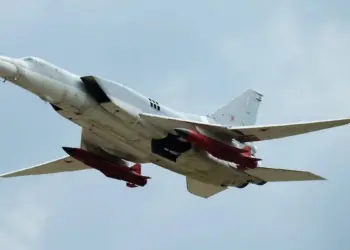
A photographer captured rare footage of one of the U.S. military’s most secretive aircraft, a Boeing 737 better known by its callsign RAT55. The video was taken near Tikaboo Peak, the closest location where civilians can observe the Groom Lake test range, more widely recognized as Area 51.
The recording shows the aircraft departing on an undisclosed mission in the morning and returning a few hours later. Before completing a full landing, it performed several practice approaches, eventually taxiing to Hangar 18, one of the largest structures on the base. This not only confirmed the plane’s connection to Groom Lake but also pinpointed its operational hub.

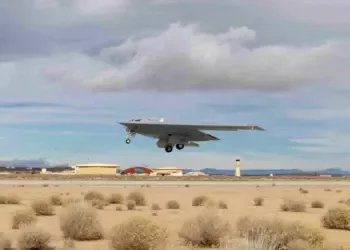
Two new radomes were spotted on the fuselage of RAT55, suggesting that additional equipment has been installed. The aircraft’s primary role is to evaluate the radar signatures of stealth platforms, including both new prototypes and established designs such as the B-2 Spirit bomber. Continuous measurements help determine whether these aircraft maintain their intended low observability over time.
The demand for such testing is increasing as development of next-generation stealth programs accelerates. Among these are the Northrop Grumman B-21 Raider strategic bomber and the Boeing F-47 fighter.
Hangar 18 itself also draws attention. In popular culture, it is often linked to conspiracy theories about extraterrestrials, but even without those associations, the facility has practical importance. Built in the 1980s, it was for many years the largest structure at the base, capable of housing any aircraft in the U.S. Air Force inventory. It has also been speculated that experimental platforms undergoing tests at Area 51 may have been stored there.
Because of the aircraft’s specialized role, high-quality photos of RAT55 are rare and usually appear only when it operates outside the test range. Officially, it belongs to the U.S. Air Force under the Air Force Materiel Command, but no public statements are provided about its missions.
The NT-43A, the designation for RAT55, is a unique aircraft. Most Boeing 737s of this type in U.S. service have long since been retired or converted, with newer models replacing them. Despite its age, RAT55 continues to receive upgrades, underscoring its ongoing relevance to current military programs.
During the same trip, Michal Rokita also documented flights of several F-117A Nighthawk aircraft. Although officially retired from service in 2008, they remain in active use over Nevada and beyond. Initially, their activity went unacknowledged, but in recent years the U.S. Air Force has confirmed their role in training exercises and even in testing new systems. The F-117s were previously stationed at Tonopah Airport, but runway reconstruction work has led to some being relocated to Groom Lake.
Experts suggest their presence may be connected to the Next Generation Air Dominance (NGAD) program, where the aircraft serve either as aggressor units or as platforms for testing emerging technologies. Using older, well-documented airframes instead of new prototypes reduces the risk of unwanted information leaks and allows testing to be carried out in daylight hours.
Read also:
- Chinese Fighter Jet Performs Risky Maneuver Near Philippine Coast Guard Aircraft
- Northrop Grumman Unveils Concept for Next-Generation F/A-XX Fighter
Source: theaviationist