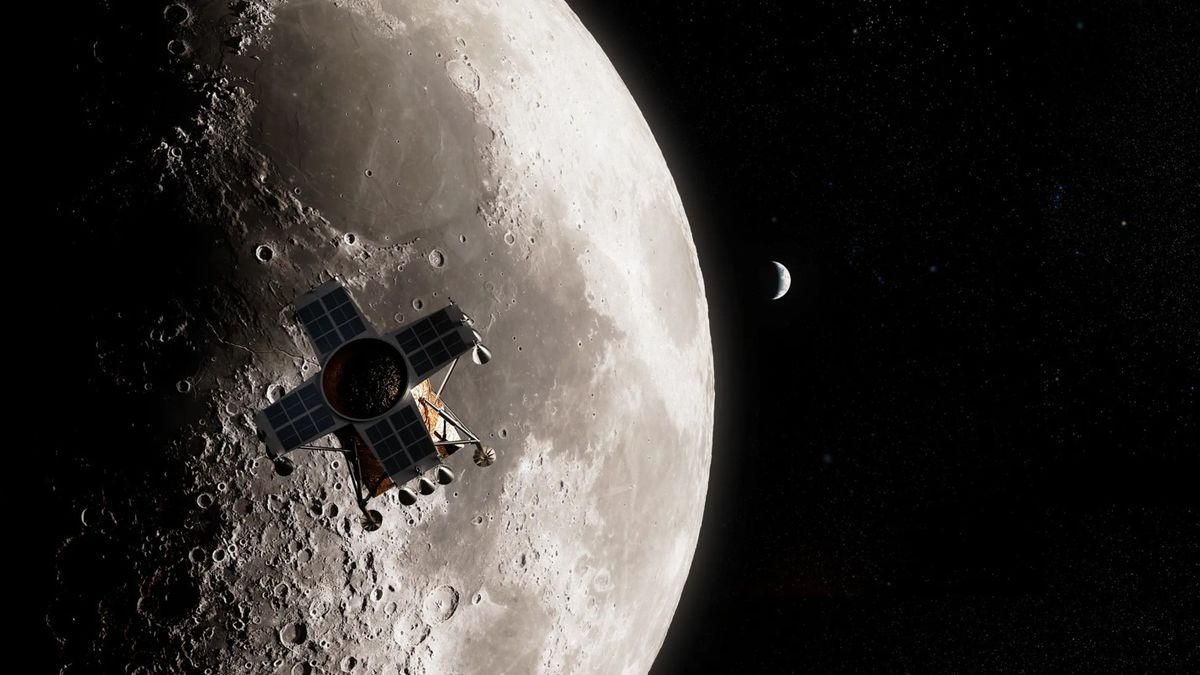
A new ambitious player has entered the private lunar exploration sector. Impulse Space, founded in 2021 by Tom Mueller – the first employee ever hired by Elon Musk at SpaceX – has announced plans to develop its own robotic lunar lander.
“As President John F. Kennedy once said, going to the Moon is hard. But we know that at Impulse, some of the most talented aerospace engineers are pushing the boundaries of innovation every day,” said Tom Mueller. “We are confident in our ability to tackle the most complex technological challenges and look forward to continuing to expand our horizons beyond Earth.”

Impulse Space specializes in in-space transportation, delivering spacecraft to precise points after reaching orbit. The company is already operating a small tug, Mira, which first flew in November 2023 as part of the SpaceX Transporter-9 mission.
Impulse is also developing a more powerful platform called Helios – a kick stage designed to transport large payloads from low Earth orbit to geostationary orbit or cislunar space. The first Helios flight is scheduled for late 2026.
This system will be a key component of the company’s new lunar project. According to the plan, Helios will carry a lunar lander developed in-house by Impulse Space. Both spacecraft are expected to launch together on a standard medium- or heavy-lift rocket.
“After placing Helios and the lunar lander into low Earth orbit, Helios will act as a cruise stage, transporting the lander to low lunar orbit over the course of one week,” the company stated. “The lunar lander will then separate from Helios and descend to the Moon’s surface. Thanks to Helios’s high delta-v capability, this mission architecture does not require in-space refueling.” Each mission will be able to deliver up to 3 t of payload to the Moon, with the first flight potentially occurring as early as 2028.
Currently, companies such as Intuitive Machines, ispace, Astrobotic, and Firefly Aerospace are already developing or testing lunar landers. However, most face limited payload capacity and technical challenges during landing. Meanwhile, NASA is working with SpaceX and Blue Origin on large-scale crewed systems for the Artemis program, aimed at landing astronauts on the Moon.
Impulse’s new development aims to fill an intermediate niche, providing a cost-effective method for delivering medium-sized payloads to support a sustainable lunar infrastructure. Potential payloads could include lunar rovers, transport platforms, power generators, communication systems, and habitation modules.
The engine for the new lunar lander is already under development. It will use a bipropellant combination of nitrous oxide and ethane, the same propellant successfully employed on the Mira tug. “We are confident in our ability to implement this solution thanks to our extensive experience in rapidly achieving mission success,” concluded Tom Mueller.
Read also:
- U.S. Delays Launch of Early-Warning Satellite
- VORTEX: France Is Developing a Next-Generation Reusable Orbital Spaceplane
Source: space