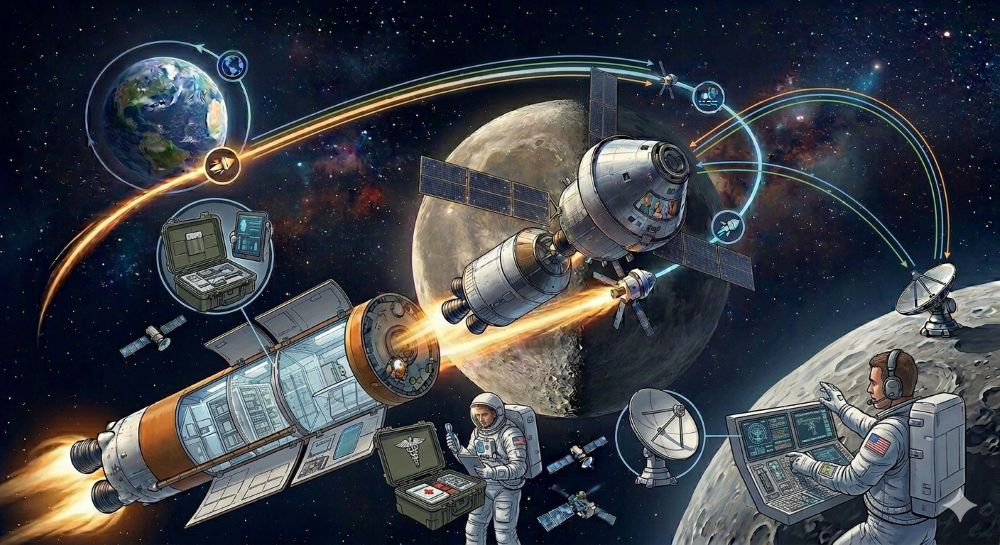
Humanity is returning to lunar orbit, and NASA has, for the first time, outlined in detail how each of the ten days of the Artemis II mission will unfold.
TABLE OF CONTENT:
Artemis II: 10 Days That Return Humanity to the Moon
This mission is not merely a flight, but a carefully structured sequence of phases in which each stage is time-critical, from launch through reentry.
Within eight minutes of liftoff aboard the Space Launch System, the four-person crew will reach Earth orbit. Commander Reid Wiseman, pilot Victor Glover, mission specialist Christina Koch, and Canadian astronaut Jeremy Hansen will begin the first crewed mission to the Moon in more than 50 years.
The ten-day mission follows a complex flight profile, including maneuvers to enter a lunar trajectory, a flyby of the Moon without landing, and return to Earth. Throughout the mission, the crew will test the Orion spacecraft under deep-space conditions, evaluating navigation, life support, and communication systems, as well as contingency procedures.

The ближайші launch windows for the Artemis II lunar mission are scheduled for April 1, 3, 4, 5, 6, and 30, 2026.
This is not a nominal “dress rehearsal,” but a critical phase of the Artemis program. The results of Artemis II will directly determine readiness for the next step – crewed lunar landings in subsequent missions.
The mission involves ten days of elevated risk, precise execution, and system validation, effectively marking the beginning of a new phase in crewed operations beyond low Earth orbit.
Read also: Boeing CST-100 Starliner: Mission That Nearly Ended in Disaster
Artemis II – Day One: Orbit, System Checks, and Preparation for Lunar Injection
The moment the engines of the Space Launch System shut down marks only the starting point of the most intensive phase of the first day of the Artemis II mission. Within minutes after launch, the Orion spacecraft, together with the Interim Cryogenic Propulsion Stage (ICPS), will separate from the core stage, initiating a sequence of precise orbital maneuvers.
The ICPS plays a central role at this stage. Approximately 49 minutes after launch, its engine will perform the first burn, raising the orbital perigee to a safe altitude above 160 km. A second ignition, roughly one hour after liftoff, will place Orion into a high Earth orbit, effectively serving as a staging point for the transition to deep space.
This is followed by nearly a full day in relative proximity to Earth. With launch loads behind them, the crew transitions to operational mode. The astronauts remove their pressure suits, configure the cabin, and adapt to microgravity conditions. At the same time, a series of critical checks begins without delay. Life support systems – including water supply, waste management, and CO₂ removal – must demonstrate reliability under actual flight conditions.
A separate segment is dedicated to flight testing. Within hours of launch, NASA will conduct the first integrated controllability test of Orion. For this purpose, the crew will use the expended ICPS stage as a reference target. Following separation, the astronauts will perform a series of proximity and flyaround maneuvers, assessing navigation accuracy and control system responsiveness. These procedures directly support preparation for future missions involving complex docking operations in lunar orbit.
After completing the tests, the ICPS will execute a final deorbit maneuver and reenter the atmosphere over the Pacific Ocean. Orion, meanwhile, will remain on its planned trajectory, preparing for the next phase of the mission.
The crew schedule will be tightly constrained. After approximately eight and a half hours of continuous activity, the astronauts will be allocated only a short rest period – around four hours of sleep – considered sufficient for recovery ahead of subsequent maneuvers.
The night phase in orbit will be interrupted by a scheduled wake-up and another engine burn. This maneuver will refine the orbital geometry ahead of the key event of day two – the trans-lunar injection (TLI), which will send the spacecraft toward the Moon.
At the most distant point in orbit, the crew will also test long-range communication systems using the Deep Space Network infrastructure. Only after confirming signal stability and correct orbital parameters will Mission Control authorize another short sleep period of approximately four and a half hours.
This concludes the first day – intensive, technically demanding, and decisive for the mission as a whole. It establishes the foundation for the primary maneuver: the transition to a lunar trajectory.
Read also: All About Starship V3: Technological Platform for the Next Spaceflight Era
Artemis II – Day Two: The Final Step from Earth to the Moon
The second day of the Artemis II mission begins not with high-visibility maneuvers, but with routine operations essential for sustained work in space. Commander Reid Wiseman and pilot Victor Glover will be the first to begin, deploying and testing an onboard flywheel-based exercise system.
This training is a critical component of the mission. In microgravity, the human body rapidly loses muscle and bone mass, making daily exercise mandatory. Each astronaut is expected to spend at least 30 minutes on physical activity, combining both aerobic and resistance training. The compact flywheel device integrated into Orion can simulate loads of up to approximately 180 kg, enabling effective workouts in weightlessness.
For NASA, this also serves as an important engineering validation. Exercise significantly increases oxygen consumption and CO₂ output, placing peak demands on life support systems. For this reason, training sessions are staggered: Christina Koch and Jeremy Hansen will exercise later to distribute the load more evenly across the spacecraft’s systems.
In parallel, the crew will prepare for the key event of the day – the trans-lunar injection (TLI) maneuver. This is the decisive burn that will place the spacecraft on a trajectory beyond Earth orbit. The main engine of Orion’s European Service Module, producing approximately 2.7 tonnes of thrust, will execute a prolonged and highly precise burn.
This maneuver marks the transition from an “orbital test” to an actual deep-space transfer. The selected trajectory is a so-called free-return path, ensuring that even in the event of major system failures, the spacecraft will naturally loop around the Moon and return to Earth.
Following completion of the TLI burn, onboard dynamics shift. Operational intensity decreases, and Orion effectively enters a translunar trajectory. The remainder of the day is allocated to adaptation: the crew continues adjusting to microgravity, while engineers analyze incoming telemetry.
During this period, active communication with Earth also begins. The crew conducts initial video transmissions, initiating a series of regular communication sessions. Up to two such sessions per day are planned throughout the mission, with exceptions only for a designated rest day and the final phase of return.
Day two represents a literal point of no return. After TLI, the spacecraft is no longer in Earth orbit but committed to a trajectory toward the Moon. This marks the beginning of the mission’s deep-space phase.
Read also: Mission Control: How Ukraine Is Building a Unified Digital Brain for Drone Warfare
Artemis II – Day Three: Course Correction and Testing at the Limits
The third day of the Artemis II mission focuses on precision, where even minimal deviations can affect the outcome of the entire expedition. Orion is now on its trajectory to the Moon, and the crew is conducting the first of three planned course correction burns. Jeremy Hansen will spend the morning preparing the systems for this maneuver. This short but highly precise engine impulse confirms the spacecraft is on the planned path.
Following the course adjustment, the mission enters a less visually dramatic but equally critical phase: emergency procedure drills. Victor Glover, Christina Koch, and Jeremy Hansen simulate urgent medical interventions, performing cardiopulmonary resuscitation in microgravity. In space, even basic medical procedures become engineering challenges. To perform compressions effectively, astronauts must secure themselves relative to the patient, as any unanchored movement would push them away.
Meanwhile, Commander Reid Wiseman and Glover will test Orion’s medical kit. This involves checking standard devices, from blood pressure monitors to stethoscopes, under deep-space conditions, where even simple measurements can behave differently in the absence of gravity.
The second half of the day shifts focus to communications and preparation for key scientific operations. Christina Koch will test emergency communication channels via the Deep Space Network – the only infrastructure capable of maintaining a stable link with the spacecraft at such distances.
The day concludes with a joint “full-dress rehearsal.” All four astronauts will practice the precise sequence of actions required during close lunar approach. This is effectively a training exercise measured in seconds. Tasks involving observation ports, cameras, and navigational markers must be perfectly synchronized, as opportunities to collect data from the Moon’s far side will be brief and unique.
Day three marks the transition from acceleration to control. The spacecraft is now on course, and the crew’s primary objective is to maintain this precision while demonstrating readiness for any contingency.
Read also: Everything About the P1-Sun – SkyFall’s Ukrainian Interceptor Drone
Artemis II – Day Four: Navigation, Training, and a View into the Infinite
The fourth day of the Artemis II mission combines precise engineering with human curiosity. Orion continues its journey toward the Moon, and the second trajectory correction is scheduled for this phase. NASA engineers calculate the maneuver to fractions of a second, ensuring the brief engine burn aligns the spacecraft precisely within its planned flight corridor.
While onboard systems perform complex calculations, the crew shifts to intensive preparation. Each astronaut dedicates roughly an hour to studying the lunar surface in detail – not theoretically, but with practical focus for upcoming observations. Terrain features, craters, mountain ranges, and navigational landmarks must be immediately recognizable.
This preparation is critical because actual lighting conditions and approach geometry depend on the exact launch time from Earth and the trajectory parameters. The crew must be ready to adapt in real time, ensuring that no observation or data collection opportunity is lost during the moments of closest lunar approach.
A distinct element of the schedule is a brief but symbolic “window” for astrophotography. For approximately 20 minutes, the crew focuses not on engineering tasks but on capturing the cosmos as seen by very few. Through Orion’s windows, they gain a unique perspective: deep space free from atmospheric distortion.
These images carry both aesthetic and scientific value. They help refine observation parameters while establishing a new visual language for space exploration – one that communicates complex concepts through simple, inspiring imagery.
Day four represents a balance between precise algorithms and the human element. The spacecraft moves ever closer to the Moon, and the crew approaches the moment for which this mission was conceived.
Read also: All About Project Suncatcher: Google’s Space Experiment
Artemis II – Day Five: Gravity’s Edge and Survival Testing
The fifth day of the Artemis II mission marks the point where abstract physics becomes tangible reality. Orion crosses a notional gravitational boundary: for the first time, lunar gravity begins to dominate over Earth’s. From this moment, the trajectory takes on a new meaning. The crew is no longer merely moving away from Earth; they are effectively “falling” toward the Moon, guided by its gravitational field.
Before reaching the mission’s climax, the crew undertakes one of the most demanding practical tests. The entire morning is dedicated to evaluating the survival suits – a critical safety system developed by NASA. These orange suits are more than launch-and-landing gear. In the event of cabin depressurization, they function as autonomous life-support systems, capable of sustaining an astronaut for several days.
The crew rehearses scenarios closely simulating emergencies: rapid suit donning, sealing, seat restraint, and system activation. Even routine actions – such as eating and drinking through helmet interfaces – are tested. The goal is to ensure that under stress, all procedures can be executed flawlessly and within the prescribed time.
This phase is critical, as Reid Wiseman, Victor Glover, Christina Koch, and Jeremy Hansen are effectively the first to test these systems in actual deep-space conditions rather than on simulators.
In the afternoon, the third and final trajectory correction takes place. This brief engine burn represents the last adjustment before the mission’s key event: the flyby of the Moon’s far side. After this maneuver, the trajectory is as precise as possible, leaving minimal margin for error.
Day five marks the transition from preparation to culmination. The spacecraft is now under the influence of another celestial body, and the crew stands just one step away from the historic moment of lunar approach.
Read also: Inertial Navigation Systems: How It Works
Artemis II – Day Six: Maximum Distance and the Silence of the Far Side
The sixth day of the Artemis II mission represents its climax. Orion reaches its greatest distance from Earth and passes closest to the Moon during the flyby.
With a favorable launch window, the crew could surpass the historic distance record for a crewed mission set by Apollo 13 – approximately 400,000 km from Earth. Whether this record is broken depends on a precise combination of launch parameters and orbital geometry.
During the flyby of the Moon’s far side, the spacecraft approaches the surface by thousands of kilometers. Much of the day is devoted to intensive observation. Reid Wiseman, Victor Glover, Christina Koch, and Jeremy Hansen operate cameras and use the Orion’s windows to document terrain not visible from Earth.
Lighting conditions play a critical role and cannot be precisely predicted before launch. Low-angle sunlight casts sharp shadows, emphasizing crater and ridge geometry. Higher sun angles reduce contrast but reveal subtle variations in color and regolith structure, which are valuable for detailed mapping.
The most dramatic phase comes with the loss of communication. As Orion passes behind the Moon, the satellite’s bulk completely blocks radio signals. Contact with Earth is cut off instantly, leaving the crew fully autonomous for 30–50 minutes – without commands from Mission Control or any outside contact.
During this “radio blackout,” the astronauts follow pre-planned procedures. They make voice recordings, document observations, and continue photography. Once communication is restored, these audio logs will be synchronized with visual data, creating a detailed timeline of the flyby.
Day Six combines peak scientific output with total isolation. This is where the mission shifts from demonstrating capabilities to putting them into practice – under the most challenging conditions of deep space.
Read also: Weapons of Ukraine’s Victory: The Heavy Cruise Missile “Flamingo”
Artemis II – Day Seven: Leaving the Moon and Heading Home
The seventh day of the Artemis II mission marks a shift in the gravitational vector. Orion exits the Moon’s dominant influence and begins its return trajectory, now heading back toward Earth. From this point, the flight is defined not by approach but by the precision of the return.
The first hours after the flyby are critical for capturing results. At NASA’s initiative, the crew conducts a series of operational communication sessions. Engineers, scientists, and analysts gather fresh impressions and technical observations while details are still “hot.” This involves not only the astronauts’ experiences but also nuances of system behavior and visual features of the Moon’s far side, which are difficult to replicate through telemetry alone.
Artemis II – Day Seven (Afternoon): Precision and Pause
In the second half of the day, the mission shifts back into precise engineering mode. Orion’s main engine executes the first in a series of mid-course corrections on the return leg. Though brief, this burn is critical: it fine-tunes the trajectory to align with the narrow Earth reentry window.
Once the course parameters are confirmed, Mission Control grants the crew a rare pause. Reed Wiseman, Victor Glover, Christina Koch, and Jeremy Hansen transition to recovery mode – reducing workload, resting, and performing basic physiological routines.
This “day of calm” serves a clear purpose: rebooting the crew and systems before the final, high-risk phase of the mission – the atmospheric entry – where there will be no room for error.
Read also: History and Achievements of SpaceX: Elon Musk’s Great Space Passion
Artemis II – Day Eight: Radiation Testing and Manual Control
The eighth day of the Artemis II mission deviated from the relatively routine schedule, exposing the crew to scenarios simulating some of the most demanding conditions in deep space. The primary hazard addressed during these activities was cosmic radiation and unpredictable solar flares, which can pose a threat to the crew within a short time frame.
Astronauts conducted emergency procedures, practicing the rapid assembly of an improvised shelter within the Orion capsule using onboard supplies and equipment in the event of a radiation alert. Numerous high-sensitivity sensors continuously measured radiation penetration through the spacecraft’s hull, generating data relevant to future missions, including potential Mars flights.
Later in the day, Commander Reid Wiseman and Pilot Victor Glover disengaged their seat restraints and the autopilot system to assume full manual control. The crew evaluated Orion’s handling under manual operation, simulating scenarios where navigation computers might fail. Tests included precise orientation toward the spacecraft’s windows, aligning the aft section with the Sun, and operating the attitude control system in both three- and six-degree-of-freedom modes.
These exercises provided engineers with detailed information on Orion’s responsiveness to manual inputs, a critical factor for planning future complex and autonomous missions in deep space.
Read also: Is Space Becoming the New Battlefield?
Artemis II – Day Nine: Preparations for Return
The ninth day of the Artemis II mission focused on both psychological and physical rehearsal in advance of the final, highest-risk phase of the expedition. The crew spent the last full 24 hours in space performing entry procedures and coordinating actions with flight controllers in Houston.
During this period, onboard computers executed the penultimate trajectory correction to ensure Orion remained on an accurate course for splashdown. Crew responsibilities extended beyond observation and scientific experiments, encompassing verification of backup systems, including alternative waste management methods in case of a primary system failure.
After more than a week in microgravity, re-entry to Earth presents significant physiological stress. Rapid re-exposure to gravity can cause orthostatic intolerance, dizziness, fainting, and temporary visual disturbances due to blood redistribution from the upper body to the legs.
To mitigate these effects, astronauts wore specialized compression garments beneath their suits. On this day, they performed fittings, conducted precise body measurements, and completed detailed questionnaires to assess comfort and usability of the garments, which are tightly fitted but essential for maintaining circulation and stability during return.
Read also: Can the U.S. Plant Its Flag on Mars?
Artemis II – Day Ten: Re-entry Operations
The tenth and final day of the Artemis II mission involved executing the procedures required for the safe return of the four astronauts. Following the final firing of Orion’s correction engines, the spacecraft was reconfigured for re-entry.
All scientific equipment was secured in storage compartments, seats were returned to launch positions, and the crew donned pressurized suits. Immediately prior to atmospheric entry, Orion separated from the service module, which had supported the crew throughout the mission.
This separation exposed the spacecraft’s critical heat shield, designed to absorb the extreme temperatures exceeding 1,600 °C during re-entry, thereby protecting the crew.
As the capsule, enveloped in plasma, passed through the densest layers of the atmosphere, the descent sequence commenced. The spacecraft’s upper cover was jettisoned to allow deployment of the parachute system for controlled landing.
Two smaller drogue parachutes deploy first, stabilizing the rotating Orion and reducing its speed to approximately 500 km/h. This is followed by the deployment of three pilot parachutes, which extract the large main parachutes from their containers, slowing the spacecraft to around 27 km/h.
The Artemis II mission is scheduled to conclude with a splashdown in the Pacific Ocean. U.S. Navy recovery teams and NASA technical personnel will recover the crew, marking the completion of a mission that extended beyond routine operations to include a journey to the Moon.
Read also: How the F-15 Eagle Fighter Plane Destroyed the Solwind P78-1 Satellite
Will humanity really be back on the Moon?
The Artemis II mission represents the culmination of decades of development in human spaceflight programs. It tested next-generation technologies – from Orion’s life support systems to advanced maneuvering engines and protective suits – and provided evidence of human capability to operate and survive in deep space.
The crew demonstrated that the combination of rigorous preparation, advanced technology, and human resilience can address a wide range of challenges, from microgravity to radiation hazards. The scientific data collected during the lunar flyby, including observations of the Moon’s far side, provide new opportunities for mapping, geological study, and planning future crewed missions to Mars and other Solar System bodies.
The conclusion of the Artemis II mission will mark not only a technical achievement but also a new phase in human space exploration. It underscores that, even across hundreds of thousands of kilometers, humans can return safely home, enriched with experience, knowledge, and insights to guide future generations of explorers.
Read also: