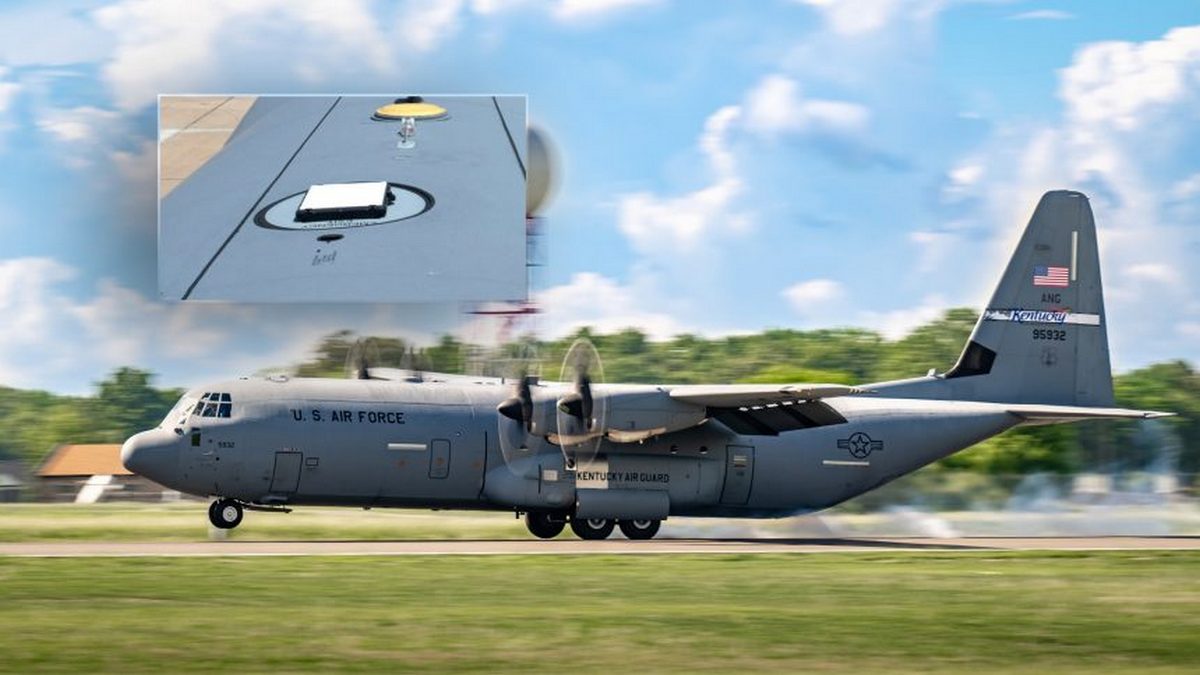
At Dyess Air Force Base in Texas, the U.S. Air Force’s 317th Airlift Wing is implementing a strategic initiative under Air Mobility Command (AMC) to equip a quarter of its fleet with modern satellite-based tactical communication systems capable of operating both within line of sight (LOS) and beyond it (BLOS). As part of the “25 by 25” project – launched by General Mike Minihan – Air Force personnel conducted a test on June 4, 2025, installing SpaceX’s Starshield terminal on the emergency hatch of a C-130J Super Hercules. Starshield is a satellite system developed specifically for military use.
This upgrade introduces what the Air Force calls a “next-generation airborne tactical communication system,” aimed at enhancing command and situational awareness for future missions. Known as the “Joint Airborne Package,” the setup integrates radio frequency antennas into aircraft hatches and uses the low-Earth orbit Starshield network to maintain secure, high-bandwidth BLOS communications.

A key advantage of the system is its ease of installation. It requires no structural modifications to the aircraft and can be mounted by standard maintenance personnel. According to Air Mobility Command (AMC), the system is capable of supporting four separate tactical networks simultaneously, each with different classification levels. This is made possible through integrated server modules and network nodes. It is also compatible with existing data exchange platforms, including Link 16 and the newer Link 22.
Photos released through the DVIDS system show a square antenna mounted on the existing cargo hatch. Technicians from the U.S. Army’s 4th Joint Communications Support Element, working alongside the Air Force’s 317th Squadron, conducted system checks – filling out test protocols, taking radio frequency measurements, and using spectrum analyzers to identify potential signal interference.
Darrell Witt, lead for the Joint Communications Support Element, emphasized that the system is designed to provide commanders with accurate, real-time information during troop movements – an essential capability for effective decision-making in rapidly changing operational environments. According to Witt, technologies that were once limited by size and cost are now becoming more mobile and adaptable, allowing for quick integration into existing aircraft systems without complex procedures.
Lieutenant Colonel Clay Holt, commander of the 317th Operations Support Squadron, noted that the technology follows a modular, “plug-and-play” format, allowing it to be installed before a flight and removed within minutes. This eliminates the need for permanent aircraft modifications or extensive personnel retraining. Upgraded communication systems on the C-130J significantly enhance crew safety, command efficiency, and situational awareness during missions. The systems are tailored to fit the Agile Combat Employment (ACE) doctrine, which emphasizes flexible, distributed, and resilient operations – particularly in regions like Europe and Asia, where the C-130 remains a key platform for tactical air support.
As part of the “25 by 25” initiative, Air Mobility Command (AMC) aims to equip 25% of its fleet with advanced airborne communication systems by the end of 2025. These systems are designed to support both unclassified and classified data exchange. Major Ryan Robinson, AMC’s tactical communications specialist, stated that the effort is part of a broader strategy to enable adaptive basing, ensure resilient communications, and support flexible, distributed operations.
In a July 2024 report, the U.S. Air Force and Armed Forces acknowledged that General Minihan had to concede the full implementation of the “25 by 25” initiative is unlikely to be completed within the 2025 fiscal year. Nevertheless, the outlined goals remain focused on delivering high-speed communications capable of transmitting critical information – such as situational updates in deployment zones, air and ground threats, fuel availability, and identification of safe landing zones.
During the Bamboo Eagle 24-3 exercise in August 2024, held over the western United States and the Pacific Ocean, Air Mobility Command (AMC) tested its Battle Management Command and Control System. As part of the drills, a KC-46 tanker crew evaluated so-called Executive Communications Kits (ECKs), which transmit satellite signals over both NIPR (non-classified) and SIPR (classified) networks.
Additional testing involved secure voice communications over the VOSIP protocol using an external antenna, as well as experimental hatches equipped with data link hardware for both line-of-sight (LOS) and beyond-line-of-sight (BLOS) communication on C-130 aircraft.
Colonel Jeremy “Grimm” Gould, from AMC’s Future Operations Division, highlighted the successful use of several non-traditional communication setups. A Roll On/Roll Off terminal installed in the emergency hatch of a C-130 provided reliable performance using the PACE framework – Primary, Alternate, Contingency, Emergency – which ensures redundant communication paths in the event of system failure.
Since 2019, SpaceX has launched approximately 4,000 Starlink satellites into low Earth orbit. In contrast, its military-focused counterpart, Starshield, has been deploying a smaller number of demonstration satellites since 2020 using Falcon 9 rockets. According to a March 2024 report by Reuters, these early missions positioned the company to secure a $200 million contract, followed by a larger $1.2 billion agreement with the National Reconnaissance Office (NRO).
The scalable, distributed architecture of the Starshield satellite constellation aligns closely with the U.S. Space Force’s Proliferated Warfighter Space Architecture (PWSA). This initiative focuses on building a resilient, low-latency data relay network capable of supporting satellite-based missile launch detection.
Separately, in January 2025, General Atomics conducted a series of tests with the Gray Eagle Extended Range drone, which was remotely controlled via a satellite network of this type.
It’s worth noting that collaboration between the U.S. Air Force and SpaceX is not new. In March 2023, Stars and Stripes reported a demonstration of Starlink terminals at Yokota Air Base in Japan. One terminal was installed on a C-130J, and during the trial, Major General John Klein conducted a video call with a service member located on Diego Garcia – more than 8,000 kilometers away.
Starlink was widely used during the first year of the Ukraine-Russia conflict, until Elon Musk acknowledged the network’s vulnerability to electronic warfare attacks from Russian forces. Meanwhile, Starshield has already been deployed by the U.S. Marine Corps and installed on U.S. Navy vessels.
Another example comes from the U.S. Navy’s 30th Air Test and Evaluation Squadron (VX-30), known as the “Bloodhounds.” In September 2024, they installed a Starlink system on a KC-130T aircraft. According to NAVAIR command, the system provided beyond-line-of-sight communications, serving as a mobile platform for maritime operations.
Source: TheAviationist