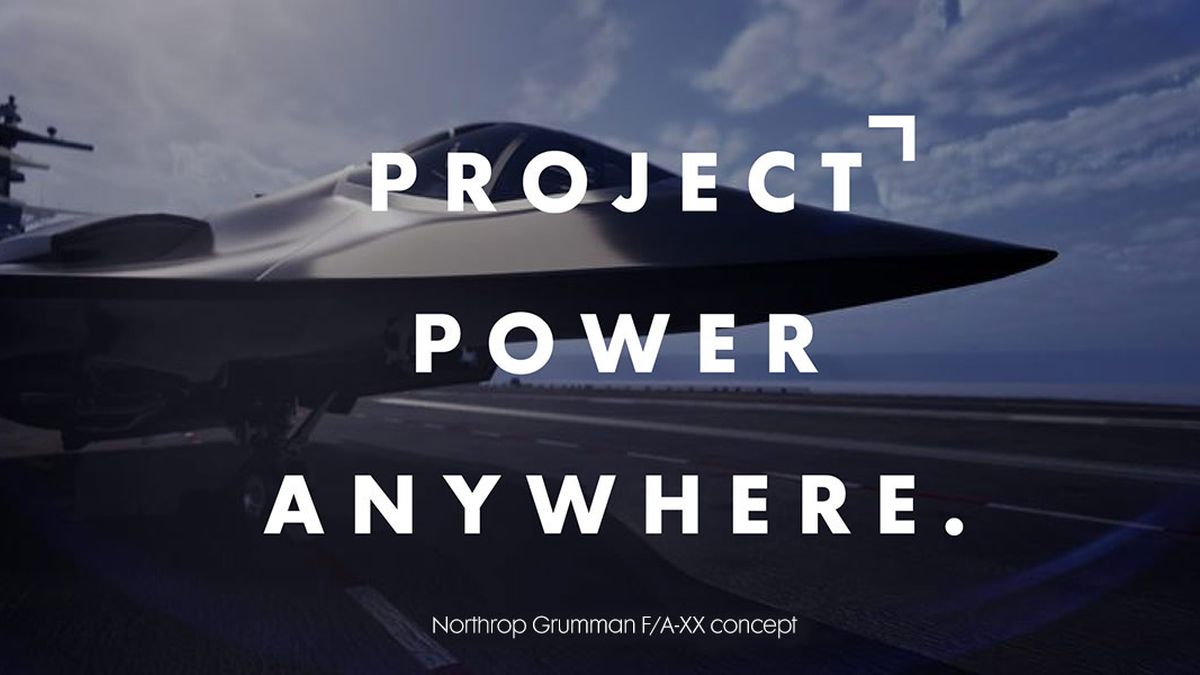
Northrop Grumman has released official concept art of its next-generation F/A-XX fighter on its website. The aircraft is intended to equip the carrier air wings of the U.S. Navy in the future. However, the program’s outlook remains somewhat uncertain, as both the Pentagon and the White House have expressed concerns that continued work on the F/A-XX could slow down development of the F-47 for the U.S. Air Force (more details on that program can be found here).
Following Lockheed Martin’s withdrawal from the program in 2024, only Boeing and Northrop Grumman remain as primary contenders for the contract. Both companies are already deeply involved in developing next-generation aircraft for the Air Force: Boeing with the F-47 fighter under the NGAD (Next Generation Air Dominance) program, and Northrop Grumman with the B-21 Raider strategic bomber.

The concept art was published on Northrop Grumman’s website, though no specific release date is provided. It’s currently unclear how closely the image reflects the final design of the aircraft, as it includes elements reminiscent of earlier concepts developed for the U.S. Air Force’s Next Generation Air Dominance (NGAD) program.
The artwork shows a darkened silhouette of the aircraft positioned on an aircraft carrier deck – an expected setting given its intended naval role. Stealth appears to be a central focus, though the cropped frame makes it difficult to confirm whether the design is tailless. A low-profile air intake is visible on the upper fuselage, just behind the cockpit, with a likely matching intake on the opposite side. Since intake geometry plays a significant role in reducing radar visibility, this image should likely be considered illustrative rather than definitive.
The aircraft’s aerodynamically refined body tapers into a sharp nose, where an active electronically scanned array (AESA) radar is likely to be housed. Notable features typical of carrier-based aviation include a dual-wheel front landing gear and a launch bar for catapult-assisted takeoff.
The F/A-XX fighter is a central combat element of the U.S. Navy’s NGAD (Next Generation Air Dominance) program. The concept was first introduced back in 2008, with an official request for information issued in 2012, aiming to find a replacement for the current F/A-18E/F Super Hornet fleet by the 2030s.
The F/A-XX was later officially incorporated into the U.S. Navy’s NGAD program, which – despite sharing a similar name – is separate from the Air Force’s initiative. According to Navy officials, the specifications are still being refined, but several core requirements are already established. These include extended range, higher speed, integration of both passive and active sensors, and compatibility with next-generation long-range weaponry.
Key features of the new fighter are expected to include AI-driven systems, the ability to operate alongside unmanned aircraft, and a 25% increase in operational range compared to current platforms. The design places strong emphasis on long-range strike capabilities and operations within dense information environments. As part of this vision, the F/A-XX is intended to serve as a command hub for coordinating with drones that form part of the broader NGAD Family of Systems. The first platform expected to implement such collaboration is the MQ-25 Stingray UAV.
Although the project received $454 million in the 2025 budget, the Pentagon has requested only $74 million for 2026 – a reduction that has raised concerns among lawmakers and Navy leadership. Reports suggest that Pentagon officials and the Trump administration are considering deprioritizing the F/A‑XX in favor of the Air Force’s F‑47 program, citing limited industrial capacity as the main reason. Despite this, Navy leaders continue to emphasize the importance of the F/A‑XX, viewing it as critical to maintaining the combat effectiveness of carrier strike groups in future high-tech conflicts.
Read also:
- Hydraulic Fitting Failure Causes B-2 Spirit Crash, Resulting in $300 Million in Damages
- USS Gerald R. Ford and Allied Aircraft Conduct Drills Over Black Sea During Neptune Strike 25-2
Source: theaviationist