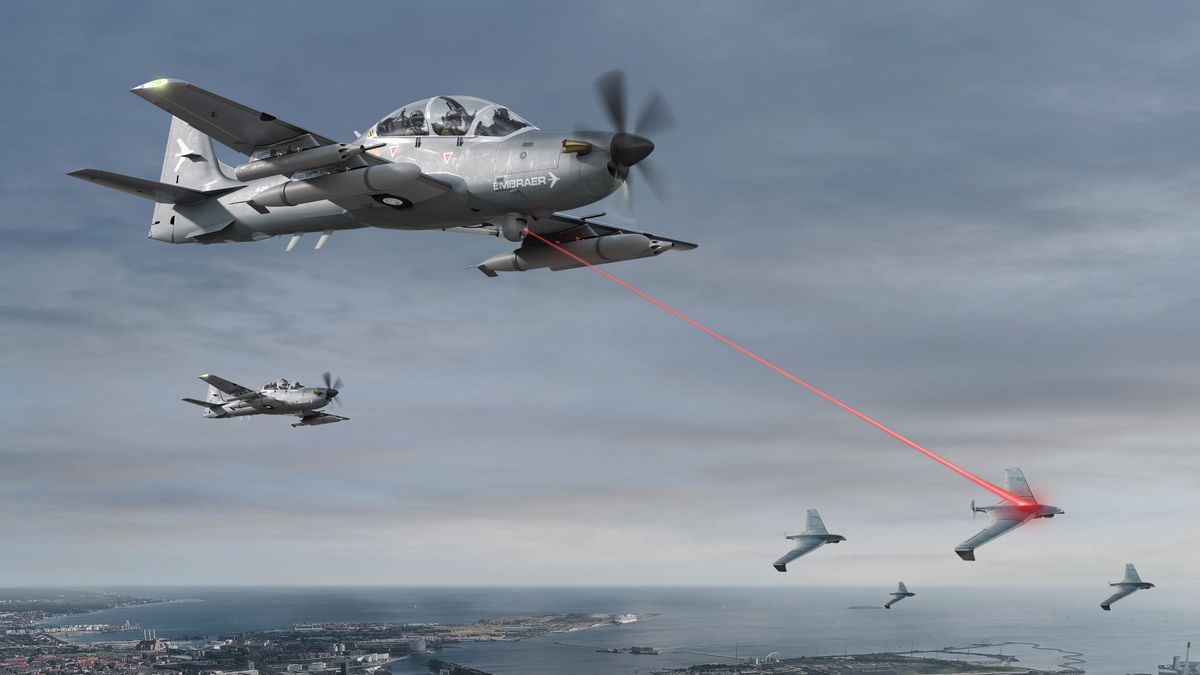
Embraer has unveiled a new concept for its A-29 Super Tucano attack aircraft, adapting the turboprop platform for counter-drone operations. The approach is intended to meet growing demand for effective, low-cost counter-UAS solutions.
The Brazilian manufacturer states that the concept relies mainly on sensors and weapons already integrated into the aircraft, supplemented by updated tactics and procedures. This allows current and future operators to add counter-drone missions to their tasking without requiring extensive avionics upgrades or structural modifications to the airframe.

In its counter-drone configuration, the A-29 Super Tucano uses dedicated data links that receive target coordinates and guide the aircraft to the area of detection. An electro-optical/infrared sensor then performs identification, tracking and laser designation of the target. Drones are engaged using guided rockets or 12.7 mm machine guns mounted on the wings.
“We continue to expand the A-29’s capabilities to address the latest challenges faced by many countries around the world,” said Bosco da Costa Junior, president and CEO of Embraer Defense & Security. “The persistent challenges of modern warfare and recent conflicts worldwide have highlighted the urgent need for counter-drone solutions. The A-29 is a suitable tool for effective and cost-efficient counter-UAS operations.”
One of Super Tucano’s key advantages in counter-drone missions is its moderate speed. Many small reconnaissance or loitering drones operate low and slow, which makes them difficult for fighters to intercept. Jet aircraft are too fast to safely employ machine guns at close range, and using air-to-air missiles against drones such as the Iranian Shahed is economically unjustifiable.
By contrast, the turboprop Super Tucano can loiter for extended periods and maneuver alongside slow targets, while costing significantly less to operate. This makes it an effective asset for persistent patrols and visual engagement of small drones without exhausting air-defense resources.
Read also: Gamified “Drone Army Bonus System” Goes Viral Among Ukrainian Troops
Similar tactics have already proven effective in Ukraine, where aircraft were adapted as “drone hunters.” One unit equipped an agricultural Zlin aircraft with R-73 infrared-guided missiles, while another used Yak-52 trainers from which crews fired rifles and shotguns. Some crews even attempted to ram hostile drones. Ukrainian forces reported shootdowns of Orlan and Zala drones, demonstrating the effectiveness of slow, maneuverable aircraft in this role.
Similar experiments were also carried out by Russia, using training aircraft to intercept Ukrainian drones. However, some of those aircraft were later destroyed by Ukrainian unmanned systems.
These improvised actions demonstrate the need for professional, affordable airborne counter-drone solutions. That is why Embraer is offering a platform that combines the advantages of a slow, economical aircraft with full sensor suites, targeting systems, and precision weapons. For countries that already operate the A-29, the new concept adds capabilities without requiring significant investment. Rather than mobilizing expensive fighters or expending surface-to-air missiles, operators can employ more affordable alternatives.
Against the backdrop of widespread use of inexpensive drones in contemporary conflicts – from Ukraine to the Middle East – the adaptation of the A-29 Super Tucano into a counter-drone platform could signal a new phase in military aviation. Turboprop aircraft, previously employed mainly for close air support and reconnaissance, would assume a significant role in air defense.
Read also:
- Sweden May Partially Finance Gripen Fighter Deal for Ukraine
- Introduced miniature drone Tornyol that destroys mosquitoes… with propellers
Source: aerotime