The U.S. military has confirmed the acceptance of at least six F-35 Joint Strike Fighter aircraft for the U.S. Marine Corps without installed radar systems. The decision stems from delays in the development of the new AN/APG-85 radar, one of the cornerstone components of the Block 4 modernization package for all F-35 variants. The upgrade program has been affected by schedule slippages and rising costs.
The head of the F-35 Joint Program Office, U.S. Marine Corps Lieutenant General Gregory Masiello, disclosed the acceptance of the six radarless F-35B aircraft during testimony before the United States Senate Committee on Armed Services. The issue was raised in response to questions from Mark Kelly regarding the operational readiness of the F-35 fleet across the U.S. Air Force, Marine Corps, and Navy.

Two weeks earlier, the United States Government Accountability Office released a report indicating that the average full mission-capable rate across all F-35 variants declined from 38% to 25% between fiscal years 2020 and 2025.
“According to the GAO, the readiness rate is 25%. Your office says it’s 56%,” Mark Kelly said during the hearing. “Let’s use your figure – 50%. That still means half of the fleet is not fully mission capable. And my understanding is that the Marine Corps has accepted aircraft without installed radars. Is that correct?”
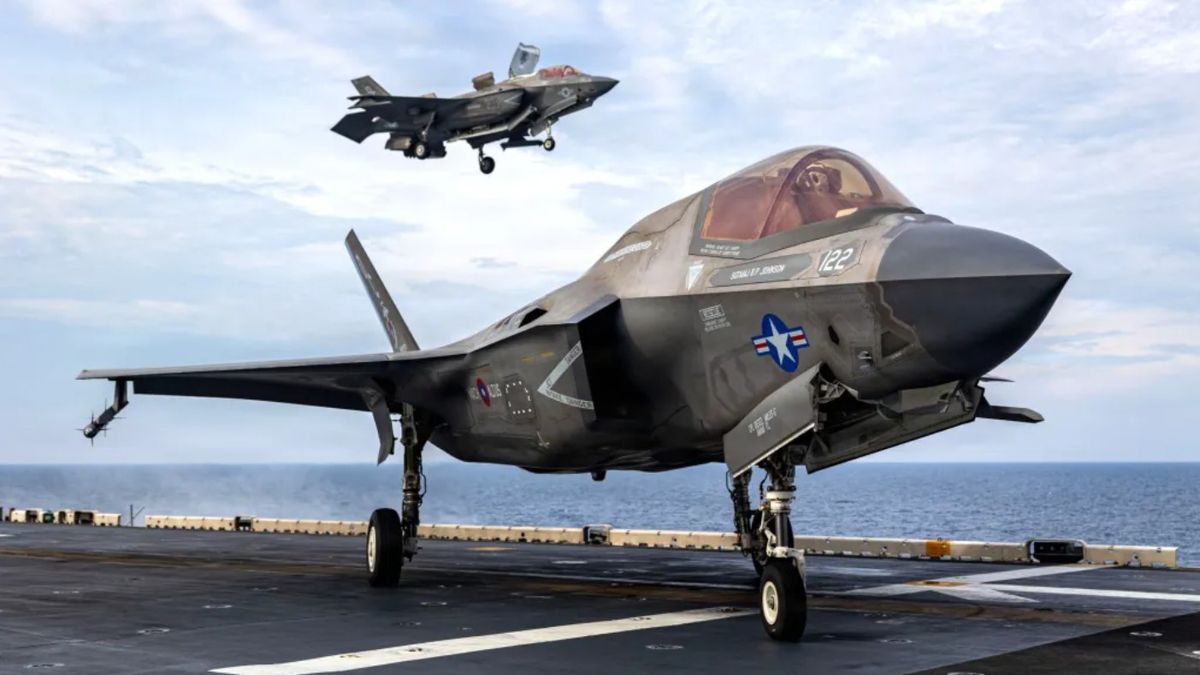
Lieutenant General Gregory Masiello replied: “We have accepted six aircraft for the Marine Corps without radar systems installed. That is correct,” confirming that the decision was driven by a shortage of available AN/APG-85 radar units. According to publicly available information, the aircraft in question are F-35B short takeoff and vertical landing (STOVL) fighters. The United States Marine Corps is the only U.S. military branch that operates the F-35B variant, although it also fields the carrier-capable F-35C.
“The Block 4 modernization program is essential to ensuring that the Marine Corps and the Joint Force maintain air superiority against future threats,” a U.S. Marine Corps spokesperson said. The spokesperson explained that the United States Department of Defense adopted a concurrent acquisition strategy, developing and fielding Block 4 capabilities while simultaneously sustaining the world’s largest fighter aircraft production line. According to the statement, the department proceeded with full awareness of the associated risks, including the possibility that production aircraft would be delivered before all Block 4 capabilities – including certain hardware components – had completed development and integration.
Back in May, it was revealed that F-35 Lightning II fighters were already being produced with provisions for integrating the new AN/APG-85 across U.S. Air Force, Navy, and Marine Corps aircraft. Officials also announced plans to accelerate production of the AN/APG-85 in order to deliver radar systems that meet the required standards for combat capability, operational reliability, and maintainability needed to address emerging threats. At the same time, the F-35 Joint Program Office stressed that the modernization schedule, the operational capabilities of aircraft equipped with the AN/APG-85, and the timeline for fielding the new radar remain classified.
For now, the standard radar fitted to the F-35A, F-35B, and F-35C remains the AN/APG-81. This active electronically scanned array (AESA) radar also features a synthetic aperture radar (SAR) mode, enabling the generation of high-resolution imagery of the terrain below. Technical details of the new AN/APG-85, developed by Northrop Grumman, remain limited. Lieutenant General Gregory Masiello declined to discuss its capabilities in an open setting. It is known, however, that the AN/APG-85 will also employ AESA technology and is expected to provide a range of new and enhanced capabilities over the current AN/APG-81.
The AN/APG-81 operates in conjunction with the F-35’s advanced electronic warfare capabilities, as well as its broader suite of onboard sensors and mission systems. The new AN/APG-85 is likewise expected to function as part of the broader Block 4 modernization package, most notably alongside a next-generation electronic warfare system.
Integration of the AN/APG-85 was originally planned to begin with Lot 17 production aircraft, deliveries of which started last year. However, the first production-standard AN/APG-85 radars are not expected to be available before April 2028. Each radar is currently estimated to cost nearly $9 million.
The complication is that the mounting interface designed for the AN/APG-85 is incompatible with the existing AN/APG-81. As a result, it remains unclear how the U.S. Marine Corps – or other branches of the U.S. military – intend to operate F-35 aircraft delivered without installed radar systems until the new hardware becomes available.
“The Block 3 (TR-2) configuration of the F-35 Lightning II currently in service is the world’s most capable fighter aircraft and has already proven its effectiveness in combat,” U.S. Marine Corps officials said. “Its advanced combat systems enable the F-35 to deter potential adversaries and, when required, achieve air dominance in any environment and under virtually any operating conditions.”
If at least one F-35 in a formation is equipped with a radar, the remaining aircraft can receive the necessary targeting and situational awareness data via the Multifunction Advanced Data Link (MADL). In theory, radarless aircraft could still participate in combat operations, albeit with a significantly higher level of operational risk. They would also be dependent on operating alongside radar-equipped aircraft, reducing tactical flexibility. At the same time, the fighters carrying radars would need to rely more heavily on their own sensors, potentially increasing the likelihood of detection by adversary electronic support systems. Although the F-35 incorporates an extensive suite of passive sensors, none can fully replace the radar, which remains a critical component of the aircraft’s electronic warfare architecture.
Meanwhile, the Block 4 modernization program continues to face schedule delays and cost overruns despite efforts to accelerate the delivery of selected capabilities. As of September 2025, even the streamlined Block 4 upgrade package was running approximately five years behind its original schedule. Under the initial plan, F-35s equipped with the full Block 4 capability set were expected to begin entering operational service this year.
Read also:
- Hunting submarines: Boeing upgrades P-8A Poseidon patrol aircraft for the U.S. Navy
- Frozen Russian Assets to Work for Ukraine: Britain to Finance 150,000 Drones
Source: twz