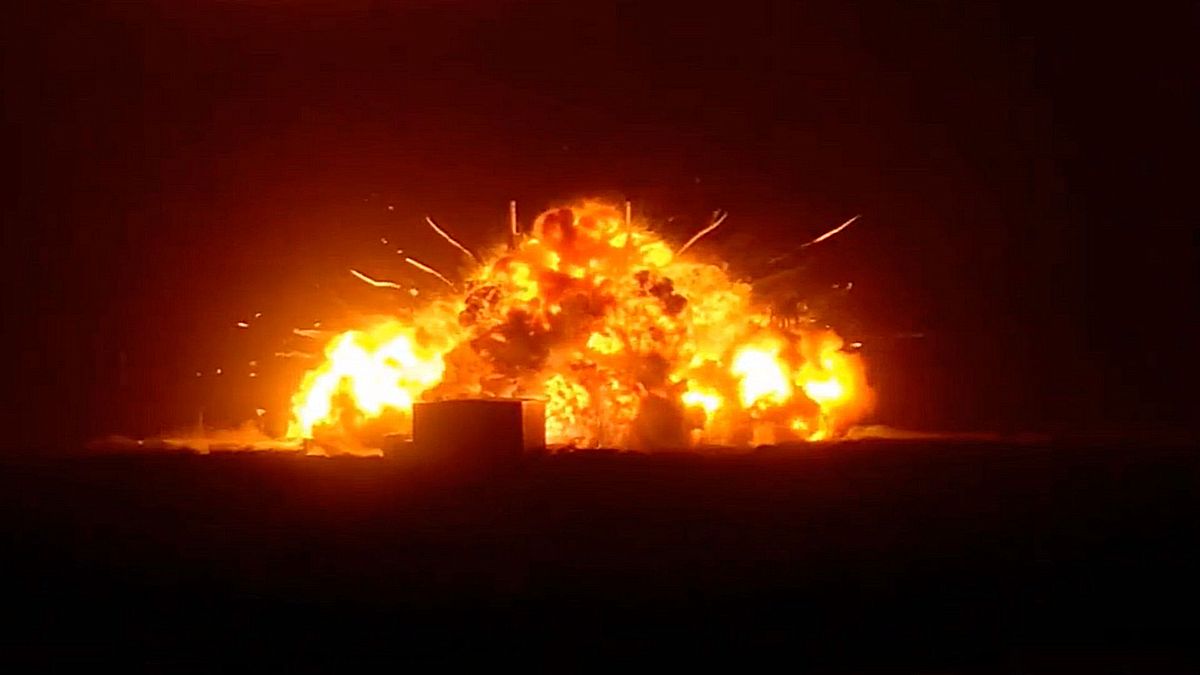
A major setback struck Blue Origin on Thursday evening when the company’s massive New Glenn rocket was destroyed in a powerful explosion during ground testing at a U.S. Space Force facility at Cape Canaveral, Florida. The incident produced a massive orange fireball in the night sky and reportedly caused noticeable shaking in nearby residential areas.
The event occurred at approximately 9:00 p.m. local time during a static-fire engine test conducted in preparation for a satellite launch scheduled for the following week. Residents of Cape Canaveral and Cocoa Beach reported hearing loud explosions and feeling vibrations in their homes, while photos and videos of the blaze quickly spread across social media.
Representatives of Blue Origin officially stated that no injuries or casualties had been reported as a result of the incident. Specialized emergency response teams remained at the launch complex for more than an hour after the explosion while personnel monitored the surrounding area for potential hazards.
Company founder Jeff Bezos wrote on X that it was still too early to determine the exact cause of the accident, although specialists had already begun an active investigation. He added that the day had been extremely difficult, but emphasized that the company would rebuild and repair everything that had been damaged and would return to flight operations, arguing that the goal remained worth pursuing.

This disaster creates another major challenge for the developers of the New Glenn program, which has already encountered technical difficulties during recent missions. Flights of the nearly 100-meter-tall rocket were fully suspended in April of this year following a propulsion system failure that left its satellite payload in an incorrect target orbit. The current accident occurred during only the third flight campaign involving the heavy launch vehicle. Blue Origin designed New Glenn as a direct competitor to other large commercial launch systems, while also intending it to support future lunar missions conducted under NASA programs.
The spacecraft is named after John Glenn, the first American astronaut to orbit Earth. The rocket is substantially larger and more powerful than the company’s New Shepard vehicles, which previously carried tourists to the edge of space from a launch site in Texas. The company had been actively preparing for a critically important flight test planned for later this autumn, which was expected to involve a prototype lunar lander developed for NASA’s Artemis program lunar exploration initiative.
The timing of the explosion coincided with the fact that only a few days earlier NASA had signed a funding agreement worth hundreds of millions of dollars with Blue Origin for the delivery of two lunar rovers intended for later phases of the Artemis program initiative.
NASA Administrator Jared Isaacman acknowledged the seriousness of the setback while also expressing support for the company’s efforts. In a post on X, Isaacman wrote that space exploration does not forgive mistakes and that developing new heavy-lift rocket systems is an extraordinarily difficult undertaking. He also pledged to provide timely updates regarding any potential consequences for the Artemis program, including the planned lunar surface base concept that he had recently presented publicly.
The New Glenn rocket from Blue Origin is expected to play a critical role in transporting lunar landers that could eventually deliver human crews directly to the Moon’s surface under NASA’s long-term exploration strategy. In addition, the vehicle had been scheduled to launch communications payloads next week for Amazon’s low-Earth-orbit satellite constellation. Despite the scale of the explosion, officials stated that operations at nearby launch facilities would continue as normal without interruptions. Representatives of the U.S. Space Force confirmed that planned missions by other aerospace operators would not be affected by the incident.
As previously scheduled, United Launch Alliance still plans to carry out the launch of its Atlas V rocket on Friday evening, deploying internet satellites for Amazon similar to the payload that had been intended for the upcoming New Glenn mission. Officials also emphasized separately that there was no danger to nearby residents from toxic smoke or other hazardous substances following the accident.
Even competing aerospace firms responded to the accident with public statements. Elon Musk, head of SpaceX – whose company has also repeatedly experienced rocket failures during experimental testing – published a message of support directed at his industry counterparts.
In a post on X, Musk stated that he was sorry to see the incident and wished Blue Origin a rapid recovery. The accident significantly increases pressure on Blue Origin as the company attempts to overcome the consequences of another costly setback amid intensifying competition within the private space industry.
Read also:
- Moon Base: What’s Behind NASA’s Ambitious Plan to Conquer the Moon
- Interview with founders of Ukrainian Global Drone Academy: How drone warfare culture and operator mindset are shaped
Read also: interestingengineering