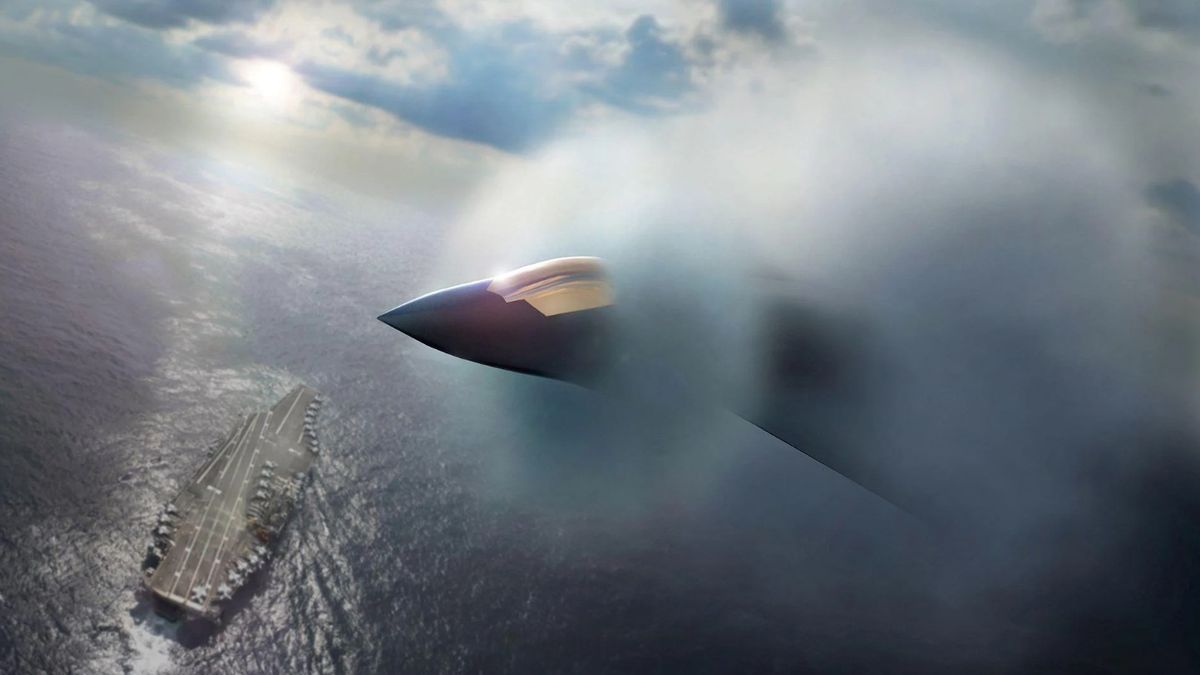
Boeing has released a new render of its F/A-XX project, a next-generation fighter for the U.S. Navy. Notably, it bears a strong resemblance to the F-47 concept, which Boeing has proposed for the U.S. Air Force’s Next Generation Air Dominance program (more about this programme at this link). While such officially released images rarely reflect the final design, they do support previous hints from Boeing that both programs could share a number of design elements.
In the image, the F/A-XX is partially obscured by clouds, similar to earlier F-47 renders. An aircraft carrier is visible beneath the plane, highlighting its Navy-focused role. The tail section is completely hidden, but the cockpit closely resembles that of the F-47. The radar dome appears shorter and narrower, though this could be a perspective effect. Based on the shape of the wing’s leading edge, the F/A-XX concept may incorporate canard-style foreplanes.

This feature has appeared on F-47 renders before and raised eyebrows among experts. Horizontal stabilizers like these are not typically associated with stealth, range, or high speed – the main criteria for sixth-generation fighters – and are usually intended to improve maneuverability. For a carrier-based fighter, however, they could offer an advantage by providing better control at low speeds, which is critical during carrier landings. It’s unclear, though, whether this feature will remain in the final design or is simply a “misdirection” element in the concept art.
Since the tail is completely hidden, it’s difficult to draw firm conclusions. The F-47 is expected to feature a tailless design, and previous renders of Boeing’s sixth-generation naval fighters also show a tailless configuration. This setup would help optimize stealth but could reduce maneuverability. To offset this, Boeing may have opted for canard-style foreplanes on the F-47 and F/A-XX.
Despite their similarities, the two projects have different roles. The F-47 will feature an entirely new adaptive engine, while the F/A-XX will use a derivative of that powerplant. Initially, the Navy indicated that the F/A-XX would have a significantly greater range than current tactical aircraft, but recent estimates suggest an increase of only about 25%, likely due to carrier aviation constraints.
Similarly, the Air Force appears to have scaled back the range requirements for the F-47. The fighter was originally positioned under the NGAD program as a long-range aircraft capable of operations in the Pacific, but current projections indicate a combat radius of “1000+” nautical miles. This represents substantial improvement over existing fighters, but it falls short of the breakthrough initially anticipated.
Boeing and Northrop Grumman remain the leading contenders for the contract. The new Boeing F/A-XX render appeared shortly after Northrop Grumman released a render of its own proposal for the program. Notably, the Northrop design lacks canard-style foreplanes and features a smooth, organic shape with an emphasis on stealth, reminiscent of the YF-23 fighter prototype.
Boeing Defense and Space CEO Steve Parker has stated that the company could develop both the F-47 and F/A-XX in parallel. To support this, Boeing has invested heavily in the Advanced Combat Aircraft Assembly Facility in St. Louis. If the two aircraft share a common platform, serial production of both models could be significantly simpler and more cost-effective.
The F/A-XX program’s winner was initially expected to be announced in March, but in June the Pentagon effectively “paused” the project, citing a need to avoid spreading resources too thin – resources that may be required for the F-47. Despite this, Navy leadership continues to push the program forward, emphasizing the need for sixth-generation carrier-based aircraft “as quickly as possible to provide our forces with the capabilities needed to counter emerging threats.” Members of Congress are also taking steps to ensure the F/A-XX development continues as planned in the fiscal year 2026 budget.
If the F/A-XX program remains in limbo, the Navy could take a simpler approach by procuring a naval variant of the F-47. This would reduce both risk and cost but would delay deployment. The strategy is similar to the Navy’s approach under the Collaborative Combat Aircraft program, leveraging proven technology without significant upfront investment while accepting longer timelines.
Read also:
- Ukrainian Drones Struck Two Mi-8 Helicopters and a Russian Vessel in Crimea
- Ukraine Confirms Delivery of Saab ASC 890 Early Warning and Control Aircraft from Sweden
Source: twz