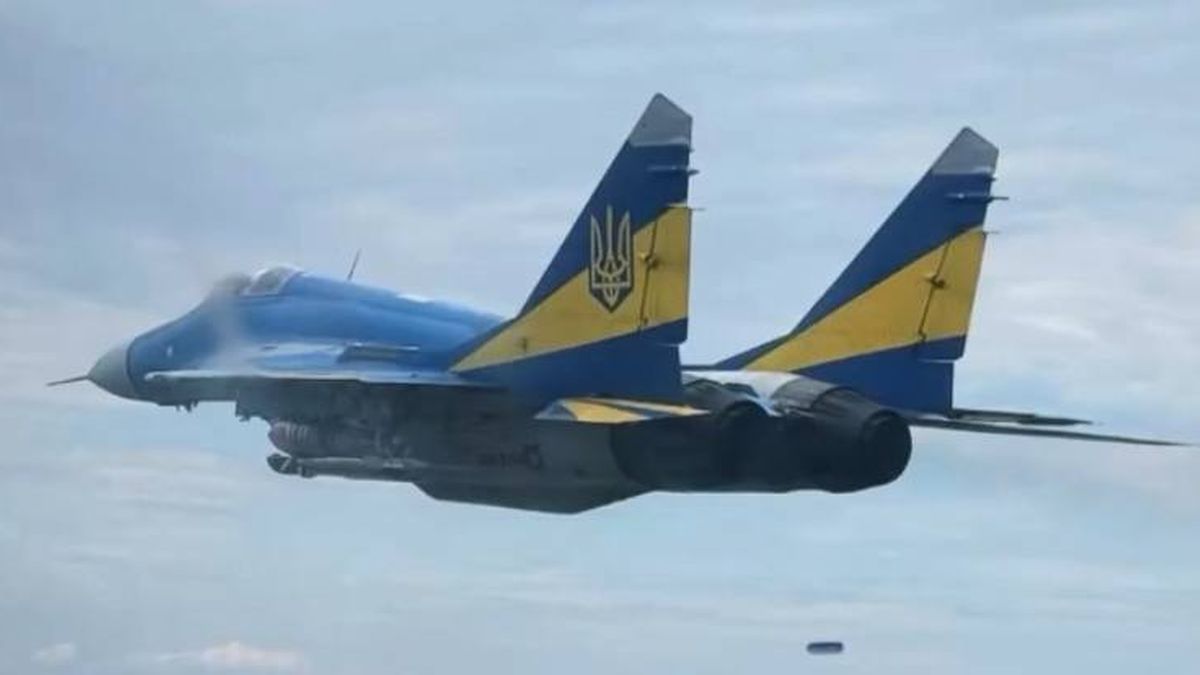
A Ukrainian MiG-29 fighter has been photographed for the first time carrying an air-dropped munition equipped with a glide and correction module – an analogue of Russia’s UMPK system that turns conventional unguided bombs into precision glide weapons.
The appearance of this Ukrainian-developed version on a MiG-29 indicates that the country’s defense industry is actively working on high-precision strike capabilities that extend engagement range. This approach reduces risks for Ukrainian pilots while increasing the effectiveness of operations against Russian targets. It also highlights Ukraine’s gradual move toward reducing dependence on Western-supplied weaponry.
New photos show an unidentified munition mounted under the left wing of a Ukrainian MiG-29 painted in bright blue-and-yellow camouflage. The bomb closely resembles Russia’s UMPK system: a standard unguided aerial bomb attached to a “flying kit” with wings and a navigation system. Once released, the folding wings deploy, turning the bomb into a guided glide weapon. Based on its dimensions, the Ukrainian design appears to belong to the 500-kg class.

The first trials of these munitions took place back in June 2025 on a Su-24 bomber. However, integration with the MiG-29 is a logical step, since it is the main aircraft of the Ukrainian Air Force and has already been adapted to carry Western-made weapons.
Earlier reports noted that during testing, the new bomb achieved a range of up to 60 km, with developers aiming to extend this to 80 km. For comparison, Russia’s glide bomb has a maximum range of about 70 km, depending on release altitude and speed. Developers emphasize that the Ukrainian variant should deliver higher accuracy thanks to its own guidance system and the use of French technologies more resistant to enemy electronic warfare. The project is being developed by Ukraine’s Meidoid Design Bureau.
Until April 2023, Ukraine’s Air Force reported that Russia was dropping “up to 20” such bombs daily, delivered by tactical aircraft operating at the edge of Ukrainian air defense coverage. Today, that number is much higher. According to Ukraine’s Ministry of Defense, in August alone Russian aircraft dropped 4,390 guided aerial bombs on Ukrainian positions. Despite questions about their accuracy and overall reliability, these systems allow Russian jets to carry out standoff attacks on targets that would otherwise put them at risk of Ukrainian air defenses. Guided bombs are also extremely difficult to intercept and destroy. For Ukraine, having its own equivalent developed by domestic engineers will provide the same standoff advantages.
Ukraine has already received precision-guided munitions from its allies – the American JDAM-ER and SDB, as well as the French AASM Hammer. However, the deliveries are limited and their cost is quite high. According to Ukrainian military estimates, at least one hundred such munitions per day are needed just to effectively contain the enemy.
The arrival of new long-range ERAM munitions is also expected, with the United States having pledged to supply more than 3,000 units (more details about this weapon can be found at this link). However, their use will likely be restricted, and they will not be allowed for strikes deep inside Russian territory. In this context, a cheaper and locally produced counterpart to Russia’s MPK could become a strategic solution. Moreover, it has the potential to be integrated not only with F-16s and Mirage 2000s, but also with Soviet-era tactical aircraft such as the Su-25.
Read also:
- Why Modern Aircraft Still Crash and How Each Tragedy Shapes Aviation Safety
- Ukraine Confirms Delivery of Saab ASC 890 Early Warning and Control Aircraft from Sweden
Source: twz