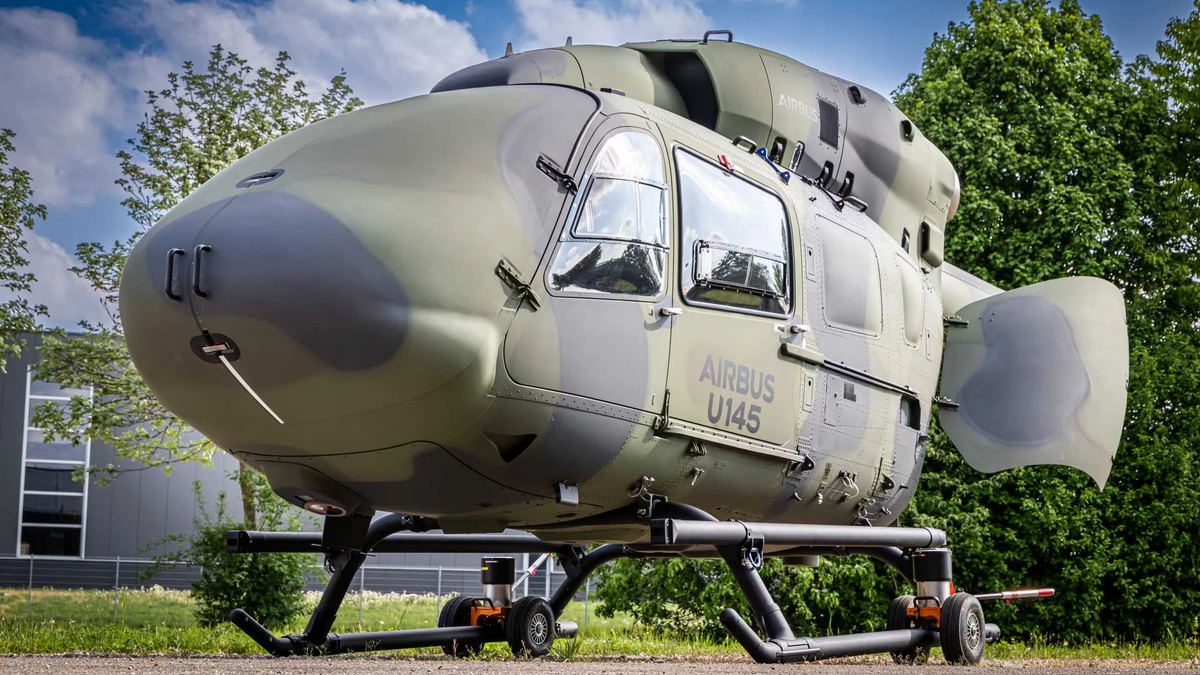
Airbus Helicopters has officially unveiled the U145 unmanned helicopter, developed on the basis of the widely used civilian and military Airbus Helicopters H145. A full-scale mock-up of the new platform was presented ahead of the ILA 2026 international aerospace exhibition in Berlin, scheduled to begin on June 10, 2026.

The use of the proven airframe and high payload capacity of the baseline Airbus Helicopters H145 is expected to enable the unmanned U145 variant to perform logistics support, intelligence gathering, and medical evacuation missions. At the same time, the use of an autonomous platform reduces risk to crewed personnel during operations in active combat zones. The developers plan to conduct the first test flight by the end of 2026, with full operational deployment targeted for the early 2030s. In a related development within unmanned aviation, another autonomous helicopter, the Skeldar V-200, also drew significant attention at the BEDEX 2026 exhibition.
This announcement represents one of the most large-scale and ambitious initiatives to date aimed at converting a certified crewed helicopter into a fully autonomous heavy-class unmanned aerial vehicle.
Unlike most existing rotary-wing unmanned systems, which are designed as drones from the outset, the U145 project is based on the technical platform of an aircraft family with more than 1,800 units in operation worldwide and a total flight time exceeding 8.5 million hours. Airbus expects that this approach will significantly accelerate certification processes, reduce financial and technical risks during development, and provide end users with an already mature logistics and maintenance ecosystem from the outset.
According to Mathieu Louvot, Head of Airbus Helicopters, the U145 unmanned aircraft combines the robust fuselage, powerful propulsion system, and strong payload capacity characteristic of the Airbus Helicopters H145, with a high level of automation and operational flexibility typical of modern unmanned systems.
The U145 follows a previous Airbus programme known as VSR700, which was based on the light Guimbal Cabri G2 helicopter. However, the scale and operational objectives of the new project are significantly more ambitious. While the VSR700 system was primarily designed for airborne reconnaissance and naval surveillance missions, the U145 is positioned as a multi-role autonomous platform intended to support both military units and civil services across a broad range of tasks.
The most visually and structurally significant difference between the U145 and its crewed counterpart is the complete removal of the cockpit. Engineers at Airbus Helicopters fully redesigned the nose section of the aircraft to maximise usable internal volume for cargo transport and to improve overall mission flexibility. The aircraft features dedicated front cargo doors with a fold-out ramp, enabling rapid loading and unloading even in challenging field conditions. In addition, a specially designed cargo floor further streamlines logistics operations by facilitating the transport of a wide range of equipment, humanitarian supplies, or military payloads.
In a conventional helicopter, a significant portion of internal volume and mass is allocated to accommodating pilots, flight controls, instrumentation, seating, and life-support safety systems. By removing these components, Airbus has been able to substantially optimise the internal layout for payload capacity, while also eliminating risks to human life during operations in hostile or otherwise hazardous environments.
With a maximum take-off weight of 3,800 kg, the U145 occupies a distinct position within the rapidly developing segment of autonomous aviation. Most modern military unmanned aerial systems are designed primarily for reconnaissance or strike missions, whereas heavy autonomous transport platforms remain relatively rare.
For military organisations, the introduction of such an aircraft could significantly change how supply operations are structured in a theatre of operations. Recent conflicts, including the war in Ukraine and other modern armed engagements, have clearly demonstrated the vulnerability of traditional logistics routes to long-range artillery, missile strikes, hostile drones, and electronic warfare systems. Autonomous transport aircraft and helicopters such as the U145 would allow military command structures to maintain resupply to forward positions while removing the need to expose pilots and transport crews to operational risk.
Beyond solving transport tasks, Airbus presents the U145 as a multi-role platform that can be adapted to a wide range of operational requirements. Particular attention is drawn to the concept of using the U145 as a kind of airborne “drone carrier”, capable of launching smaller unmanned systems during flight. In this configuration, the helicopter could transport and deploy small expendable drones for reconnaissance, suppression of electronic warfare assets, or precision strike missions. In this area, Airbus is already collaborating with European missile manufacturer MBDA, reflecting broader interest from NATO states in distributed, multi-layered warfare concepts based on robotic systems.
The helicopter’s autonomous control architecture is expected to be based on a complex suite of sensors, high-performance onboard computing systems, and artificial intelligence technologies. Although detailed technical specifications have not been disclosed by Airbus, the company has confirmed that the U145 will feature a dedicated sensor package enabling fully automated flight operations and mission execution.
Read also:
- Airbus Tests Aircraft Capable of Nearly 24 Hours of Continuous Flight, Marking a Potential Shift in Civil Aviation
- Lethal Transformation of Atlas: Airbus Converts a Transport Aircraft into Combat Platform
Source: armyrecognition