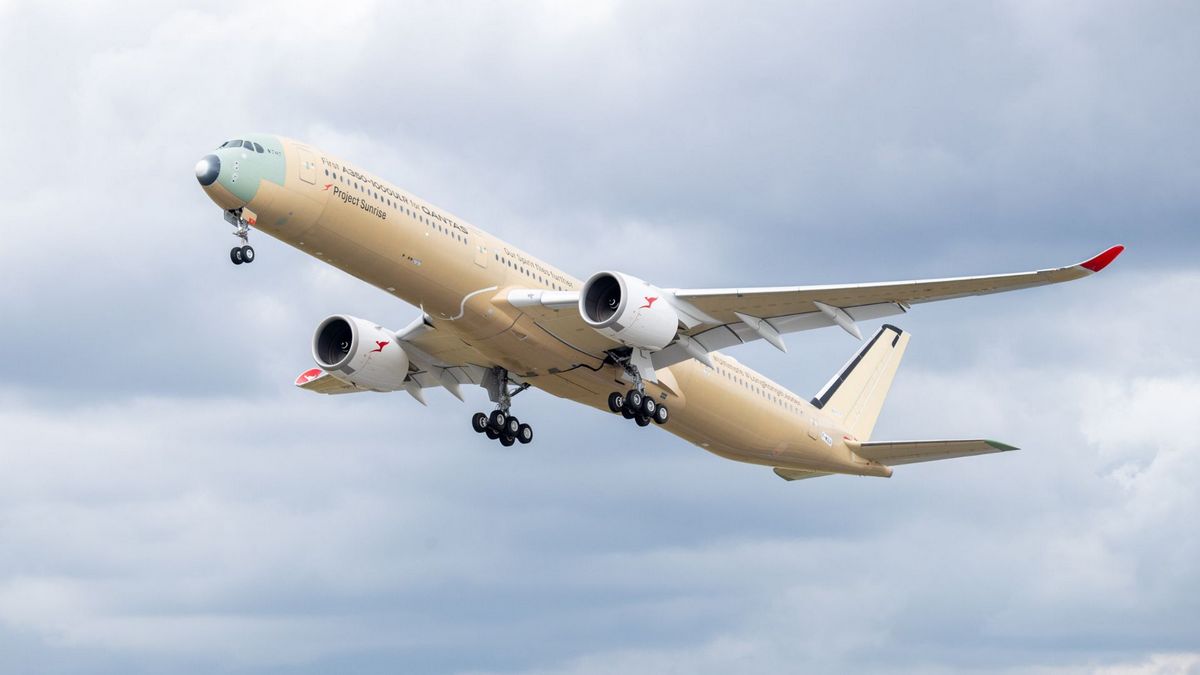
Real-world testing of an aircraft designed for ultra-long-haul operations has begun in France. Airbus has completed the maiden flight of the A350-1000ULR, a variant selected by Australian carrier Qantas for its Project Sunrise initiative. The aircraft features a modified fuel tank configuration, extended range capabilities, and the ability to remain airborne for close to 24 hours.
The first test flight took place in Toulouse and lasted three hours and 43 minutes. During the flight, the aircraft reached an altitude of more than 12,496 meters. This wide-body jet is the first of twelve A350-1000ULR aircraft ordered by Qantas. The flight marks the beginning of the formal certification program for the variant, which was developed to extend the operational limits of long-distance commercial aviation.

The A350-1000ULR variant was developed specifically for nonstop flights between Sydney and London, a route spanning nearly 18,520 km. To achieve this range, Airbus engineers added an extra fuel tank in the rear center section of the aircraft. The modification increased total fuel capacity and extended the aircraft’s range by approximately 1,852 km compared with the standard A350-1000 configuration.
The updated design is expected to allow the aircraft to remain airborne for up to 22 hours without refueling. This would enable direct flights between Australia and European cities that previously required at least one stopover. During the maiden flight, Airbus specialists evaluated overall system performance and tested the new fuel distribution architecture. The mission also marked the start of a two-month flight test campaign required for certification ahead of commercial service entry.
The certification process covers more than range performance and fuel capacity. Airbus engineers are also required to validate a new galley cooling system developed specifically for ultra-long-haul operations. According to the company, the system uses lighter and more efficient refrigeration units, reducing overall aircraft weight and supporting extended flight durations.
As part of the testing campaign, engineers will also assess cabin ventilation performance and the precision of temperature control systems. Reliable operation of these systems is considered essential for aircraft designed to keep passengers and crew in a confined environment for nearly a full day. Once certification is complete, Airbus will reconfigure the aircraft interior in line with Qantas’ final commercial requirements before delivery.
At the same time, a second A350-1000ULR aircraft is currently in the final assembly stage. Airbus stated that the aircraft will soon be moved to the paint facility, after which it will receive its engines and a premium four-class cabin configuration. The company expects this aircraft to become the first unit delivered to Qantas, with handover scheduled for April 2027.
Project Sunrise continues to move forward as one of the aviation industry’s most ambitious long-haul initiatives, aimed at enabling direct connections between regions that previously required intermediate stops. Qantas has ordered 12 A350-1000ULR aircraft for the program and has also signed a separate agreement for 12 standard A350-1000 jets intended for other international routes.
The extended-range variant will expand the existing A350 family, which already includes the A350-900, A350-900ULR, and the standard A350-1000 passenger models. In parallel, Airbus is continuing development of the A350F freighter variant, with its first flight currently scheduled for the end of this year.
Demand for aircraft in the A350 family remains strong. As of the end of April 2026, Airbus had received a total of 1,579 orders from 68 customers worldwide. More than 700 A350 aircraft are currently in active service with 41 airlines, primarily on long-haul intercontinental routes.
The successful initial test flight represents an important milestone for both Airbus and Qantas, bringing the launch of commercial Project Sunrise operations closer and reinforcing the feasibility of nonstop flights between Sydney and London.
Read also:
- The Aircraft That Never Were: Convair Kingfish
- Weapons of Ukraine’s Victory: The Hornet UAV, Also Known as “Martian-2”
Source: interestingengineering