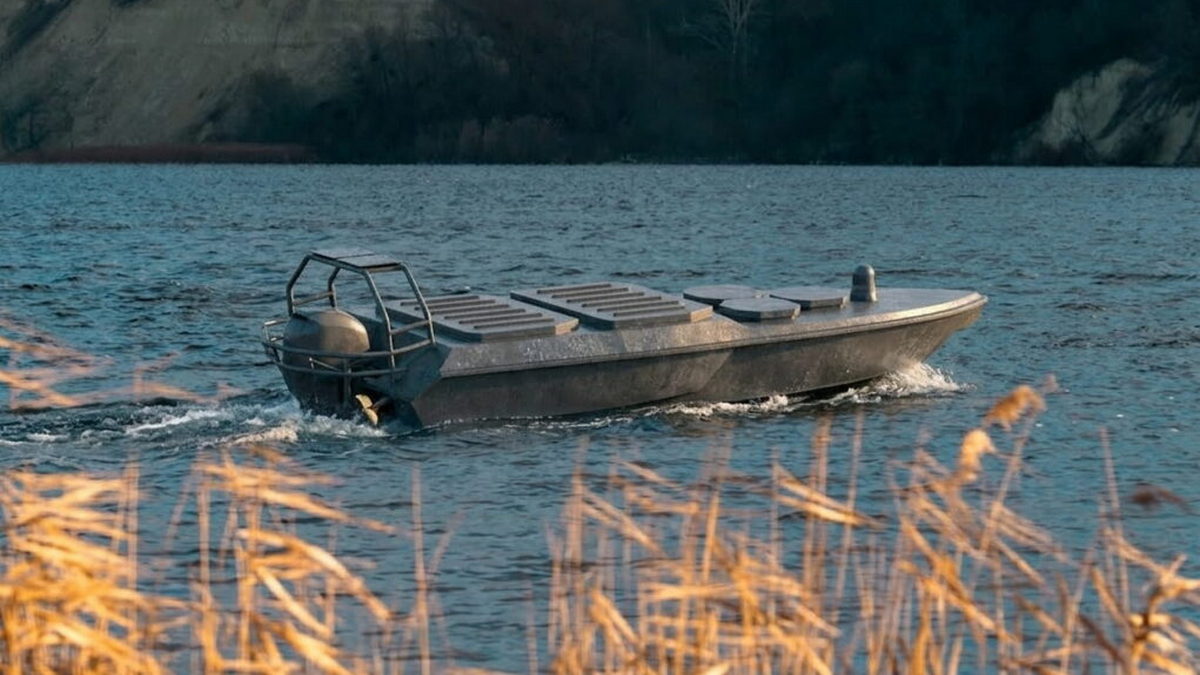
Katran X1.2 is an unmanned surface vessel developed by the Ukrainian company MAC HUB. Its primary function is to transport and deploy groups of strike drones and interceptor UAVs directly from the water surface, creating an additional floating layer for air and naval defence, as intended by its developers.
The autonomous surface platform is designed to serve as a mothership for swarms of AI-controlled interceptor drones tasked with tracking loitering munitions such as Shahed-type UAVs in maritime zones and river corridors. It is also intended to function as a launch platform for strike operations and missile deployment.

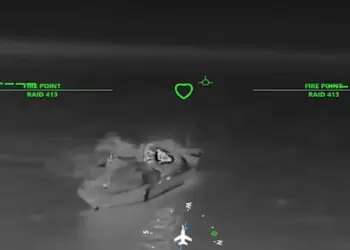
In May, the vessel was demonstrated to foreign reporters during test trials on the Dnipro River, where it successfully proved its capability as a mobile launch platform for the company’s interceptor drones. The development of the system reportedly involved joint work between MAC HUB engineers and personnel from the “Black Sea Legion”, a maritime unit subordinate to the Main Directorate of Intelligence of the Ministry of Defence of Ukraine, which has previously conducted strikes against Russian gas and oil platforms in the Black Sea and had already deployed the Katran in combat operations in the autumn of the previous year.
The key structural feature of this system is that it functions as a true carrier for other drones, rather than a one-time-use kamikaze vessel. During the river demonstration, the platform carried 27 AI-controlled interceptor drones (“MAC Dead Fly”), exceeding the officially stated capacity of 23 units.
According to representatives of the company, these interceptor systems are capable of independently detecting and pursuing aerial targets at speeds of up to 380 km/h, which is considered sufficient to neutralise Shahed-type drones. At the request of Ukrainian military users, developers are currently working to increase this performance figure to 450 km/h. The concept of deploying a floating launch platform on rivers is driven by both geographic factors and operational practicality. Russian Shahed-type UAVs are reported to frequently use river corridors in Ukraine as low-altitude flight paths toward Kyiv and other cities. Positioning such a vessel along waterways therefore allows interceptor drones to be deployed directly along expected flight routes.
Beyond countering aerial targets, Katran X1.2 is described as a flexible platform that can be reconfigured for other mission profiles. MAC HUB reports that it can carry nine proprietary “Thunder 10” FPV strike drones along with four fixed-wing “Osa” UAVs. In addition, integration of two short-range R-73 air-to-air guided missiles is proposed, enabling the system to engage light aircraft, helicopters, cruise missiles, and hostile UAVs. The manufacturer also offers a higher-payload configuration under the designation “NEMESIS”, which appears to be oriented toward a bomber-type unmanned platform. The vessel is designed for reuse and is intended to return to base after completing missions, although it can also be used in a one-way (suicidal) mode if operational requirements demand it.
In the published specifications, the manufacturer states that the Katran X1.2 has a length of 9.11 m, a width of 2.79 m, and a height of up to 1.45 m. Its 350 hp propulsion system enables a top speed of 93 km/h, a cruising speed of 65 km/h, and a range of up to 1,600 km thanks to a 1,100-litre fuel tank. MAC HUB adds that the vessel is capable of remaining on station autonomously for several days. It is equipped with an autopilot system, damage detection and dewatering systems, a satellite communication antenna for operations in the Black Sea area, and an AI-based control system capable of detecting and tracking targets and maintaining vessel control even in the event of complete loss of communications.
Interaction between the vessel and its aerial drones is managed through a dedicated hardware–software system called MAC HUB Mission Control. This system integrates all components into a unified network and coordinates their actions in real time from a mobile shore-based command post. The overall mission set for the vessel includes transporting FPV drones, conducting patrol, surveillance, and reconnaissance operations, as well as carrying out strikes against ship decks, landing craft, port infrastructure targets such as radar nodes and command posts, light armoured vehicles, enemy air defence systems, fuel depots, refuelling facilities, and concentrations of personnel.
Read also:
- Large-Scale “Birds” Hunt: Ship, Trains, and Critical Enemy Equipment Destroyed in Crimea and Donbas
- Interview with Bell Textron: Investing in the future in Ukraine
Source: ukdefencejournal