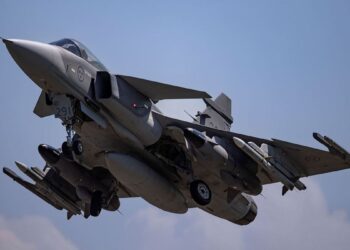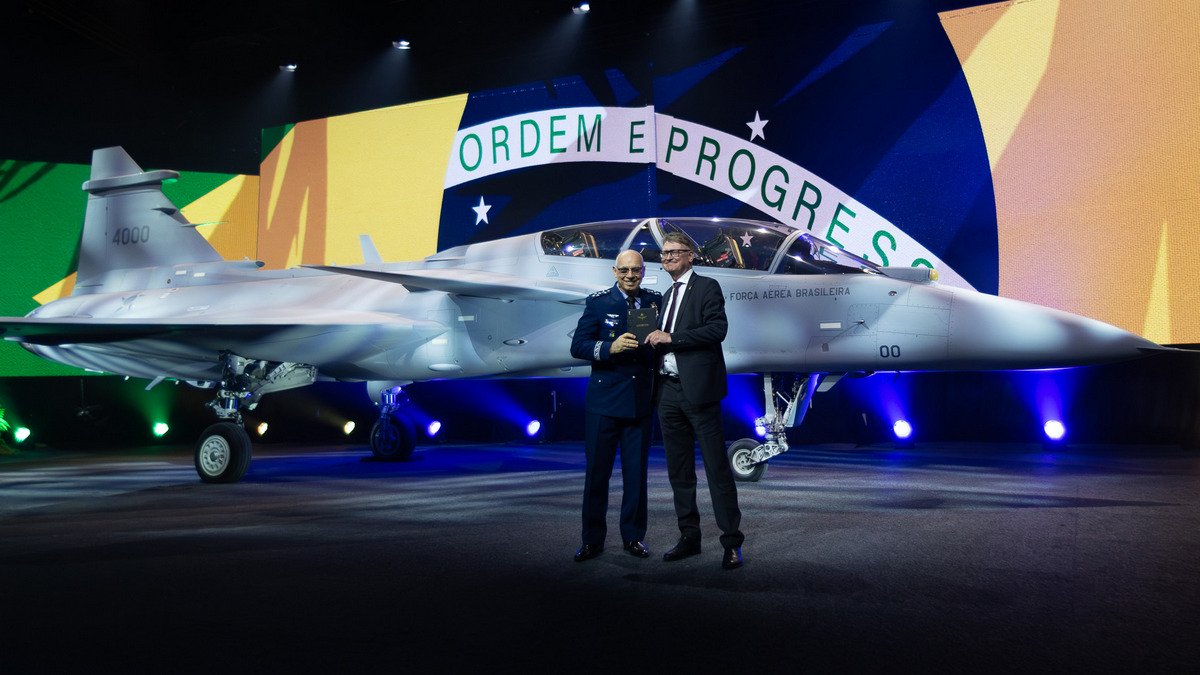
Saab held an official presentation of the first Gripen F fighter aircraft prototype at its production facility in Linköping. This two-seat variant belongs to the Gripen E family and was developed in response to the modern requirements of air forces for both pilot training and tactical operations.
The two-seat Gripen F is described as the first aircraft of its kind capable of controlling groups of drones to improve combat effectiveness. Its fully independent second cockpit allows instructor-assisted training flights to be conducted directly on a combat-capable aircraft. Saab developed the aircraft in cooperation with Brazilian partners. In the near future, the Gripen F will be transferred to Saab’s flight test center before later being delivered to the Brazilian Air Force.

Brazil signed a contract with Saab in 2014 for the delivery of 36 Gripen fighter aircraft. Under the agreement, the company was to produce 28 single-seat Gripen E jets and 8 two-seat Gripen F variants. Saab began assembly of the first Gripen F aircraft in 2020. So far, 11 aircraft have already been delivered to the Brazilian military as part of the contract.
The key feature of the Gripen F is that it is designed not only for combat operations, as the cockpit includes an additional seat for a flight instructor. The second workstation can also reduce the workload on the primary pilot and is considered valuable during mission planning and coordination.
The aircraft retains the full combat capabilities of the single-seat Gripen E version while also serving as a training platform. According to company representatives, the inclusion of a second crew member is expected to improve pilot training quality across the air fleet and provide better operational effectiveness in high-risk environments. The presence of a fully independent second cockpit allows instructor-led flights to be conducted on an operational combat aircraft, giving trainee pilots experience in conditions closer to real mission scenarios.
Lars Tossman, head of Saab’s aviation division, stated that the unveiling of the Gripen F represents a joint achievement involving the company, Brazil’s defense sector, and the Brazilian Air Force, reflecting a high level of mutual trust developed over many years. He added that the joint development of the aircraft demonstrates the maturity of the partnership, while the fighter itself is not only a high-performance platform for Brazil, but also a practical result of long-term cooperation and shared objectives.
The aircraft has a length of 15.9 meters and a width of 2.44 meters. Although this variant is slightly longer than the Gripen E version, its width and maximum takeoff weight of 16,500 kg remain unchanged.
Similar to the earlier single-seat variant, the aircraft features 10 hardpoints for weapons and payloads, delivers a maximum thrust of 98 kN, and is equipped with an aerial refueling system. According to Saab, the Gripen F architecture is designed to support rapid upgrades within a very short timeframe. In practice, this means the fighter can be quickly updated with new software, advanced AI algorithms, or next-generation hardware components.
The addition of a second seat allows the second crew member in the Gripen F to directly manage, monitor, and coordinate multiple unmanned systems in real time. This capability could be used to organize precision strikes from multiple directions, deploy drones into contested or restricted airspace for reconnaissance missions, and support the suppression of enemy air defense systems.
The company also noted that the Gripen F is capable of carrying the same weapons package as the previous model, including an AESA radar, beyond-visual-range air-to-air missiles, and electronic warfare systems.
Read also:
- The Aircraft That Never Were: Convair Kingfish
- Saab JAS 39 Gripen as an Option for the Ukrainian Air Force: Understanding This Aircraft
Source: interestingengineering