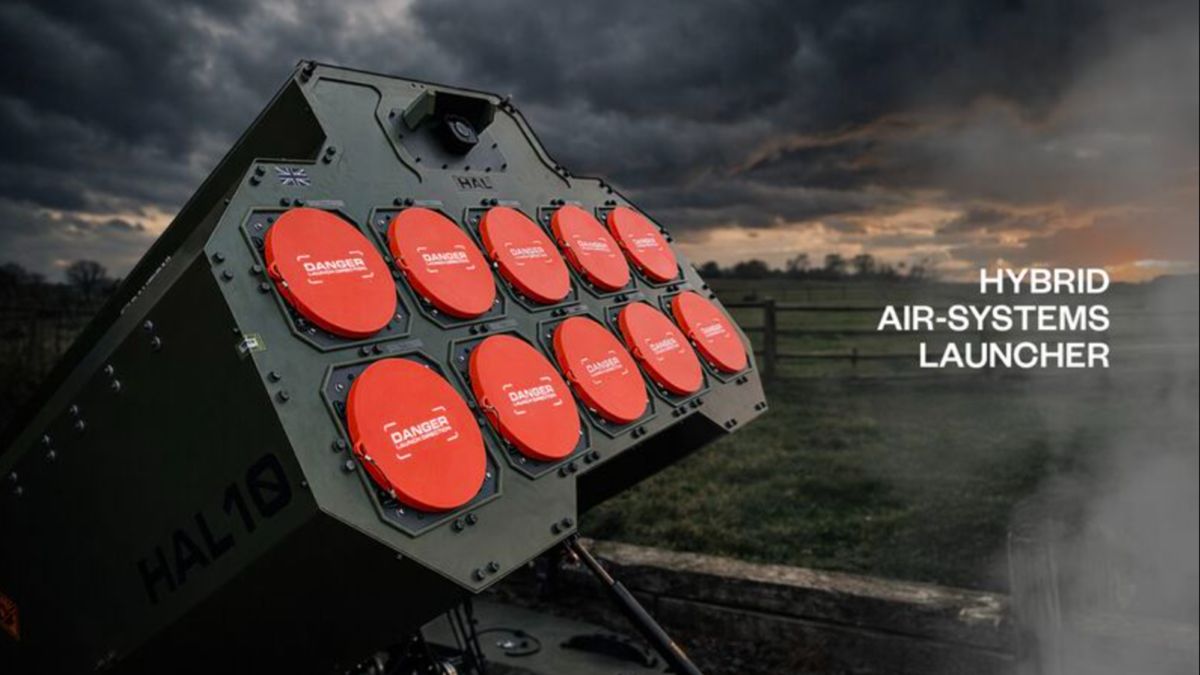
The British company ISS Aerospace has introduced an interesting launch system called HAL10, which represents a different approach to the deployment of unmanned aerial systems. The platform is designed to launch up to 10 drones simultaneously from a single unit.
While most discussions around UAVs tend to focus on the specifications of the aircraft themselves – such as range, payload capacity, or autonomy – the deployment method is often treated as a secondary consideration. HAL10 is positioned as an attempt to address this gap. It effectively shifts drone deployment from individual launches to a coordinated, scalable process.
The main idea behind the system is to enable rapid saturation of airspace with unmanned platforms. Rather than sequential deployment, it supports near-salvo launch capability, which can be relevant in operational scenarios where speed, volume, and coordination are critical factors.

In this sense, HAL10 highlights an often overlooked but straightforward point: the effectiveness of a UAV system is determined not only by its flight performance characteristics, but also by how quickly and in what coordinated manner it can be deployed into operational use. From this perspective, the British system appears to be an attempt to address the requirements of a new type of warfare – one defined by system-level integration rather than the capabilities of individual platforms.
Read also: Weapons of Ukraine’s Victory: The “Shvidun” Interceptor Drone
TABLE OF CONTENT:
What is known about ISS Aerospace
ISS Aerospace (legal name: ISS Group Ltd.) was founded in 2015. In its early phase, the company focused primarily on the development of electronic instrumentation and related systems. Over time, it expanded its activities and shifted toward the design and production of its own unmanned aerial systems (UAS). This transition reflects a broader industry trend toward vertical integration within defense and aerospace technologies, where companies move from component-level development toward full platform production.
However, a full technological lifecycle in this sector is rarely contained within a single company. Recognizing this, ISS Aerospace pursued a cooperative development model.
In partnership with OSL Technology, the company established a joint venture, ISSOS Technologies, through which the lightweight multipurpose UAV Wasp drone was developed.
Operational experience with the Wasp system – particularly the need for rapid, scalable, and reliable field deployment – reportedly served as a catalyst for the development of the HAL10 launch system. In this context, HAL10 is not an isolated product, but a continuation of an ecosystem-based approach in which the platform and its deployment mechanisms evolve in parallel.
Read also: Everything About Ukrainian Interceptor Drone JEDI Shahed Hunter
What HAL10 is and how it works
The name HAL10 stands for Hybrid Air-Systems Launcher, which directly reflects the system’s primary function as a launch platform for airborne unmanned systems. The “10” refers to its ten-channel configuration, designed for the simultaneous deployment of a group of UAVs.
The design is intentionally utilitarian and focused on field reliability. At its core, the system is based on a box-shaped platform equipped with hydraulic or mechanical jacks at each corner, allowing for rapid leveling on uneven terrain. Mounted on the platform is a rotating module with electric actuators for targeting adjustments. This module holds a pack of ten transport-and-launch canisters. This architecture enables the system to change its launch sector without physically repositioning the entire unit, which can be critical in dynamic operational environments.
Each UAV launch is enabled by a solid-fuel booster with electric ignition. This approach reduces dependence on external launch infrastructure and helps ensure consistent performance across a range of weather conditions. Launches can be performed either individually or in rapid sequence with minimal interval between aircraft. This enables swarm deployment concepts or rapid airspace saturation.
An integrated forward-facing video camera is installed on the upper section of the rotating module. It provides the operator with visual monitoring of the launch sector prior to deployment, allowing assessment of obstacles, terrain, and overall trajectory safety. Control is performed remotely, either via a wired connection or a radio link. This allows the operator station to be positioned at a safe distance, reducing exposure risk for the launch crew.
The exact dimensions and weight of the system have not been disclosed. However, based on available materials, the launch module length exceeds one meter. A transport configuration is provided, in which the container block folds along the platform, reducing overall dimensions and simplifying logistics – from vehicle transport to concealed deployment.
In terms of deployment options, HAL10 demonstrates a degree of flexibility. It can be used as a stationary system or integrated onto mobile platforms, ranging from pickup trucks to specialized vehicle chassis. This effectively turns the system into a mobile force projection tool capable of rapid repositioning, operating on the move, and reducing vulnerability to counter-battery targeting.
Read also: Weapons of Ukraine’s Victory: High-precision APKWS II Missile
The Wasp drone: what is launched from these containers
The Wasp drone is a quadcopter with an unconventional airframe design. Its fuselage is shaped as a cylindrical body with a hemispherical nose section and a tapered rear cone. It features four folding arms with propulsion units. In the transport configuration, these arms are folded along the fuselage, while the propellers are partially recessed into an open central section. This folding mechanism allows the aircraft to fit inside the HAL10 transport-and-launch container without increasing overall dimensions.
After launch, the system automatically deploys: the arms extend into flight position, the motor assemblies lock into place, and the drone transitions into stabilized autonomous flight. This design represents a compromise between compact transportability and operational aerodynamic performance.
According to open-source data, the maximum takeoff weight of the Wasp is around 4 kg, with a payload capacity of up to 1 kg. In a clean configuration, flight endurance reaches up to 30 minutes, while with maximum payload it decreases to approximately 20–22 minutes. The stated range is up to 45 km, indicating its intended use not only for immediate tactical reconnaissance but also for operations deeper within the operational environment.
In its baseline configuration, the system is used for reconnaissance and surveillance. Its electro-optical payload provides real-time video transmission to the operator. At the same time, the modular architecture allows the Wasp drone to be reconfigured into a loitering munition role, which aligns with the broader concept of multi-role platforms where a single base airframe can be adapted for different mission profiles.
Currently, control is maintained remotely, with the operator sending commands via a radio link while receiving a live video feed in return. However, further development of the system is oriented toward increased autonomy.
In particular, ISS Aerospace has signed an agreement with Anduril UK to integrate the Lattice system developed by Anduril Industries. This software-hardware solution is known for its use in network-centric command systems and swarm coordination frameworks. Such integration could enable the Wasp platform to operate not only as an individual UAV, but also as part of a coordinated group, with role distribution, collective navigation, and a degree of autonomous decision-making.
In practice, the Wasp drone appears to be more than just another compact UAV. It is designed as a platform intended from the outset for integration into more complex, system-level operational scenarios – ranging from individual missions to coordinated swarm deployments.
Read also: Mission Control: How Ukraine Is Building a Unified Digital Brain for Drone Warfare
A systems-based approach as a strategy
What ISS Aerospace is developing is not limited to an individual drone or a standalone launcher. Instead, the company is building an integrated system consisting of the aerial platform, the deployment mechanism, and a software layer for swarm-level control. In the longer term, the HAL10 together with the Wasp drone equipped with the Lattice are intended to form a unified mobile multi-role complex. Such a system could support both reconnaissance and strike-related tasks, using either individual drones or coordinated groups.
This approach aligns with a broader trend in modern tactics, which increasingly relies on the mass deployment of small UAVs. In this context, the key requirement is not only the availability of drones themselves, but also the ability to deploy them rapidly and in sufficient numbers when needed.
Current status of the project
The first public information about HAL10 appeared in early March 2025, accompanied by video materials showing live launch tests. This indicates that the system has already progressed beyond the initial prototype stage and has validated its core performance characteristics. ISS Aerospace is currently working to complete the testing cycle and refine the integration between HAL10 and the Wasp drone. In the near term, both systems are expected to be presented together at one of the upcoming European defense exhibitions.
As for actual orders, the company is currently sticking to optimistic forecasts. Only time will tell whether the Wasp and HAL10 will find buyers.
Interesting, but still not a combat-ready system
The HAL10 project is noteworthy primarily as an example of unconventional systems thinking. Rather than focusing on another individual UAV, it proposes infrastructure for mass drone deployment. The concept of a “ten-drone launcher” addresses a real tactical challenge: the rapid deployment of UAV swarms. However, a cautious perspective is still necessary. At this stage, the system remains a prototype accompanied by public demonstrations and promotional material.
To evolve into a fully operational combat system – combined with integration of the Lattice, formal certification, extensive field testing, and serial production – there is still a significant development path ahead. It is also possible that competing solutions from other manufacturers will emerge before the system reaches the market. Given the current pace of development in unmanned technologies, even a one-year delay can significantly reshape the competitive landscape.
Read also: