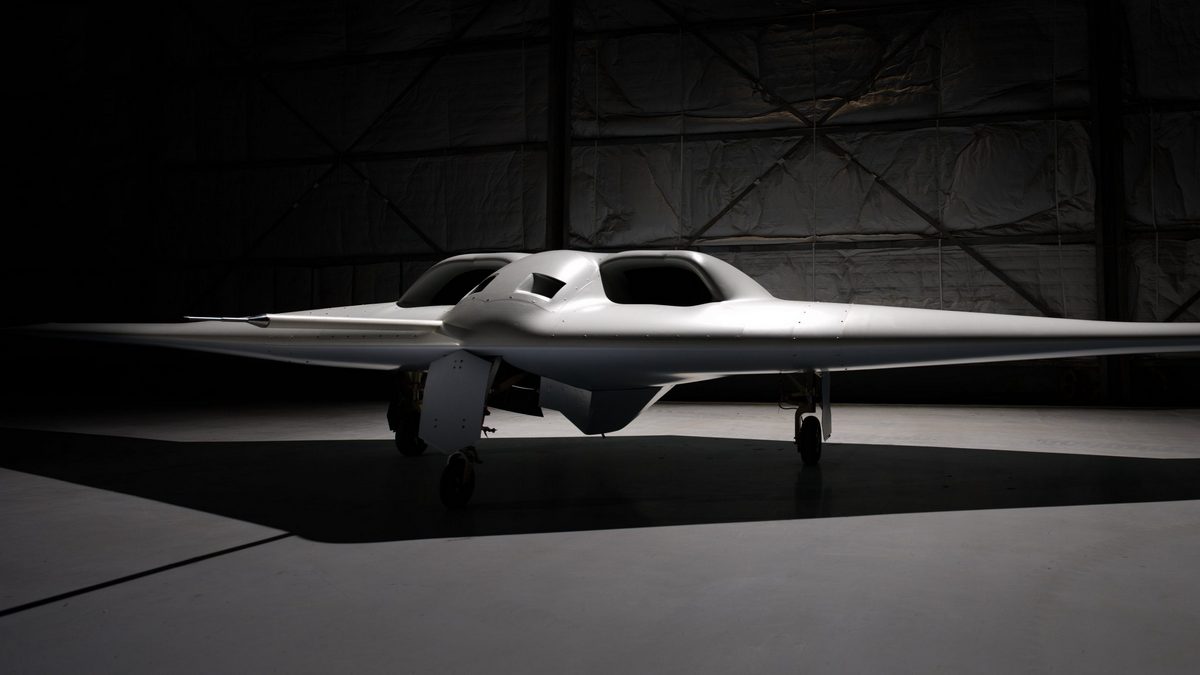
In April 2026, a notable development took place in the U.S. defense industry: a new military unmanned aircraft equipped with a hybrid-electric propulsion system completed its first flight. The test flight marked an important step toward the development of aircraft intended for combat and reconnaissance operations with significantly reduced acoustic signatures.
The XRQ-73 unmanned aircraft was designed and developed by Northrop Grumman in cooperation with its subsidiary Scaled Composites. The maiden flight took place at Edwards Air Force Base. Representatives of DARPA later confirmed the successful completion of the tests, describing them as an important milestone in the development of military aircraft using hybrid propulsion technologies.

Published materials indicate that the aircraft’s first flight actually took place on April 14, 2026. However, DARPA did not officially disclose the event until several weeks later, underscoring the level of confidentiality surrounding the program. The aircraft was developed under the SHEPARD initiative, short for Series Hybrid Electric Propulsion AiRcraft Demonstration. The program is considered a direct continuation of the earlier and relatively little-known XRQ-72 Great Horned Owl project.
The defining feature of the XRQ-73 is its use of an exceptionally quiet electric propulsion system powered by a gas turbine generator. This configuration is intended to significantly reduce both acoustic emissions and thermal signature, making the aircraft more difficult to detect during reconnaissance missions.
According to information provided by Northrop Grumman, the drone has an approximate weight of 555 kg. Under the classification system used by the U.S. Department of Defense, the aircraft falls into Group 3 unmanned systems. Platforms in this category are typically capable of operating at altitudes of up to 5,486 meters and reaching speeds of around 463 km/h.
Representatives of DARPA emphasize that the significance of the project extends well beyond a single successful flight. The SHEPARD program manager, Lieutenant Colonel Clark McGhee, stated that the achievement should not be viewed merely as the completion of an isolated milestone. According to him, the architecture validated by the XRQ-73 establishes a foundation for the development of new mission systems and future strike platforms. The development team intends to continue advancing the technology through a series of additional tests aimed at expanding its operational capabilities.
It is also worth noting that the program was initially expected to begin flight testing in 2024, although the schedule was later revised. Officials have not publicly disclosed the reasons for the delay. Recent imagery further indicates that the XRQ-73 has undergone several design changes compared to the original renderings released in mid-2024. Among the visible modifications are the addition of vertical stabilizers at the wing tips, although it remains unclear whether these elements will remain part of the final configuration. Engineers also introduced a redesigned upper fuselage air intake and installed blade-style antennas.
A new device with a forward-facing open aperture was also observed between the frontal air intakes. Analysts suggest that the component may house optical sensors or other elements related to the aircraft’s control and navigation systems. During testing, black strips were also visible on the wings. These are believed to be airflow sensors used to study the aerodynamic characteristics of the wing structure during flight trials. Such instrumentation is typically temporary and will likely be removed once the testing phase is completed.
The primary role of the XRQ-73 remains covert reconnaissance. The aircraft retains a large fairing beneath the fuselage, which is likely intended to house surveillance and intelligence-gathering equipment. Although the exact payload configuration has not been disclosed, the combination of a flying-wing layout, a low-noise propulsion system, and a reduced infrared signature makes the platform particularly suited for covert operations at low and medium altitudes.
Interestingly, photographs released by DARPA show the drone positioned on the surface of Rogers Dry Lake rather than on a conventional runway. The site has a long history associated with experimental aviation testing, including programs involving aircraft such as the North American X-15 and the Space Shuttle program. Further XRQ-73 flight testing is expected to continue, although most details surrounding the program are likely to remain classified due to the project’s confidential nature.
Read also:
- Attack on a Kalibr Carrier: Ukrainian Drones Strike Russian Missile Corvette
- The “China Loop”: How U.S. Restrictions on DJI Created a Drone Supply Gap
Source: interestingengineering