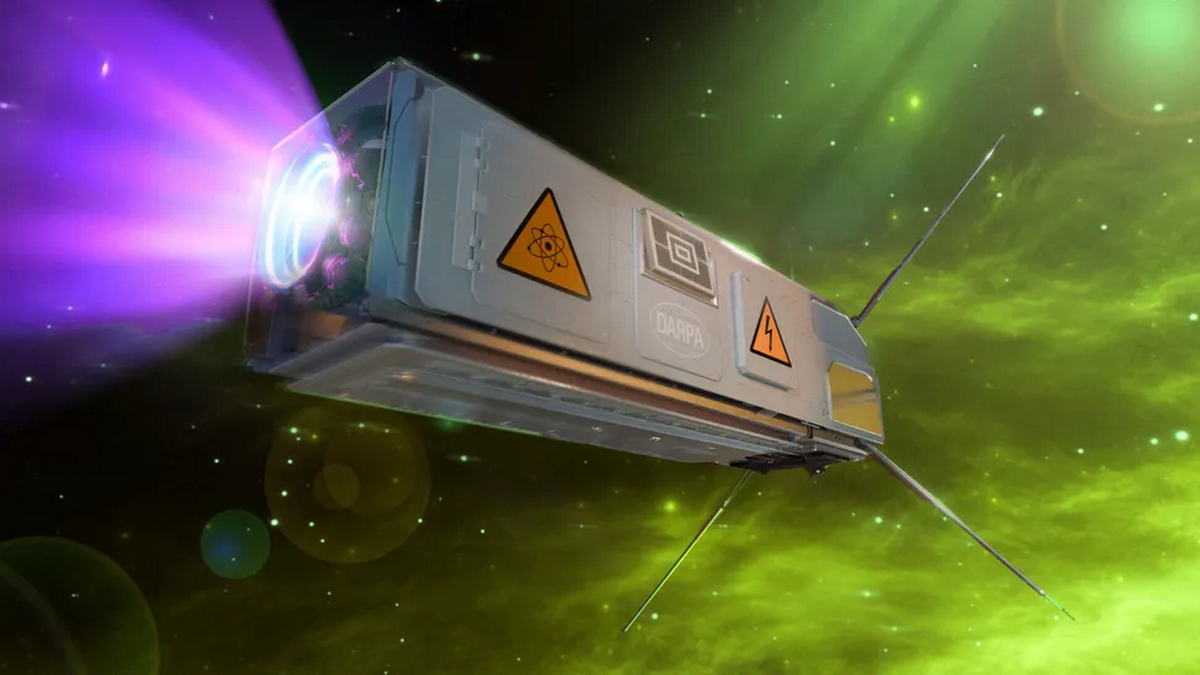
Power sources capable of operating for decades without the need for recharging or replacement have long been a dream among technology enthusiasts. However, DARPA’s “Rads to Watts” initiative could bring this concept closer to reality by developing unique portable power sources with multi-year lifespans based on a new generation of radiovoltaic devices. Recently, Morgan State University received a $3.37 million contract from DARPA to advance this technology. According to a report by Defense One, future batteries based on nuclear waste could operate for up to 30 years, providing power for next-generation drones.

Morgan State University now has substantial funding to support its researchers working on a project called SYMPHONEE (Strontium-Yttrium Multi-junction PIN-based High-Density Output Nano-system for Extreme Environments). Radioisotope power sources have been used for decades in low-power applications, such as smoke detectors and spacecraft. However, the new program led by the university, in partnership with organizations including Northrop Grumman, PNNL, Project Omega, ARA, and Widetronix, aims to take the technology to the next level. More specifically, under the umbrella and financial support of the “Rads to Watts” initiative, the team seeks to develop next-generation radiovoltaic micro-power systems designed to operate in extreme environments.
The proposed next-generation power cells are expected to use radioactive isotopes extracted from spent nuclear fuel, including strontium-90. One of the research partners, Project Omega, already has experience developing similar devices and will be responsible for assembling the prototype for DARPA. The company has also published a promotional video showcasing potential applications, including unmanned maritime vehicles with a decade-long operational lifespan. Overall project coordination is being handled by researchers at Morgan State University. Meanwhile, PNNL laboratories will be responsible for working with radioactive materials and conducting tests, Northrop Grumman and ARA will develop AI-based models, and Widetronix will design the architecture of radiovoltaic converters for nuclear microgenerators.
“Our team is pushing the boundaries of radiovoltaic technology by developing high-power systems with operational lifespans that were previously considered unattainable,” said Professor Michael Spencer, the technical lead of the project. “By combining advanced materials, device engineering, and nuclear physics, we are laying the foundation for a new generation of continuous power sources designed for operation in extreme environments.”
Researchers hope that bringing together such a strong team of experts in research, design, and manufacturing will enable a major technological breakthrough and significantly increase the energy density of radiovoltaic microsystems. The ultimate goal is to provide continuous autonomous operation for equipment over decades in remote or hard-to-reach environments, including space, underwater locations, and conflict zones. A representative of Northrop Grumman separately highlighted the potential of such a long-lasting power source for future defense systems. Meanwhile, Project Omega is interested in developing reliable autonomous underwater security systems, including maritime unmanned vehicles.
Read also:
- Pentagon Buys Ukrainian: F-Drones Delivers 2,000 Ukrainian-Made F10 Combat Drones to the United States
- No One Suspected It: Pokémon Go Data Helped Train a Navigation System for Military Drones
Source: tomshardware