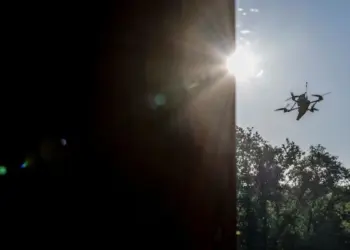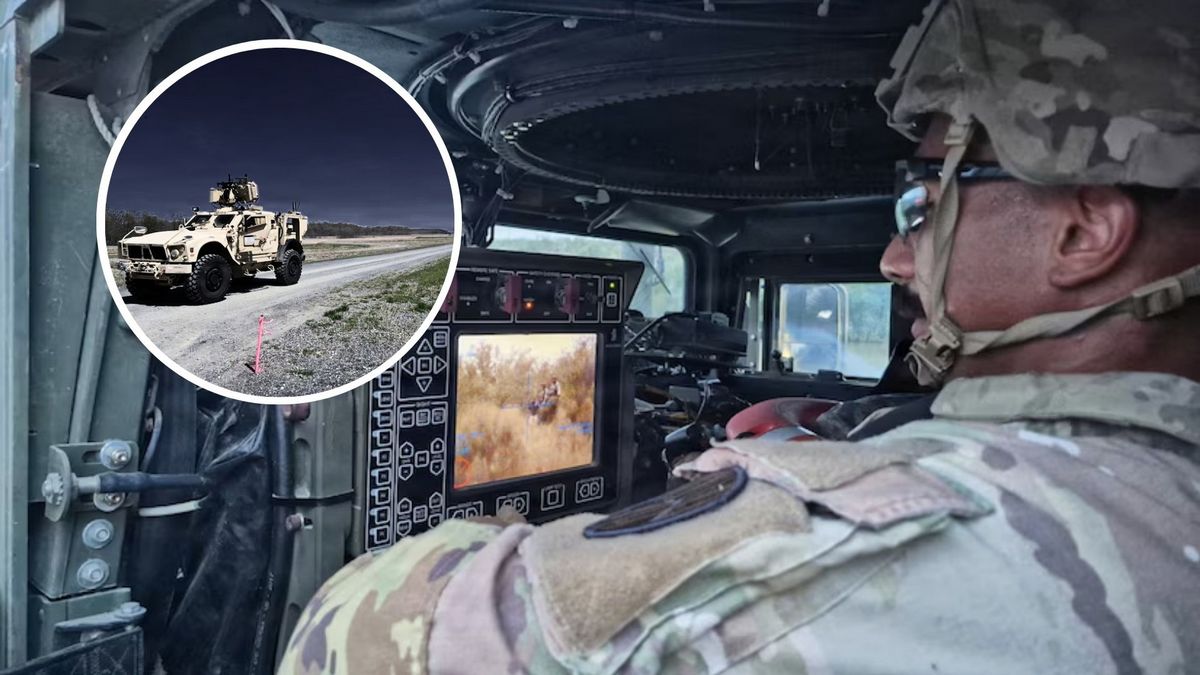
The United States Army Combat Capabilities Development Command Armaments Center has successfully implemented a new initiative in the field of counter-uncrewed aerial systems (C-UAS). The U.S. Army Combat Capabilities Development Command demonstrated an upgraded fire-control system capable of detecting and engaging unmanned aerial systems using a standardized remotely operated weapon station, while the host vehicle remains in motion.
The development is the result of work carried out by the Science and Technology Integration Office, whose specialists designed and validated advanced software algorithms to improve engagement performance against aerial targets. Field demonstrations of the system took place in mid-spring at the Aberdeen Proving Ground, located in Aberdeen.

Nick Caskey, who leads the project, explained that the initiative emerged as an urgent response to the rapidly growing threat posed by small autonomous aerial systems. The effort began after U.S. Army leadership tasked engineers with quickly developing an effective solution for countering micro-drone threats.
As part of the project, the engineering team adapted the Gunslinger airborne fire-control system, originally developed for the Future Attack Reconnaissance Aircraft (FARA) program, for use in a ground-to-air role. By incorporating updated Gunslinger algorithms and fusing multiple data streams from the vehicle’s onboard sensors, the remotely operated weapon station receives accurate real-time targeting information. This enables the system to maintain continuous tracking of a maneuvering quadcopter, even while the host vehicle is moving over challenging terrain.
:::
The newly developed fire-control system is based on a modular open architecture, allowing its software to be readily shared, integrated, and further developed across different branches of the U.S. Armed Forces. Once fully refined and deployed at scale, the system is expected to significantly improve engagement accuracy against aerial targets, reducing the number of rounds required to achieve a successful interception.
According to Deputy Project Manager James Little, the engineering team recorded highly encouraging results during the April demonstrations. These findings will serve as the foundation for the next phase of development, with future test cycles focused on further improving the system’s overall performance. Upcoming evaluations will progressively increase the operating speeds of both the host vehicle and the unmanned aerial targets, enabling engineers to validate the system under increasingly demanding combat-representative conditions.
Nick Caskey described these results as an excellent start to what will be a long-term development effort. He noted that the team invested a tremendous amount of time and effort in developing advanced targeting algorithms and meticulously preparing for the field trials.
According to Caskey, the moment the system began consistently engaging and neutralizing the test aerial targets, it became clear to everyone involved that the extensive and demanding work had fully paid off. He emphasized that these initial successes validate both the underlying mathematical models and the overall approach to enhancing counter-drone capabilities for future operational deployment.
Read also:
- Netherlands finances hundreds of Ruta missiles for Armed Forces of Ukraine: details from Destinus production facilities revealed
- Hunting submarines: Boeing upgrades P-8A Poseidon patrol aircraft for the U.S. Navy
Source: interestingengineering