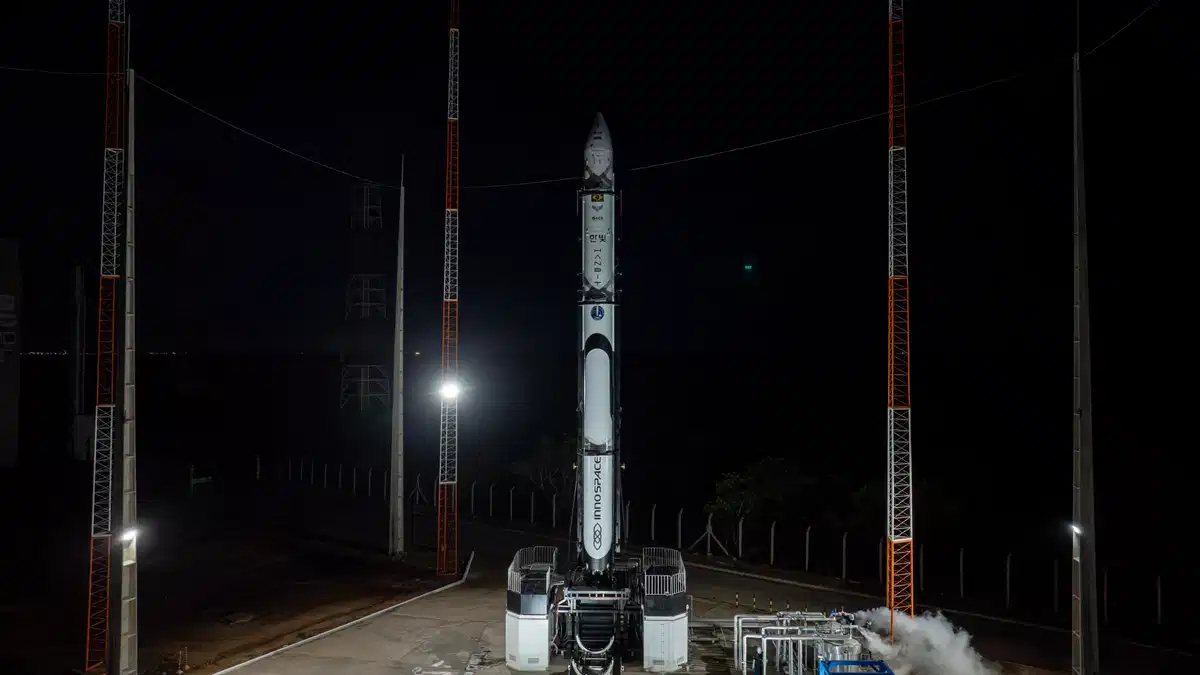
South Korean space startup Innospace failed to achieve a successful debut orbital launch, which was set to be a historic milestone for the country’s private space sector. The company attempted the launch on Monday evening, December 22. The Hanbit Nano rocket lifted off from the Alcântara Launch Center in Brazil at 20:13 EST (03:13 Kyiv time on December 23).

This marked the first attempt by a South Korean private company to place a payload into orbit. As is often the case with inaugural launches, the mission ended in failure. According to Space Orbit, which tracked the flight, the 17.3-meter rocket fell back to Earth roughly one minute after liftoff. The cause of the failure remains unknown at this stage. Innospace has not issued an official explanation on social media, and the live broadcast of the launch was cut off shortly after an anomaly was reported during the flight.
The Hanbit Nano is a two-stage rocket. Its first stage uses a hybrid engine fueled by liquid oxygen and paraffin. The upper stage has two possible configurations: one using liquid oxygen and paraffin, and another using liquid oxygen and liquid methane. The rocket is designed to deliver up to 90 kg of payload to a sun-synchronous orbit when launched from Brazil. On its debut mission, the Hanbit Nano carried five small satellites for customers in Brazil and India, along with three additional payloads intended for technology demonstration.
Innospace was founded in 2017. According to CEO Kim Su-jong, speaking in October at the International Astronautical Congress in Sydney, the startup, with a team of around 260 employees, developed all key launch technologies in-house.
Innospace’s strategy is not limited to the Hanbit Nano rocket. The company is also developing more powerful launch vehicles, named Hanbit Micro and Hanbit Mini, aimed at a broader range of commercial missions. Today’s launch was initially scheduled for December 17, but Innospace postponed it several times due to technical challenges and unfavorable weather conditions.
Read also:
- Su-24, Radar, and Drones: Defence Intelligence Reports on “Prymary” Operations
- Ukrainian Intelligence Reveals Details of a New Modification of the Russian “Geran” Drone Equipped with an R-60 Air-to-Air Missile
Source: Space